Error Codes



Is GE Cafe considered high end?
Yes. GE Café is considered a high-end (premium) appliance line within the GE family. It is positioned above standard GE appliances, with upgraded design, finishes, and feature sets; it is commonly compared with other premium lines like GE Monogram.
GE organizes products into tiers; Café sits in the premium tier, while Monogram is typically the ultra-premium tier.
| GE family line | Typical positioning | What you usually get |
|---|---|---|
| GE (standard) | Mainstream | Core features, value-focused |
| GE Profile | Upper-mainstream | More features, more tech |
| GE Café | Premium (high-end) | Pro-style design, premium finishes, advanced features |
| GE Monogram | Ultra-premium | Built-in luxury options, top-tier materials and customization |
When customers call a line “high end,” they usually mean a mix of design, features, and price. With GE Café, we typically see:
- Premium styling (often pro-style handles and coordinated finishes)
- More feature-rich refrigeration and cooking options
- Higher price points than standard GE and many GE Profile models
- More emphasis on aesthetics and matching suites
- More electronic controls and specialty functions (varies by model)
For a GE refrigerator like model CYE22UP2MHS1, “premium” often means more sensors, boards, and dispenser components. When troubleshooting, we focus on the exact symptom and then match the correct replacement part.
Common examples on this model include:
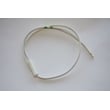
- Temperature sensing issues: refrigerator temperature sensor WR55X10025
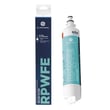
- Water quality and flow concerns: GE refrigerator water filter RPWFE
- Dispenser or control problems: refrigerator main control board WR55X46805
For step-by-step DIY help that applies to many GE refrigerators, use: GE refrigerator error codes
Last updated: January 2026
How to remove bottom grille on GE refrigerator?
On the GE CYE22UP2MHS1 bottom-mount refrigerator, the bottom grille (base grille or toe grille) typically comes off by removing any retaining screws (if present) and then pulling the grille straight out to release the clips. Reinstall by aligning it and pressing or sliding it back into place.
- Unplug the refrigerator or switch off power at the breaker (recommended if you will reach near wiring or the condenser fan).
- Protect the floor with a towel or cardboard to prevent scratches.
- Use a flashlight; the fasteners and clips are easier to see at floor level.
- Look for screws first. Check the left and right ends of the grille for Phillips-head screws.
- Remove screws (if equipped). Set them aside so they do not roll under the refrigerator.
- Release the clips. Grip the grille near both ends and pull straight outward. If it feels stuck, pull from one end slightly, then the other.
- Lift away. Some designs drop down and then pull out; others pull straight out. Use gentle, even force to avoid cracking the plastic.
- Confirm all screws are removed.
- Check for hidden tabs along the top edge; press the grille inward slightly, then pull outward.
- If the refrigerator is tight to the floor, raise the front leveling legs slightly to create clearance.
With the grille removed, we typically inspect and clean common airflow areas:
- Dust buildup on the condenser area (restricted airflow can cause warm temps)
- Signs of water dripping or a puddle near the front
- Unusual fan noise or vibration
| What you notice | What it usually means | What to do next |
|---|---|---|
| Heavy dust/lint | Poor condenser airflow | Vacuum and brush carefully |
| Water at the front | Drain or defrost water issue | Follow how to get rid of refrigerator puddles |
| Door alarm keeps sounding | Door not closing fully or switch issue | Follow how to reset the door alarm on a GE refrigerator |
The bottom grille helps protect components and supports proper airflow across the condenser area. Keeping it secure and the area clean helps the compressor and cooling system run efficiently.
Last updated: January 2026
What is the most common problem with GE profile refrigerators?
The most common issue we see with GE Profile refrigerators like model CYE22UP2MHS1 is a cooling problem (warm fresh food section, warm freezer, or temperatures that swing). Cooling complaints often trace back to airflow, sensors, or control issues rather than a single “one-size” failure.
- Not cooling or inconsistent temps: dirty condenser area, blocked vents, evaporator fan airflow issues, or a bad temperature sensor
- Ice maker not making ice: water supply issue, frozen fill tube, or ice maker failure
- Water dispenser not working: clogged filter, air in the line, or a weak inlet valve
- Strange noises: fan blade hitting ice, failing fan motor, or normal compressor/valve sounds changing over time
- Water leaking: clogged defrost drain, loose water line, or inlet valve seepage
- Confirm the controls are set to typical targets: 37°F fresh food and 0°F freezer.
- Make sure food packages are not blocking the air tower and return vents.
- Listen for the evaporator fan (freezer) running when the door switch is pressed.
- If you have dispenser issues, replace the filter and purge air.
- Check for error codes and follow the guided troubleshooting.
| Symptom | Most likely system | Parts that commonly apply |
|---|---|---|
| Warm temps, temp swings | Temperature sensing/control | Refrigerator temperature sensor WR55X10025, refrigerator main control board WR55X46805 |
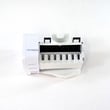
| No ice | Ice maker/water supply | Ice maker WR30X28731, refrigerator water inlet valve WR57X10098 |
| Slow water flow | Filtration/water supply | GE refrigerator water filter RPWFE |
Cooling and ice or water problems can look similar from the outside, but the fix changes depending on whether the root cause is airflow, water supply, or an electrical control. Starting with quick checks helps avoid replacing the wrong part.
Last updated: January 2026