Owner’s manual
 Error Codes

What is the most common problem with a GE refrigerator?
The most common GE refrigerator complaint is not cooling properly (fresh food warm, freezer soft, or temperatures swinging). On your GE CFE28TSHESS, the usual causes are airflow problems, a failing fan motor, a bad temperature sensor, or a defrost issue; we use the owner's manual to confirm diagnostics and settings.
- Fridge warm but freezer cold: restricted airflow, evaporator fan issue, or iced evaporator
- Both sections warm: condenser airflow problem, control issue, or sealed system concern
- Loud humming, rattling, or squealing: fan motor or fan blade interference
- Water under the fridge or inside drawers: clogged/iced defrost drain or door seal leak
- Ice maker slow or not making ice: water supply, filter restriction, or ice maker fault
- Verify temperature settings and allow 24 hours after changes.
- Make sure vents inside the fresh food section are not blocked by food packages.
- Clean dust from the condenser area and confirm the unit has proper clearance.
- Check door closing and gasket contact all the way around.
- Listen for the evaporator fan running when the doors are closed.
| Symptom | Common suspect | Example part for CFE28TSHESS |
|---|---|---|
| Warm temps, weak airflow | Evaporator fan motor | Refrigerator evaporator fan motor WR60X26866 |
| Temps swing or read wrong | Temperature sensor | Refrigerator temperature sensor WR55X10025 |
| Frost buildup, warm fridge | Defrost system issue | Refrigerator defrost heater WR51X10132 or refrigerator defrost bi-metal thermostat WR50X10108 |
Cooling problems can spoil food quickly and force the compressor to run longer than normal. Catching an airflow, sensor, or defrost problem early usually prevents bigger performance issues.
Last updated: February 2026
Is a top mount or bottom mount fridge better?
For a GE CFE28TSHESS bottom-mount refrigerator, a bottom-mount design is usually “better” when you want fresh-food items at eye level and more organized freezer storage; a top-mount is usually “better” when you want the simplest layout and typically lower purchase cost.
| Feature | Top mount (freezer on top) | Bottom mount (freezer on bottom) |
|---|---|---|
| Everyday access | Freezer is easiest to reach | Fresh food is easiest to reach |
| Freezer organization | Often basic shelves | Often pull-out drawers/baskets |
| Space planning | Usually a bit easier in tight kitchens | Often deeper; measure clearances carefully |
| Best for | Frozen-food heavy households | Fresh-food heavy households |
Bottom-mount refrigerators like the GE CFE28TSHESS tend to win for day-to-day convenience because you reach the refrigerator section far more often than the freezer.
Common reasons to choose bottom mount:
- Fresh food sits higher, so you bend less for daily items
- Freezer drawers help separate meats, frozen meals, and bulk items
- Wide shelves make it easier to store platters and meal prep containers
- Better visibility of refrigerated foods, which helps reduce waste
Common reasons to choose top mount:
- Straightforward layout with fewer moving drawer parts
- Often a smaller footprint and easier door-swing planning
- Typically a lower upfront cost for similar capacity
Before deciding, measure your opening and pathways. For this model family, the manual calls out clearances for airflow and notes that doorways may need to be wide enough to move the unit without removing doors/handles.
Checklist before you buy or move one:
- Measure cabinet opening width and depth
- Confirm clearance for the back and top for airflow
- Check doorway and hallway widths to the install location
- Plan for door swing and drawer pull-out space
For the model-specific dimensions and clearance guidance, use the owner's manual.
The “better” choice is the one that matches how you cook and shop. If you access fresh food constantly, bottom-mount convenience adds up every day; if you want the simplest, most basic layout, top-mount can be the better fit.
Last updated: February 2026
Is GE CFE28TSHESS considered high end?
Yes. The GE CFE28TSHESS is generally considered a higher-end, premium-style refrigerator within GE’s lineup, especially compared with basic top-freezer and standard French-door models. It is not in the built-in luxury tier, but it is positioned as an upscale, feature-forward model.
“High end” usually means a mix of design, features, and price tier. For the CFE28TSHESS, we treat it as premium because it is a GE Café model family (CFE prefix) and is built to deliver a more upgraded look and feature set than entry-level refrigerators.
Key signs it is premium:
- GE Café series positioning (upscale styling and features)
- French-door, bottom-mount configuration (typically a premium format)
- Advanced electronics and sensors are common on this platform (controls, temperature monitoring)
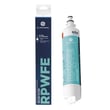
- Uses a cartridge-style water filter system (RPWFE)
Premium models often have more control boards, sensors, and specialty assemblies. That can affect troubleshooting and part cost, but it also means many issues are repairable with the right diagnosis.
Common premium-component examples for this model:
- Temperature sensing: refrigerator temperature sensor WR55X10025
- Main control electronics: refrigerator main board assembly WR55X46805
- Water filtration: GE refrigerator water filter RPWFE
| Tier | Typical refrigerator types | Where CFE28TSHESS fits |
|---|---|---|
| Entry | Top-freezer, basic bottom-freezer | Above |
| Mid-range | Standard French door, fewer features | Above |
| Premium | Feature-rich French door, upgraded design | Yes |
| True luxury | Built-in columns, pro-style built-ins | Below |
If you are deciding whether it is “high end,” it helps set expectations for ownership: premium models like the CFE28TSHESS often have more features to maintain (ice and water dispenser, sensors, fans, control boards), and they benefit from following the maintenance and troubleshooting guidance in the owner's manual.
Last updated: February 2026