Owner’s manual
 Error Codes



How to reset LG DLE3400W dryer?
To reset an LG DLE3400W dryer, we recommend doing a simple power reset: turn the dryer off, then disconnect power for about 1 minute and restore power. This clears many temporary control glitches without changing your cycle settings permanently.
Quick reset steps (power reset)
- Press Power to turn the dryer off.
- Unplug the dryer (or switch the breaker off).
- Wait 60 seconds.
- Plug the dryer back in (or switch the breaker on).
- Press Power, select a cycle, then press Start/Pause.
For control locations and normal operation details, use the DLE3400W owner's manual.
If the panel beeps but won’t start
On the DLE3400W, a very common “it won’t respond” situation is Control Lock being enabled.
- Turn the dryer on.
- Press and hold Wrinkle Care for 3 seconds to toggle Control Lock off.
- Try starting a cycle again.
What a reset can and can’t fix
| Situation | Reset helps? | What to check next |
|---|---|---|
| Display frozen, buttons lagging | Yes | Power reset, then retry cycle |
| Dryer won’t start at all | Sometimes | Door fully closed, breaker, outlet |
| Error code returns after reset | Sometimes | Troubleshoot the specific code |
| No heat or long dry times | Rarely | Airflow, venting, heating circuit |
If you’re seeing an error code, we recommend checking our LG dryer error codes guide.
Why it matters
A proper reset is a safe first step because it can clear a temporary electronic control issue without disassembling the dryer. If the problem comes back quickly, it usually points to a condition the dryer is detecting (power supply, airflow restriction, door switch, or a sensor issue).
Last updated: January 2026
Does the DLE3400W have a wrinkle care option?
Yes. The LG DLE3400W dryer includes a Wrinkle Care option that periodically tumbles the load after the cycle ends to help keep wrinkles from setting when you cannot unload right away (up to about 3 hours). See the DLE3400W owner’s manual for the exact button and cycle details.
How Wrinkle Care works on the DLE3400W
When Wrinkle Care is turned on, the dryer will intermittently tumble the clothes after the cycle completes.
- Helps reduce wrinkles if laundry sits in the drum
- Runs brief tumbles every few minutes
- Can run for up to 3 hours, or stops when you open the door
- Works best when you remove clothes as soon as you can
How to turn Wrinkle Care on
On this model, Wrinkle Care is an option button on the control panel.
- Select your drying cycle.
- Press Wrinkle Care to enable the option.
- Press Start/Pause.
If you are trying to use Control Lock, note that this model uses a press-and-hold on the Wrinkle Care button to toggle Control Lock (details are in the manual).
Quick comparison: Wrinkle Care vs. removing clothes promptly
| Method | What it does | Best for |
|---|---|---|
| Wrinkle Care option | Periodic tumbling after the cycle | When you might forget to unload right away |
| Unload immediately | Prevents wrinkles from forming in the drum | Best overall wrinkle prevention |
Why it matters
Wrinkles often form when warm fabrics cool while compressed in the drum. Wrinkle Care keeps items moving so they cool with fewer creases, which can reduce ironing and re-washing.
Last updated: January 2026
What is the most common problem with LG dryers?
For LG dryers like model DLE3400W, the most common service issue is no heat or weak heat, which is frequently tied to the heating circuit (heating element on electric models) or an airflow-related overheat condition that can open a safety fuse. See the DLE3400W owner's manual for model-specific troubleshooting steps and safety guidance.
Most common issues we see (and what they usually point to)
- Dryer runs but doesn’t heat: heating circuit problem (electric) or gas ignition/heating problem (gas)
- Drying takes too long: restricted venting, clogged lint path, or blower airflow issue
- Stops mid-cycle: overheating from poor airflow, or a safety device opening
- Loud rumbling/squealing: drum support or belt path wear
- Won’t start: door switch, power supply, or control-related issue
Quick model-specific checks for DLE3400W (before replacing parts)
These checks apply directly to DLE3400W because they’re called out in the owner’s manual troubleshooting and maintenance sections.
- Clean the lint screen before every load and confirm it seats fully
- Check airflow at the outside vent hood while the dryer runs; weak airflow usually means a restriction
- If drying is slow on Normal, turn off Energy Saver for faster heated drying at the start of the cycle
- For electric models, confirm the dryer is getting full 240V (a dryer can run but not heat with a supply issue)
- If the Flow Sense indicator shows restriction, correct the duct issue and run several cycles to allow it to reset
Common “no heat” parts (electric dryers) and when they’re suspects
| Symptom | More likely cause | Example compatible part for DLE3400W |
|---|---|---|
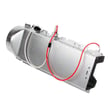
| Runs, no heat | Failed heater or opened safety fuse | Dryer heating element 5301EL1001J |
| Runs, overheats or shuts down | Airflow restriction or thermostat issue | Dryer high-limit thermostat (varies by symptom) |
| Erratic temps or sensor errors | Temperature sensing issue | Dryer thermistor (varies by diagnosis) |
Why it matters
A “no heat” complaint is often caused by airflow restrictions (lint buildup, crushed duct, long duct run). Fixing airflow first can prevent repeat failures of heating and safety components and helps DLE3400W dry faster with less energy.
Last updated: January 2026
Are LG ventless dryers any good?
Yes, LG ventless dryers are a solid choice when you cannot run an outdoor exhaust; they are typically energy-efficient and gentle on fabrics, but they usually take longer to dry. The LG DLE3400W is a vented dryer that uses a 4-inch exhaust duct; see the venting and airflow guidance in the DLE3400W owner's manual.
What “ventless” means (and what to expect)
Most LG ventless dryers are heat pump models that recirculate air and remove moisture without an outside vent.
Common advantages
- No exterior vent required (good for apartments, closets, and interior laundry rooms)
- Lower operating temperatures can be gentler on many fabrics
- Often lower electricity use than traditional electric resistance vented dryers
Common tradeoffs
- Longer cycle times, especially for towels and heavy loads
- More routine maintenance (additional filters and condenser or heat exchanger cleaning)
- Higher upfront cost in many cases
How DLE3400W differs (vented dryer)
Because the LG DLE3400W exhausts air through ductwork, drying performance depends heavily on airflow, vent length, and lint buildup.
| Feature | Ventless LG dryer (heat pump, general) | LG DLE3400W (this model) |
|---|---|---|
| Outside vent required | No | Yes |
| Typical cycle time | Longer | Faster when venting is clear |
| Maintenance focus | Filters plus condenser or heat exchanger | Lint filter plus vent duct |
If your DLE3400W takes too long to dry
Restricted airflow is a top cause of long dry times on vented dryers.
- Clean the lint filter before every load
- Confirm the vent hood opens fully and is not clogged
- Keep the duct run short with as few elbows as possible
- Avoid crushed or kinked transition duct behind the dryer
- Do not overload; heavy fabrics need room to tumble
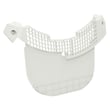
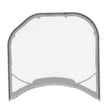
If your lint screen is damaged or missing, replace it with the correct part for this model: lint filter - dryer part by LG ADQ56656401.
Why it matters
Choosing ventless vs. vented affects installation options, cycle time, and maintenance. With a vented dryer like the DLE3400W, good venting is the difference between normal dry times and repeated “clothes still damp” loads.
Last updated: January 2026