Owner’s manual
 Error Codes


Is GE Profile considered high end?
Yes. GE Profile is widely considered GE’s higher-end line; it typically adds more premium design, convenience features, and advanced controls than standard GE models. For your GE PWE23KSDDSS counter-depth refrigerator, the Profile branding aligns with that “step-up” positioning. See the PWE23KSDDSS owner's manual for model-specific features and operating details.
GE Profile models commonly focus on upgrades that affect daily use, food preservation, and fit-and-finish.
- More feature-rich temperature management and electronic controls
- Enhanced lighting and interior layout options
- More filtration-focused water and ice systems
- Counter-depth styling on many Profile models (PWE models are counter-depth)
- Quieter, more refined operation compared with entry-level lines
| Category | GE (standard line) | GE Profile (step-up line) |
|---|---|---|
| Features | Core essentials | More premium features and options |
| Design | Practical styling | More upgraded finishes and styling |
| Controls | Basic to mid-level | More advanced electronic controls |
| Price tier | Value to mid-range | Mid-range to higher-end |
Because “high end” can mean different things to different shoppers, we recommend checking the exact feature set on your unit.
- Look up the feature list and operating modes in the PWE23KSDDSS owner's manual
- Confirm whether your model uses the RPWF-style filter platform; the manual notes RPWF filter cartridge guidance
- If you are comparing models, note that PWE models are counter-depth (built-in style)
- If you see control panel messages or unusual behavior, use GE refrigerator error codes
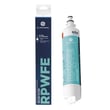
Knowing GE Profile is a step-up line helps set expectations for parts, features, and maintenance. For example, water filtration is a common “premium” feature area; using the correct filter such as the refrigerator water filter RPWFE helps maintain flow and ice and water performance.
Last updated: January 2026
What is the average lifespan of a GE refrigerator?
Most GE refrigerators last 12 to 16 years on average, and 10 to 20 years is a typical overall range. For your GE PWE23KSDDSS bottom-mount refrigerator, consistent maintenance (airflow, clean coils, and on-time filter changes) is what most directly extends service life; see the PWE23KSDDSS owner's manual for model-specific care guidance.
Refrigerator longevity depends most on compressor run time, heat removal, and how well doors seal.
| Lifespan range | What it usually means | Common drivers |
|---|---|---|
| 0 to 5 years | Early failure is uncommon | Power issues, installation problems |
| 6 to 10 years | Mid-life repairs start | Fans, sensors, ice maker or dispenser wear |
| 12 to 16 years | Typical “average” lifespan | Normal wear with routine upkeep |
| 17 to 20+ years | Above-average life | Great airflow, clean coils, stable temps |
These steps reduce stress on the sealed system (compressor, condenser, evaporator) and help prevent temperature swings.
- Keep the condenser area clean and unobstructed so heat can leave the refrigerator efficiently.
- Replace the water filter on schedule; a restricted filter can reduce water flow and strain the inlet valve.
- Confirm doors close fully and gaskets seal; warm air leaks increase run time and frost.
- Avoid overpacking; blocked vents reduce airflow and can cause uneven cooling.
- Set stable temperatures and avoid frequent, long door openings.
If you notice warm temperatures, heavy frost, or unusual fan noise, these model-matched parts are often involved:
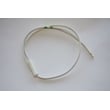
- Refrigerator evaporator fan motor and blade WR60X10352 (moves cold air through compartments)
- Refrigerator defrost heater WR51X10131 (melts frost off the evaporator)
- Refrigerator temperature sensor WR55X10025 (feeds temperature data to the control)
- Refrigerator water filter RPWFE (supports dispenser and ice maker water flow)
A refrigerator that runs longer to maintain temperature uses more energy and wears key components faster. Simple upkeep helps your GE PWE23KSDDSS cool more efficiently, which is the most reliable way to reach the high end of the lifespan range.
Last updated: January 2026
What is the most common problem with GE Profile refrigerators?
The most common issue we see with GE Profile refrigerators like model PWE23KSDDSS is cooling problems (warm fresh food section, soft ice, or freezer temperature swings). Cooling complaints often trace back to airflow, defrost system issues, or a sensor/control problem; start with basic checks, then follow the diagnostic steps in the PWE23KSDDSS owner's manual.
- Confirm the temperature settings were not accidentally changed.
- Make sure vents inside the fresh food section are not blocked by food containers.
- Verify both doors close fully and the gaskets seal all the way around.
- Clean dust from the condenser area (restricted airflow raises temperatures).
- Listen for the evaporator fan; a failed fan can cause warm temps and odd noises.
| Symptom | Common cause | What to check first |
|---|---|---|
| Not cooling or uneven temps | Airflow restriction, defrost failure, sensor/control issue | Vents, frost buildup, fan operation |
| Strange noises | Fan blade hitting ice, worn fan motor, normal compressor sounds | Frost on rear panel, fan noise pattern |
| Ice maker not working | Water supply issue, filter restriction, valve problem | Water line, filter, inlet valve |
| Dispenser weak/no water | Clogged filter, air in line, low supply pressure | Replace filter, purge air |
| Water leaking/puddles | Defrost drain issue, water line connection, valve seep | Drain area, tubing, valve |
If troubleshooting points to a failed component, these model-matched parts are often involved:
- Refrigerator temperature sensor WR55X10025 (temperature feedback issues)
- Refrigerator evaporator fan motor and blade WR60X10352 (poor airflow, warm fresh food)
- Refrigerator defrost heater WR51X10131 and refrigerator defrost bi-metal thermostat WR50X10108 (frost buildup, airflow blockage)
- Refrigerator water filter RPWFE and refrigerator water inlet valve assembly WR57X20873 (ice and water dispenser problems)
Cooling and airflow problems can quickly lead to food spoilage and extra compressor run time. Catching a fan, defrost, or sensor issue early helps restore stable temperatures and reduces strain on the sealed system.
Last updated: January 2026