Owner’s manual
 Error Codes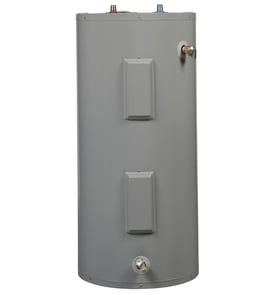

How do I read my water heater model number?
Your Kenmore water heater model number is printed on the model rating plate on the front of the tank, typically near the lower access panel. For model 153321442, use the exact model number from that plate (not the capacity or electrical specs) when ordering parts or service; see the 153321442 owner's manual.
Where to find the model number on the tank
Look for a rectangular rating plate label on the front of the water heater. On this label, you will usually see:
- Model number (this is what we use to match parts)
- Serial number (helps identify production details)
- Capacity (U.S. gallons)
- Voltage and wattage (upper and lower element ratings)
- Maximum working pressure
How to read the rating plate (what matters vs. what doesn’t)
When you are identifying the unit or ordering parts, focus on the model number and serial number.
| Rating plate item | Use it for | Example of why it matters |
|---|---|---|
| Model number | Finding correct parts diagrams and parts | Ensures the thermostat or element matches your tank |
| Serial number | Service history and production info | Helps confirm the correct revision/version |
| Capacity (gallons) | General sizing | Does not identify the exact parts list by itself |
| Volts/watts | Electrical troubleshooting | Useful when diagnosing heating issues |
Tips to avoid common mix-ups
- Write the model number exactly as shown, including all digits.
- Do not use the gallon capacity as the model number.
- Do not use “watts” or “volts” values as the model number.
- If the label shows check boxes for element configuration, ignore those for model identification.
Why it matters
Kenmore water heaters can share similar tank sizes but use different thermostats, heating elements, gaskets, or anode rods. Using the exact model number from the rating plate helps us match the correct parts the first time.
Last updated: January 2026
What is the average lifespan of an electric hot water tank?
Most electric tank-style water heaters, including the Kenmore 153321442 (40-gallon), typically last 10 to 15 years with normal use. Regular maintenance like flushing sediment and checking the anode rod helps you reach the upper end of that range; neglected tanks usually fail sooner.
What affects lifespan the most
- Water quality and sediment: Hard water speeds scale buildup on the heating elements.
- Anode rod condition: A depleted anode rod lets the tank corrode faster.
- Operating temperature: Higher thermostat settings increase wear and scald risk.
- Usage patterns: Heavy daily demand and frequent recovery cycles shorten life.
- Maintenance history: Periodic draining and inspection slows corrosion and scale.
Quick maintenance checklist (high impact)
Use the steps and safety guidance in the 153321442 owner's manual.
- Turn off power at the breaker before opening access panels.
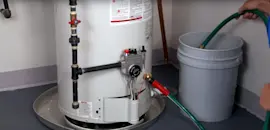
- Flush or drain the tank periodically to reduce sediment.
- Inspect and replace the anode rod when significantly worn.
- Watch for rumbling or popping noises (often scale on elements).
- Check for moisture around fittings and the drain valve.
Common “end of life” symptoms
| Symptom | Most common cause | Typical fix |
|---|---|---|
| Not enough hot water | Failed thermostat or heating element | Test and replace the failed part |
| Rumbling noise | Scale on heating element | Clean or replace element |
| Rusty or smelly hot water | Worn anode rod | Replace anode rod |
| Leaks at bottom of tank | Internal tank corrosion | Replace water heater |
Parts that often extend service life
If you are maintaining a Kenmore 153321442, these are common wear items:
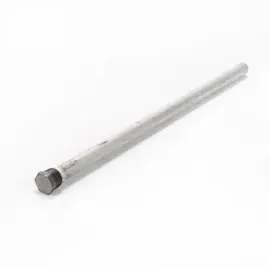
- Water heater anode rod 100108660 (helps protect the tank from corrosion)
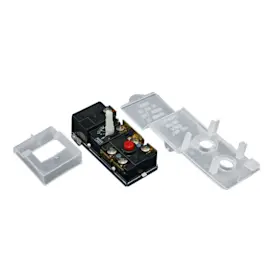
- Thermostat 100108424 (controls water temperature)
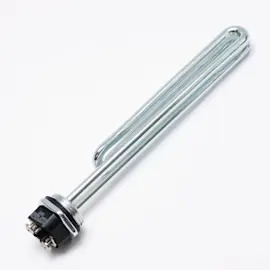
- Element 3800 100108346 (heats the water; scale can shorten its life)
Why it matters
A tank that is near the end of its lifespan is more likely to leak or lose heating performance. Staying ahead of sediment and corrosion helps maintain hot water recovery, energy efficiency, and reliability.
Last updated: January 2026
How do I know if my electric water heater element is bad?
If your Kenmore electric water heater model 153321442 has no hot water, runs out of hot water quickly, or keeps tripping the high-limit reset, a failed heating element is a top suspect. We confirm it by safely shutting off power, then testing the element for continuity and for a short to ground.
Common symptoms of a bad heating element
- No hot water at all (often points to an upper element issue)
- Lukewarm water or hot water that runs out fast (often points to a lower element issue)
- Breaker trips or the reset button trips repeatedly
- Slow recovery after heavy hot-water use
- Popping or sizzling sounds (mineral buildup on the element)
How we test the element (safe, practical steps)
- Turn power OFF at the breaker and verify power is off.
- Remove the access panel and insulation to reach the element terminals.
- Label and remove the two wires from the element screws.
- Use a multimeter:
- Continuity test: a good element shows resistance; an open circuit indicates a failed element.
- Ground test: check each element screw to the metal tank; any continuity indicates a shorted element.
- Reassemble insulation and covers before restoring power.
What to replace if the element tests bad
Replacement elements must match the voltage on the rating plate and must not exceed the wattage listed for the water heater. We also replace the gasket to prevent leaks.
| If you replace | Also replace | Why |
|---|---|---|
| Heating element | Element gasket | Prevents seepage around the element threads |
| Heating element | Thermostat (only if heat is still inconsistent) | A thermostat that is not regulating can mimic element problems |
Recommended model-matched parts:
Why it matters
A burned-out or grounded element can leave you without hot water and can overheat wiring or trip protection devices. Following the correct fill and power-on sequence also protects the new element from immediate damage.
For model-specific access-panel locations, wiring notes, and safety steps, use the 153321442 owner's manual.
Last updated: January 2026