 Installation guide
 Owner’s manual
 Error Codes





What is the most common problem with a Frigidaire dishwasher?
For Frigidaire dishwashers like model FGID2466QF7A, the most common day-to-day complaint is poor cleaning (food soils left on dishes), usually tied to loading issues, water temperature/pressure, or spray not reaching dishes because something is blocking the spray arms. See the FGID2466QF7A owner's manual troubleshooting section for the exact checks Frigidaire recommends.
- Food soils left on dishes after the cycle
- Dishes not drying well (especially plastics)
- Cycle takes a long time (often normal on energy-efficient models)
- Water left in the bottom of the tub after the cycle
- Leaks around the door area
From the Use and Care guidance, these are the highest-impact items to verify first:
- Use fresh automatic dishwasher detergent (old detergent cleans poorly)
- Confirm home water pressure is 20 to 120 psi
- Confirm incoming hot water is about 120°F (49°C)
- Avoid nesting and overloading; keep spray paths open
- Make sure dishes are not blocking spray arm rotation
- Keep the filter and trap area maintained; reinstall correctly after cleaning
| Problem you notice | Most likely cause | What to do first |
|---|---|---|
| Food still on dishes | Blocked spray, poor loading, cool water | Re-load, verify 120°F water, clear spray paths |
| Water in tub bottom | Drain issue | Check for kinks/clogs; inspect dishwasher drain hose 807117001 |
| Leaking | Door gasket not seated, unit not level, oversudsing | Reseat gasket, level unit per installation guide |
| Detergent not dispensing | Cup blocked or not opening | Make sure items do not prevent opening; inspect dishwasher detergent dispenser assembly 5304506521 |
Poor cleaning is usually a setup or maintenance issue, not a major failure. Correct water temperature, proper loading, and clear spray paths restore wash performance and help prevent repeat problems like odors, residue, and long cycles.
Last updated: February 2026
Can I replace dishwasher parts myself?
Yes, for the Frigidaire FGID2466QF7A dishwasher, we can replace many common parts ourselves if we shut off power and water first and follow the step-by-step procedures in the FGID2466QF7A installation guide. For electrical wiring, leak-related repairs, or anything involving the heater circuit, we use extra caution and stop if the job goes beyond basic DIY.
Many repairs are straightforward because they involve accessible parts and simple fasteners.
- Cleaning or replacing a clogged filter (often improves wash performance)
- Replacing a worn spray arm such as the Frigidaire dishwasher spray arm (blue) 5304507158
- Replacing a leaking or kinked drain line such as the dishwasher drain hose 807117001
- Replacing a no-fill component such as the dishwasher water inlet valve 807047901
- Replacing a no-drain component such as the drain pump a A00126401
The manual and install guide both emphasize disconnecting power before servicing and using care around hot components.
- Turn off power at the breaker (not just the control panel)
- Shut off the water supply valve under the sink
- Let the heating element cool before touching anything inside the tub
- Wear gloves when handling sharp metal panels
- Keep the dishwasher secured so it cannot tip when the door is opened
| Repair type | Typical DIY difficulty | Why |
|---|---|---|
| Filter, spray arm, rack rollers | Easy | Minimal disassembly, low risk |
| Drain hose, inlet valve, drain pump | Medium | Water connections, leak checks needed |
| Control board, wiring in junction box | Advanced | Shock risk, correct wiring is critical |
A dishwasher that is not level, not secured, or has loose wiring can leak, tip forward when the door opens, or fail to run correctly. Following the installation and service steps helps the repair last and keeps the unit safe to operate.
Last updated: February 2026
What is the average lifespan of a Frigidaire dishwasher?
A Frigidaire dishwasher typically lasts 10 years. To get the full life from your FGID2466QF7A, we recommend consistent cleaning, correct detergent use, and fixing small issues (draining, heating, filling) early so they do not turn into major pump or control failures.
- Water quality: hard water speeds up mineral buildup on the heating system and spray paths.
- How often you run it: multiple loads daily shortens life compared to a few loads per week.
- Cleaning and maintenance: filter and sump cleaning prevents recirculation strain.
- Loading habits: overloading blocks spray arms and increases motor load.
- Drying and heat use: heated drying and high-temp options add thermal stress over time.
Use the care and cleaning steps in the FGID2466QF7A owner’s manual. Then focus on these high-impact items:
- Clean the filter regularly; replace it if it is damaged (see dishwasher filter 5304532206).
- Keep the spray arm holes clear; replace a cracked or warped arm (see Frigidaire dishwasher spray arm (blue) 5304507158).
- Watch for slow draining; a weak pump or blockage can shorten motor life (see drain pump a A00126401).
- Use the right detergent amount and keep the dispenser door working smoothly.
- Run hot water at the sink before starting cycles if your home’s hot water line runs cold.
| Usage pattern | Typical lifespan | What to prioritize |
|---|---|---|
| Light (1 to 3 loads/week) | 11 to 13 years | Filter cleaning, occasional deep clean |
| Average (4 to 7 loads/week) | 9 to 11 years | Filter, spray arms, proper loading |
| Heavy (1 to 2 loads/day) | 7 to 9 years | Drain performance, heating, leak checks |
Dishwashers usually fail from avoidable stress: restricted water flow, poor draining, and heat-related wear. Keeping water moving freely through the filter and spray arms helps protect the pump and motor assembly and keeps wash performance consistent.
Last updated: February 2026
What are the commonly replaced parts in a dishwasher?
In a Frigidaire dishwasher like model FGID2466QF7A, the most commonly replaced parts are the wash and drain components (spray arms, pumps, hoses), heating and fill parts (heating element, water inlet valve), and door hardware (springs, cables, handles). These parts wear from heat, detergent, clogs, and normal use; see the FGID2466QF7A owner’s manual for care tips that reduce repeat failures.
These are the parts we see replaced most often when a dishwasher will not drain, will not clean, leaks, or will not dry:
- Drain system: drain pump, drain hose, clogs at the disposer connection
- Wash system: spray arm, pump and motor assembly, filter
- Heating and drying: heating element
- Filling and overflow protection: water inlet valve, float switch
- Door and rack wear items: door spring, door cable, dishrack rollers
| Symptom | Most likely area | Example part for this model |
|---|---|---|
| Water left in tub | Drain system | Drain pump a A00126401, dishwasher drain hose 807117001 |
| Dishes not clean | Wash system | Frigidaire dishwasher spray arm (blue) 5304507158, dishwasher filter 5304532206 |
| Not drying well | Heating | Frigidaire dishwasher heating element 154825001 |
| Not filling or fills slowly | Water supply/fill | Dishwasher water inlet valve 807047901 |
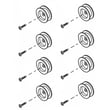
| Door drops open or will not stay balanced | Door hardware | Dishwasher door spring 154579101, dishwasher door cable 154756401 |
A lot of “bad part” symptoms start with installation or maintenance issues. For example, kinked water or drain hoses can cause performance problems, and the water line should be flushed before final connection to help prevent clogging the inlet valve screen (details are in the FGID2466QF7A installation guide).
- Keep the filter and spray arms clear of debris
- Use fresh detergent and keep rinse aid filled for better cleaning and drying
- Confirm hot water supply and adequate water pressure for proper fill
- Avoid kinking the drain hose and water line when pushing the unit back
- Level and anchor the dishwasher so it runs quieter and seals better
Replacing the correct part the first time saves money and prevents secondary damage. A restricted fill (inlet valve screen, low pressure) can lead to poor cleaning; a restricted drain can leave dirty water behind; and weak heating can cause wet dishes and longer cycle times.
Last updated: February 2026





