 Installation guide
 Owner’s manual



Can a clogged drain cause an FTD error?
Yes. On the GE GDF570SGJ0BB dishwasher, a clogged drain path can leave water standing in the tub, and that standing water can prevent the dishwasher from starting the next fill and wash normally. Clearing the drain system and any air gap usually resolves the condition (see the GDF570SGJ0BB owner’s manual).
- Cancel the cycle and confirm whether water is standing in the bottom of the tub.
- Check the sink drain; if the sink drains slowly, the dishwasher drain can back up too.
- If the dishwasher drains through a disposer, run the disposer to clear it.
- If you have an air gap, remove the cap and clean it (food debris is a common blockage).
- Verify the drain hose is not kinked or crushed behind the dishwasher.
- Confirm the drain hose routing has a proper high loop or air gap (see the GDF570SGJ0BB installation guide).
Your dishwasher needs to empty correctly between steps. If the drain is restricted, water can remain in the tub, and the dishwasher may not transition into the next fill as expected.
| What you notice | Most likely cause | What to do |
|---|---|---|
| Water standing in tub after cycle | Air gap clogged | Clean the air gap cap and cover |
| Won’t pump out, disposer connection used | Disposer or inlet plug issue | Run disposer; check disposer connection |
| Intermittent draining | Kinked hose or poor routing | Straighten hose; correct high loop |
| Drains slowly, sink also slow | House drain restriction | Clear sink drain or have plumbing serviced |
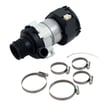
If cleaning and hose routing checks do not restore normal draining, these model-specific parts are often inspected next:
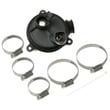
- Dishwasher drain hose WD24X10062 (cracks, kinks, internal restriction)
A restricted drain can cause poor cleaning, odors, and repeated cycle interruptions because the dishwasher cannot reliably empty and refill at the right times.
Last updated: January 2026
How to do a hard reset on a GE dishwasher?
On the GE GDF570SGJ0BB dishwasher, the most reliable “hard reset” is to cancel the current cycle at the control panel, then restore power by turning the breaker off and back on. Canceling clears the active cycle; power-cycling reboots the control.
- Cancel the cycle: Press and hold Start for 3 seconds, then close the door so the dishwasher drains.
- Pause and restart: Open the door to pause, press Start, then close the door within 4 seconds to resume.
- Power-cycle reset: Turn the dishwasher circuit breaker OFF for 1 minute, then ON.
- Check door closure: A door that is not fully latched can look like a “frozen” control.
See the exact button timing in the GDF570SGJ0BB owner’s manual.
- Press and hold Start for 3 seconds to cancel, then close the door.
- Wait until draining stops and the cycle light turns off.
- Switch the dishwasher breaker OFF for 60 seconds.
- Switch the breaker ON.
- Press Start and close the door within 4 seconds.
These checks solve most “has power but won’t start” complaints:
- Make sure the water valve under the sink is ON.
- Confirm the control panel is not locked.
- Verify the door latch is engaging; a weak latch can prevent starting.
- If the unit shows an error, match it to the GE electronic dishwasher error codes.
- If the control is dead or erratic after power-cycling, the dishwasher electronic control board WD21X24901C is a common suspect.
| Action | What it does | When to use it |
|---|---|---|
| Cancel (hold Start 3 sec) | Stops the cycle and drains | Stuck cycle, wrong cycle selected |
| Breaker power-cycle | Reboots the control electronics | Unresponsive buttons, glitchy behavior |
Canceling the cycle prevents standing water and clears the current program; power-cycling resets the electronic control so the dishwasher can accept a fresh start sequence.
Last updated: January 2026
What is a good db level for a dishwasher?
A good (quiet) dishwasher sound level is 44 dBA or lower; 38 to 42 dBA is very quiet, and around 50 dBA is more “average.” For your GE GDF570SGJ0BB, confirm the exact published dBA rating in the GDF570SGJ0BB owner’s manual.
- 38 to 42 dBA: very quiet; you may barely notice it running
- 43 to 44 dBA: quiet; normal conversation nearby is easy
- 45 to 49 dBA: moderate; you will hear it in a quiet kitchen
- 50+ dBA: average to loud; more noticeable during wash and drain
Even with the same dBA rating, real-world noise can change based on installation and conditions:
- Leveling: if the unit is not level, racks can roll and vibration increases
- Door alignment: a door that rubs the tub or cabinet can add noise
- Hose and wire contact: drain or supply lines touching the frame or motor can transmit vibration
- Water temperature: proper hot water helps cleaning so the machine does not struggle through the cycle
- Load and spray arm clearance: tall items can hit spray arms and create a knocking sound
The installation instructions for this model emphasize preventing vibration and contact noise. Use this checklist:
- Level the dishwasher left to right and front to back
- Confirm the door closes without hitting the tub sides
- Make sure supply and drain lines are not kinked
- Keep hoses and wiring from touching the motor or frame
- Verify incoming hot water is 120°F to 140°F for best performance
| Noise symptom | Most common cause | What to check first |
|---|---|---|
| Rattling or vibration | Not level, loose contact points | Leveling legs and rear adjusters |
| Knocking during wash | Spray arm hitting dishes | Loading and spray arm clearance |
| Buzzing during drain | Drain hose contact or restriction | Hose routing and kinks |
Lower dBA usually means a more comfortable kitchen, but correct leveling and hose routing often make the biggest difference in perceived noise and wash performance.
Last updated: January 2026





