Owner’s manual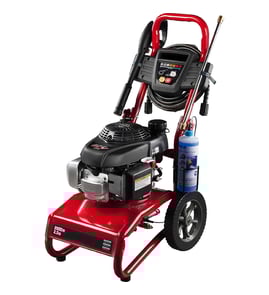



Can I use 87 gas in my pressure washer?
Yes. For the Troybilt pressure washer model 020245, we recommend using regular unleaded gasoline (87 octane minimum); premium is not required. Use fresh fuel and store it properly to help prevent hard starting, surging, and carburetor varnish. See the fuel guidance in the 020245 owner’s manual.
Fuel recommendations for model 020245
Use these best practices to keep the engine running cleanly:
- Use fresh gasoline (buy only what you’ll use in about 30 days).
- If your fuel contains ethanol, keep it as low as practical (many areas offer E10; avoid higher blends).
- Add a fuel stabilizer any time the washer may sit more than a couple of weeks.
- Store fuel in a sealed, approved container; keep it cool and out of direct sun.
- If the unit will be stored, run the engine briefly after adding stabilized fuel so treated fuel reaches the carburetor.
Ethanol vs. non-ethanol gas: what changes?
Ethanol-blended fuel can attract moisture and can contribute to deposits during storage. Non-ethanol fuel can reduce storage-related issues, but it is not required for normal operation.
| Fuel type | OK to use? | Best for | Watch-outs |
|---|---|---|---|
| 87 octane regular (typical E10) | Yes | Everyday use | Use stabilizer if storing |
| 87 octane non-ethanol | Yes | Seasonal equipment, longer storage | Often costs more |
| Premium (91-93) | Not needed | Rarely provides benefit | Doesn’t fix stale-fuel problems |
Why it matters
Using the correct octane and keeping fuel fresh helps prevent common pressure washer problems like no-start, rough running, and engine losing power. For broader troubleshooting steps, see solving pressure washer problems.
Last updated: January 2026
What are the most common issues with 20245?
The most common issues we see on the Troybilt 020245 gas pressure washer are no or low pressure, surging or pulsing spray, leaks at hose or pump fittings, and hard starting or stalling. Most problems trace back to a clogged nozzle, air in the water supply, worn O-rings, or unloader valve wear; use the owner's manual for model-specific checks and settings.
Common problems and what they usually point to
- Low pressure or no pressure: clogged spray tip, kinked hose, inlet screen blocked, air leaks on the inlet side
- Pulsing or surging pressure: partially clogged nozzle, unloader valve sticking, inconsistent water supply
- Water leaking at connections: worn or nicked seals, loose couplers, damaged hose
- Detergent not siphoning: wrong nozzle/tip for soap mode, clogged injector path, air leak at pickup tube
- Engine starts then dies or won’t start: stale fuel, dirty air filter, fouled spark plug, low oil shutdown (if equipped)
Quick checks we recommend first (fastest wins)
- Confirm a steady water supply; fully open the spigot and purge air by holding the trigger until flow is smooth.
- Inspect and clean the spray tip; swap to a known-good tip if you have one.
- Check for leaks at every connection; replace seals if they look flattened or cracked.
- Look for hose damage; a weak spot can balloon and reduce pressure.
Parts that commonly solve these symptoms
| Symptom | Common fix | Example part on this model page |
|---|---|---|
| Low pressure, poor spray pattern | Replace/clean spray tip | Nozzle 195983XGS |
| Leaks at fittings | Replace sealing rings | O-ring 190584GS |
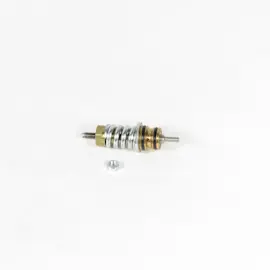
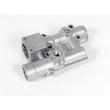
| Pressure spikes or won’t regulate | Service unloader components | Generac pressure washer unloader valve seat 190630GS |
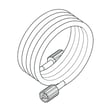
| Hose leaks or bursts | Replace high-pressure hose | Pressure washer hose 84006753 |
Why it matters
Running the 020245 with a clogged nozzle or air in the inlet makes the pump work harder, which accelerates wear on seals and unloader parts and can turn a simple cleaning job into a pump repair.
For deeper troubleshooting by symptom, use solving pressure washer problems.
Last updated: March 2026
What is a good PSI for a gas pressure washer?
A good PSI depends on what you’re cleaning, but for the Troybilt 020245 gas pressure washer, the rated maximum outlet pressure is 2,200 PSI, which is a strong “all-purpose” level for most home cleaning when you choose the right spray nozzle and keep a safe distance. See the 020245 owner’s manual.
PSI ranges that work well (and what they’re for)
- 1,200 to 1,800 PSI: cars, patio furniture, delicate surfaces
- 1,800 to 2,500 PSI: siding, decks, general outdoor cleanup
- 2,500 to 3,000 PSI: driveways, sidewalks, brick and concrete (use care)
- 3,000+ PSI: heavy stripping and commercial-grade cleaning (higher risk of damage)
How to “set” the right pressure on the 020245
This model doesn’t use a PSI dial; you control cleaning force mainly with spray tip selection and distance.
- Start with a wider fan pattern and step closer gradually
- Keep the nozzle roughly 8 to 24 inches from the surface for effective cleaning
- Use the black nozzle for detergent application (low pressure)
- Avoid the most aggressive tip on fragile materials
If your spray pattern is uneven or pressure pulses, a worn or clogged nozzle is a common cause; replacing the spray tip can restore performance. A compatible option is the nozzle 195983XGS.
Quick guide: match the job to a spray tip
| Task | Recommended approach | Risk level |
|---|---|---|
| Washing a car | Wider fan pattern, more distance | Low |
| Siding and decks | Medium fan pattern, test a hidden spot | Medium |
| Concrete/driveway | More pressure, steady motion, avoid lingering | Medium to high |
| Paint/rust removal | Most aggressive tip, only if surface can handle it | High |
Why it matters
Using more PSI than you need can etch concrete, shred wood fibers, strip paint, and force water behind siding. Using too little PSI wastes time and can tempt you to get too close, which also increases damage risk.
Last updated: January 2026