 Owner’s manual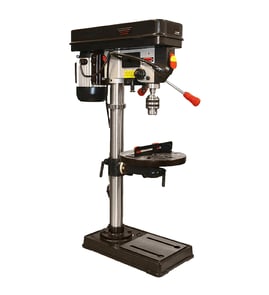

What is the 4 inch rule for drill press?
The 4-inch rule for a drill press means we keep our hands and fingers at least 4 inches away from the rotating drill bit, chuck, and point of operation. On the Craftsman 152219110 bench drill press, this works with the manual’s core safety steps like securing the workpiece and shutting power off before adjustments (see the owner's manual).
- Clamp the workpiece to the table or hold it in a vise; do not hand-hold small pieces.
- Use a brush or scrap wood to clear chips; do not sweep chips away with your fingers.
- Keep sleeves, gloves, jewelry, and long hair away from the spinning bit and chuck.
- Set the table height and depth stop before you start drilling so your hands stay back.
- Turn the drill press off and wait for a complete stop before clearing the table or repositioning the work.
Your manual includes specific limits that reduce the chance of a sudden grab or break that can pull hands toward the bit.
| Safety item | What to do | Why it matters |
|---|---|---|
| Workpiece control | Secure the workpiece against spinning (clamp or vise) | Prevents the part from rotating and injuring hands |
| Bit length limit | Do not use bits over 7 inches long or extending 6 inches below the chuck jaws | Reduces bending, breakage, and kickback risk |
| Adjustments and cleanup | Power off, unplug, and wait for full stop before changing setup or cleaning | Prevents accidental contact with moving parts |
Most drill press injuries happen when a hand drifts into the danger zone during chip clearing, work repositioning, or when a workpiece spins. The 4-inch rule creates a simple buffer that helps prevent contact even if the bit grabs or the work shifts.
Last updated: February 2026
What are the measurements of a drill press?
For the Craftsman 152219110 bench drill press, the overall measurements are 34 inches high x 11 inches wide x 21 inches deep, and it weighs about 93 lb. This model also has a 6-inch throat depth (which equals a 12-inch swing) and an 8-1/2 inch x 9-3/8 inch base work area; see the owner's manual.
- Height: 34 in.
- Width: 11 in.
- Depth (front to back): 21 in.
- Throat depth: 6 in. (12 in. swing)
- Base work area: 8-1/2 in. wide x 9-3/8 in. deep
- Table size: 8-5/8 in. wide x 10 in. deep
| Measurement | What it tells you | Why you care |
|---|---|---|
| Height x width x depth | Overall footprint and clearance | Confirms bench space and overhead clearance |
| Throat depth | Spindle-to-column distance | Determines max center drilling distance (swing = 2x throat) |
| Base work area | Base plate size | Helps plan mounting and stability |
| Table size | Usable support area | Affects clamping room for workpieces |
Getting the right measurements helps you plan safe placement, proper fastening, and enough clearance to open the belt cover, adjust speeds, and clamp work securely. This model is designed to be fastened to a supporting surface to reduce tipping, sliding, or walking.
- Measure overall height from the bench surface to the top of the head.
- Measure width at the widest point (often the table crank or motor area).
- Measure depth from the front edge of the base to the farthest rear point.
- Confirm swing by doubling the throat depth (this model: 6 in. throat depth = 12 in. swing).
Last updated: February 2026
How to repair a drill press spindle?
On the Craftsman 152219110 bench drill press, spindle repair usually means cleaning and reseating the chuck taper, lubricating the quill and spindle, or replacing worn bearings or the spindle/quill assembly. Always unplug the drill press first and follow the disassembly and adjustment steps in the owner's manual.
Many “bad spindle” symptoms come from the chuck taper or return spring, not the spindle itself.
- Unplug the drill press and remove the bit.
- If the chuck slips off, clean the spindle taper and the chuck taper (oil or grease will prevent a tight fit).
- Check belt tension and feed technique if you see chatter or stalling.
- Lubricate the quill and spindle periodically with light machine oil.
- If you hear grinding or feel roughness, suspect spindle bearings.
| Symptom | Most common cause | What we do first |
|---|---|---|
| Chuck will not stay on | Dirty or oily taper surfaces | Clean spindle taper and chuck taper, then reseat chuck |
| Quill feels sticky or squeals | Dry quill/spindle | Apply a thin film of lightweight machine oil and cycle quill |
| Rough, noisy rotation | Worn bearing(s) | Inspect bearings, replace if rough or loose |
| Spindle return too slow/fast | Return spring tension off | Adjust spindle return spring tension |
Exact fasteners and order vary by drill press design, but the workflow is consistent.
- Disconnect power and remove the chuck and bit.
- Clean and inspect tapers: remove grease, dirt, and oil from the spindle taper and chuck taper.
- Reseat the chuck correctly: open jaws fully, seat chuck onto the spindle, then drive it on using a wood block (do not strike the chuck with a metal hammer).
- Lubricate the quill and spindle: lower the quill and wipe a thin film of light machine oil on the quill surface; add a few drops down the spindle, then raise/lower to distribute.
- If bearings are bad: remove the quill/spindle assembly, press off the worn bearing(s), install new bearing(s), and reassemble.
- Verify operation: check for smooth travel, proper return, and that the chuck stays seated.
A loose chuck taper or dry quill can mimic spindle failure and cause wobble, poor hole accuracy, and unsafe bit grab. Proper taper cleaning, correct chuck seating, and periodic lubrication keep the Craftsman 152219110 drilling straight and smooth.
Last updated: February 2026
What to look for in a bench top drill press?
For a benchtop drill press like the Craftsman 152219110, focus on capacity, speed range, and how securely it locks and holds work. This model’s manual highlights a 5-speed setup (620 to 3100 RPM), 2-3/8 inch quill travel, and a 1/2 inch keyless chuck, which are strong baseline specs for general shop drilling.
- Speed range and number of speeds: More usable speeds helps you match wood, metal, and bit size. The 152219110 uses 5 speeds (620, 1100, 1720, 2340, 3100 RPM).
- Quill travel (drilling depth): More travel means fewer repositioning steps. This model lists 2-3/8 inch quill travel.
- Chuck type and capacity: A keyless chuck is fast for bit changes; this model is keyless and accepts 1/32 inch to 1/2 inch bits.
- Table size and adjustability: Look for a stable table and easy height adjustment. This model uses rack-and-pinion table movement and a cast iron table.
- Rigidity and stability: A heavier head, solid column, and a bolted-down base reduce vibration and improve hole accuracy.
| What to check | Why it matters | What this model provides |
|---|---|---|
| Lowest speed | Better control for larger bits and metal | 620 RPM |
| Highest speed | Cleaner holes in wood with small bits | 3100 RPM |
| Quill travel | Determines max single-stroke drilling depth | 2-3/8 inch |
| Chuck capacity | Determines bit shank sizes you can use | 1/32 inch to 1/2 inch |
| Table movement | Easier setup changes | Rack and pinion |
- Confirm you can bolt the drill press to a bench; vibration can cause walking or tipping.
- Make sure the head and table locks are easy to tighten and stay tight.
- Verify you can clamp a vise or workpiece securely; small parts must be held safely.
- Check that the switch can be secured; this model uses a toggle ON/OFF with removable key.
The right benchtop drill press is not just about horsepower; it is about repeatable accuracy. A solid column, stable table, and the right speed for the material reduce bit wandering, chatter, and oversized holes.
For the exact specifications and operating limits (including bit length guidance and safe accessory use), use the owner's manual.
Last updated: February 2026