Owner’s manual
 Error Codes



What are the disadvantages of a bottom freezer refrigerator?
Bottom-freezer refrigerators like the GE CYE22TSHSSS make fresh food easy to reach, but the tradeoff is that frozen items sit lower and are often stored in deeper bins, so access and organization can take more effort than a side-by-side.
Common disadvantages to expect
- More bending and lifting: You reach down for frozen foods, and heavier items (meat, bulk bags) can be awkward to lift out.
- “Digging” for items: Deep drawers can hide smaller packages under larger ones.
- Less usable freezer organization: Fewer door bins and shelves than many side-by-sides.
- Drawer clearance needs: You need space in front of the unit to fully pull out freezer drawers.
- Ice buildup can be more noticeable: If the door is left ajar or seals are dirty, frost can reduce drawer glide and storage space.
Quick comparison: bottom freezer vs other styles
| Feature | Bottom freezer | Side-by-side | Top freezer |
|---|---|---|---|
| Fresh food access | Best | Good | Fair |
| Frozen food access | Fair | Best | Fair |
| Freezer organization | Fair | Good | Fair |
| Space needed to open | More (drawers) | Less | Less |
Tips to reduce the downsides
- Use bins or baskets to group frozen foods (breakfast, veggies, meats).
- Keep frequently used items on the top freezer drawer level.
- Avoid overpacking; air circulation helps temperature stability.
- Clean door gaskets regularly to reduce frost and moisture issues.
- Follow the storage and loading guidance in the CYE22TSHSSS owner's manual.
Why it matters
Most “disadvantages” come down to ergonomics and organization. If you use frozen foods daily or store bulky items, drawer access and visibility can affect convenience more than cooling performance.
Last updated: January 2026
Which is better top mount or bottom mount fridge?
A bottom-mount refrigerator like the GE CYE22TSHSSS is usually better for everyday convenience because fresh foods sit at eye level and the freezer is in a pull-out drawer. A top-mount is usually better for lower upfront cost and slightly lower energy use in many households.
Quick comparison (what most homeowners notice)
- Bottom-mount: easier access to fresh food, more drawer-style organization, freezer items are easier to sort.
- Top-mount: often lower purchase price, simpler layout, freezer access is easiest for frequent freezer use.
- Either style: performance depends more on door seals, airflow, and temperature settings than the freezer location.
| Feature | Top-mount (freezer on top) | Bottom-mount (freezer on bottom) |
|---|---|---|
| Fresh food access | You bend more | You bend less |
| Freezer access | Eye level | Drawer level |
| Organization | Often simpler shelves | Often more bins and pull-outs |
| Typical buyer priority | Budget, simplicity | Convenience, fresh-food use |
How to choose for your kitchen and habits
- If you cook often and use produce, dairy, and leftovers daily, bottom-mount usually feels better.
- If you use the freezer more than the fridge (meal prep, frozen foods), top-mount can be more convenient.
- If you have limited space, compare door swing and drawer clearance; check the exact dimensions in the CYE22TSHSSS owner’s manual.
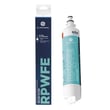
- If you want filtered water and ice, confirm filter type and replacement steps; the GE refrigerator water filter RPWFE is a common maintenance item for this model.
Why it matters
The “better” choice is the one that matches how you reach for food every day. Bottom-mount designs reduce bending for fresh-food access, while top-mount designs often keep costs and complexity down.
Last updated: January 2026
What is the most common problem with GE profile refrigerators?
The most common issue we see on GE Profile refrigerators like model CYE22TSHSSS is a cooling problem (warm fresh food section, warm freezer, or temperature swings). Cooling complaints usually trace back to airflow, defrost, or control and sensor inputs rather than a single “one size fits all” failure.
Most common symptoms customers report
- Refrigerator not cooling or not cold enough
- Freezer cold but fresh food warm (or the reverse)
- Loud or unusual fan noise
- Ice maker not making ice or slow ice production
- Water dispenser weak flow or no water
- Water leaking inside the cabinet or onto the floor
Quick checks that solve many “not cooling” calls
Start with these basics before replacing parts:
- Confirm temperature settings; allow 24 hours after changes for temperatures to stabilize.
- Make sure vents are not blocked by food packages.
- Check door closure and gasket sealing; a door left ajar can mimic a cooling failure.
- Clean dust from the condenser area and ensure good airflow around the cabinet.
- Listen for the evaporator fan; if it is not running, cold air will not circulate.
Parts that commonly relate to these problems (when diagnosis points there)
Use the symptom to guide the part, not the other way around:
| Symptom | Common system involved | Example part for CYE22TSHSSS |
|---|---|---|
| Temperature swings | Sensing and control | Refrigerator temperature sensor WR55X10025 |
| Warm temps with frost buildup | Defrost system | Refrigerator defrost heater WR51X10131 or refrigerator defrost bi-metal thermostat WR50X10108 |
| Warm fresh food, fan noise | Air circulation | Refrigerator evaporator fan motor and blade WR60X10352 |
| Random operation, no response | Electronic control | Refrigerator main control board WR55X46805 |
Why it matters
A refrigerator can “run” and still not cool correctly if airflow is restricted, the defrost system is failing, or the control is getting bad temperature feedback. Matching the symptom to the right system prevents repeat failures and unnecessary part returns.
For model-specific operating details and recommended settings, use the CYE22TSHSSS manual.
Last updated: January 2026