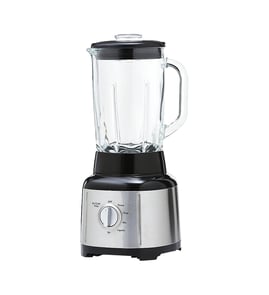



Can I put my KitchenAid blender in the dishwasher?
Yes, for the KitchenAid KSB4027PA0 blender, the removable jar and lid are typically dishwasher-safe, while the motor base and any electrical parts must never go in the dishwasher. For best results and longest life, we recommend hand-washing the jar assembly when possible.
What you can (and cannot) dishwash
- Dishwasher-safe (typical): blender jar and lid
- Never dishwash: motor base, power cord, control knob area
- Use caution: any part with seals, couplers, or metal drive interfaces
If your jar is cloudy or the seal starts to seep after repeated dishwasher cycles, switch to hand-washing.
Quick cleaning method (hand-wash)
- Fill the jar halfway with warm water.
- Add a drop of dish soap.
- Run on low for 10 to 20 seconds.
- Rinse and air-dry upside down.
This method cleans the blades and interior without stressing the jar or lid.
Parts that matter if cleaning causes leaks or slipping
If you notice leaking at the bottom of the jar, poor engagement, or a burning rubber smell, these parts are common suspects:
| Symptom | Most likely area | What to check next |
|---|---|---|
| Jar leaks at bottom | Jar sealing surfaces | Inspect jar base and lid fit; replace jar if cracked |
| Jar slips, rattles, or won’t drive | Coupler/drive interface | Check for rounded or stripped coupler teeth |
| Blender won’t run after liquid spill | Controls/electrical | Unplug, dry fully, then inspect cord and base |
Relevant model parts include the jar assembly W11433178 and the blender drive coupling W11627528.
Why it matters
Dishwashers use high heat and strong detergents that can haze plastic, weaken seals, and shorten the life of couplers. Keeping the motor base dry also prevents corrosion and electrical damage.
Last updated: February 2026
How do I tell which KitchenAid model I have?
For your KitchenAid blender, the fastest way to confirm the exact model is to find the model/serial label on the base and match it to the format KSB4027PA0. Once you have that full model number, we can make sure every replacement part fits correctly.
Where to look on a KitchenAid blender
Check these common label locations on the blender base (not the jar):
- Bottom of the base (most common); tip the blender carefully onto a towel
- Back of the base near the power cord exit
- Underside rim of the base (around the perimeter)
- Inside a recessed area on the bottom plate
What to write down (and why)
Record the full model number and the serial number exactly as shown.
- Model number: identifies the exact design and compatible parts
- Serial number: helps confirm production run details when parts changed mid-series
- Suffix letters/numbers: matter; they can affect fit and color-matched components
Quick checklist
| Item on label | Example | Use it for |
|---|---|---|
| Model number | KSB4027PA0 | Correct parts lookup and diagrams |
| Serial number | (varies) | Verifying version/production run |
| Electrical rating | 120V, Hz, amps | Troubleshooting power issues |
If the label is missing or unreadable
Use these practical cross-checks to narrow it down:
- Compare the control style (rotary knob vs. buttons) and base shape
- Match the jar style and lid style to your blender
- If the blender runs but the jar does not spin, inspect the coupler area for wear
If you suspect a worn coupler, the blender drive coupling W11627528 is a common wear item on this model family.
Why it matters
KitchenAid blender parts are model-specific; using the exact model number (like KSB4027PA0) prevents ordering a jar assembly, lid assembly, or drive coupling that looks similar but will not lock in or drive correctly.
Last updated: February 2026
Is the KitchenAid KSB4027PA0 discontinued?
Yes. The KitchenAid KSB4027PA0 blender is treated as a discontinued model when it is no longer being manufactured and sold as a current item; you can still keep it running by replacing wear items and broken components with the correct KSB4027PA0-COMPATIBLE parts such as the jar assembly W11433178.
How we confirm it in practical terms
A model is effectively discontinued when you see these patterns:
- The blender is no longer listed as a current model by major retailers
- Replacement parts remain available even though the full unit is not
- Only limited “new old stock” shows up, or listings shift to “used”
- Cosmetic assemblies (like color-specific bases) are sold as service parts
What to do if you need parts for a discontinued blender
Even if KSB4027PA0 is discontinued, repairs are usually straightforward because common failure points are modular.
- If the jar is cracked, leaking, or the blade drive is worn, replace the jar assembly W11433178
- If the motor runs but the blades do not spin, inspect the blender drive coupling W11627528
- If the unit is dead or cuts out, check the outlet first, then inspect the power cord W11392823
- If the controls do not respond, the issue often points to the electronic control W11580224
Quick symptom-to-part guide
| Symptom | Most likely area | Example KSB4027PA0 part to check |
|---|---|---|
| Motor runs, blades do not turn | Coupling/drive interface | Blender drive coupling (W11627528) |
| Leaks, cracks, poor blending | Jar and sealing surfaces | Jar assembly (W11433178) |
| No power | Power input | Power cord (W11392823) |
| Buttons/knob act erratic | Control system | Electronic control (W11580224) |
Why it matters
Knowing a blender is discontinued helps set expectations: you may not find a brand-new replacement unit easily, but you can often extend the life of your KitchenAid blender by replacing the exact-fit coupling, jar, control, or cord instead of replacing the whole appliance.
Last updated: February 2026
Why is my KitchenAid blender not working?
If your KitchenAid KSB4027PA0 blender won’t run, the most common causes are a power issue, the jar not seating correctly, an overheated motor, or a worn drive connection between the motor base and jar. Start with simple checks, then inspect the coupler and controls.
Quick checks first (no tools)
- Confirm the outlet works by plugging in a lamp or phone charger.
- Unplug the blender for 1 minute, then plug it back in to reset the control.
- Make sure the jar is fully seated and the lid is installed correctly.
- Let the motor cool 15 to 30 minutes if it stopped during heavy blending (thick smoothies, ice, nut butters).
- Check for a jam: remove the jar and verify the blade area spins freely by hand (with the unit unplugged).
What to inspect on KSB4027PA0 if it still won’t start
A blender that powers on but won’t blend often has a stripped or slipping drive connection, or a jar assembly issue.
- Drive coupling: If you hear the motor but the blades do not move, the coupler can be worn. See the blender drive coupling W11627528.
- Jar assembly: If the jar leaks, wobbles, or the blade area binds, replacing the jar can restore normal operation. See the jar assembly W11433178.
- Controls: If the knob feels loose, doesn’t “click” through settings, or the unit behaves erratically, the rotary knob or control can be involved.
Symptom-to-likely-cause guide
| What you notice | Most likely cause | What to do next |
|---|---|---|
| No lights, no sound | Outlet, cord, internal power issue | Check cord for damage; try a different outlet |
| Lights on, motor hums, blades don’t spin | Worn drive coupling | Inspect/replace coupler |
| Starts then stops | Overheating or jam | Cool down; reduce load; check for binding |
| Leaks or grinding from jar | Jar assembly problem | Inspect/replace jar assembly |
Why it matters
Running a jammed jar or a slipping coupler can overheat the motor and damage internal components. Fixing the root cause first helps protect the motor and electronic control.
Last updated: February 2026