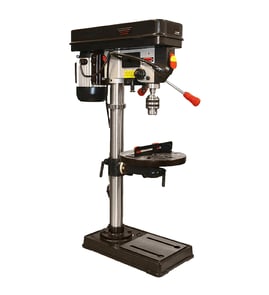

What is the 4 inch rule for drill press?
The 4-inch rule for a drill press means we keep our hands and fingers at least 4 inches away from the rotating drill bit, chuck, and spindle while the Craftsman 11321310 drill press is running. This reduces the risk of accidental contact, cuts, or entanglement.
How to follow the 4-inch rule on a drill press
Use setup and holding methods that keep your hands out of the danger zone:
- Clamp the workpiece to the table whenever possible (especially small parts)
- Use a drill press vise, V-block, or hold-down clamps instead of hand-holding
- Use a scrap backer board under the work to reduce tear-out and grabbing
- Stop the machine before clearing chips; use a brush, not your fingers
- Keep sleeves, gloves, jewelry, and long hair away from rotating parts
Quick safety checklist (before you pull the switch)
| Check | What we look for | Why it matters |
|---|---|---|
| Work holding | Work is clamped or in a vise | Prevents spinning and hand injuries |
| Bit condition | Bit is sharp and seated fully in the chuck | Reduces grabbing and wobble |
| Speed | Correct RPM for bit size and material | Improves control and cut quality |
| Table height | Table supports the work close to the bit | Reduces leverage and chatter |
Why it matters
A drill press can pull material upward or spin it if the bit binds. Keeping a 4-inch buffer and using clamps or a vise helps prevent your hand from being pulled into the point of operation.
Related DIY help
For safe electrical troubleshooting habits when a power tool will not start or trips power, we use the same basics shown in how to use a multimeter to test electrical parts video.
Last updated: February 2026
What is a good horsepower for a drill press?
For most DIY drilling on a Craftsman drill press like model 11321310, 1/2 HP is a solid all-around choice. If you regularly drill larger holes, use Forstner hole saws, or work in steel, 3/4 HP to 1 HP gives better torque and reduces stalling.
Quick horsepower guide (what to buy for the work you do)
- 1/3 HP: light duty, small bits, softwood, occasional use
- 1/2 HP: most home shops; wood, plastics, light metal drilling
- 3/4 HP: frequent use, larger bits, tougher hardwoods, thicker stock
- 1 HP: heavy drilling, larger hole saws, more demanding metalwork
Horsepower vs. what actually improves drilling
Horsepower helps, but drill press performance also depends on speed control, rigidity, and how you run the cut.
| What you’re doing | What matters most | Practical target |
|---|---|---|
| Small holes in wood | sharp bit, correct speed | 1/3 to 1/2 HP |
| Larger holes in hardwood | torque, low speed range | 1/2 to 3/4 HP |
| Steel or thick metal | low RPM, feed control, lubrication | 3/4 to 1 HP |
| Hole saws/Forstner bits | torque, belt condition, low RPM | 3/4 to 1 HP |
How to choose the right HP for your shop
- Match HP to bit size: bigger diameter bits need more torque at low RPM.
- Prioritize low-speed capability: metal drilling needs slower speeds more than “more HP.”
- Use proper technique: steady feed pressure and cutting oil on metal reduce load.
- Keep the drive system healthy: a worn belt or slipping pulleys can feel like “low power.”
- Avoid bogging: if the motor slows, reduce feed, lower speed, or step down bit size.
Why it matters
Choosing enough horsepower helps you drill cleaner holes with less chatter, reduces overheating (especially in metal), and makes the drill press safer and easier to control under load.
For more DIY repair and safety basics that apply to power tools, we recommend are diy appliance repairs safe.
Last updated: February 2026
What does the drill press do better than any machine in the shop?
A drill press like the Craftsman 11321310 does one job better than anything else in the shop: it drills accurate, repeatable holes. Because the bit is guided straight down with a fixed table and adjustable depth stop, we get cleaner, rounder holes at consistent locations and depths.
What a drill press excels at
- Drilling perfectly perpendicular holes (90 degrees to the work surface)
- Repeating the same hole pattern across multiple parts
- Controlling hole depth with a depth stop for consistent results
- Keeping holes round and true, especially in metal and hardwood
- Improving safety and control versus freehand drilling (less bit wander)
Why it outperforms a hand drill for precision
A hand drill is great for portability, but it is harder to keep the bit square, hold steady pressure, and repeat the same depth. A floor model drill press and bench setup like the 11321310 gives us a stable column, a rigid quill feed, and a table that supports the workpiece.
| Task | Drill press | Hand drill |
|---|---|---|
| Straight (plumb) holes | Excellent | Fair to good |
| Repeatable depth | Excellent (depth stop) | Limited |
| Repeatable hole location | Very good (with fence/jig) | Fair |
| Large bits (Forstner/hole saw) | Better control | More kickback risk |
Tips to get the most accuracy from your Craftsman 11321310
- Set the table square to the bit; verify with a small machinist square.
- Use a center punch on metal to prevent bit walking.
- Clamp the workpiece to the table; do not hold it by hand.
- Match speed to material and bit size; slower for larger bits and metal.
- Use sharp bits and back up wood with scrap to reduce tear-out.
Why it matters
Accurate holes control fit and alignment for joinery, brackets, hinges, and hardware. When hole size, roundness, and depth are consistent, assemblies go together faster and parts last longer.
For more help identifying the exact model number on your tool before ordering parts, use how to find your appliance model number (and what it means for parts).
Last updated: February 2026
How much does a Craftsman 11321310 drill press weigh?
A Craftsman 11321310 drill press is a heavy, cast-iron floor-model tool; plan for a multi-person move or a hand truck. Listings for this model commonly show a shipping weight around 350 lb, so the assembled drill press weight is typically somewhat less than that.
What weight number should you use?
Use the number that matches what you are doing (moving, freight, or lifting).
- Shipping weight: includes crate/pallet and packing materials; used for freight quotes
- Net (tool) weight: the drill press itself; used for lifting and placement planning
- As-installed weight: tool plus stand, vise, table, and any accessories
Practical ways to confirm your actual weight
These methods give you a reliable number without guessing.
- Check any freight bill, pallet label, or old invoice for “shipping weight”
- If the drill press is already installed, weigh it in major subassemblies (head, table/arm, column/base) using a platform scale
- If you only have a bathroom scale, use the two-person method: weigh person A, then person A holding the part; subtract
- Remove heavy add-ons (vise, auxiliary table, work light) before weighing
Quick reference table
| Weight type | What it includes | Best for |
|---|---|---|
| Shipping weight | Tool + packaging/pallet | Freight and delivery planning |
| Net weight | Tool only | Lifting, stairs, shop placement |
| As-installed | Tool + accessories | Floor loading and stability |
Why it matters
Using shipping weight for lifting can lead to overplanning, but using an underestimated “typical drill press” weight can cause unsafe handling. For the 11321310, treating it as a heavy floor drill press and planning around the higher shipping-weight figure keeps the move safer.
For help confirming you are matching the correct model number when looking up parts, use how to find your appliance model number (and what it means for parts).
Last updated: February 2026
How to repair a drill press spindle?
On the Craftsman 11321310 drill press, spindle repair means correcting wobble, noise, or rough rotation by servicing the quill and spindle stack: remove the chuck, pull the quill, replace worn spindle bearings or a damaged spindle, then reassemble and verify smooth travel and low runout.
Safety and prep
- Unplug the drill press; lock out power so it cannot be switched on.
- Remove the bit and chuck key; lower the table for working clearance.
- Wear eye protection; snap rings and springs can release suddenly.
- Take photos as you disassemble; keep spacers and washers in order.
Spindle repair steps (what we do on most Craftsman drill presses like 11321310)
- Remove the chuck and arbor; use the correct drift/wedge method for your quill slot.
- Open the belt cover, relieve belt tension, and move the belt off the pulleys if it blocks quill removal.
- Remove the quill return spring housing carefully; control spring tension as you unwind it.
- Remove the quill retaining hardware (commonly a snap ring/retainer and stop components), then slide the quill out of the head.
- Press the spindle out of the quill and replace bearings as needed; press only on the correct bearing race.
- Reassemble in reverse order; set the return spring so the quill retracts smoothly without slamming.
What to inspect while it is apart
- Spindle bearings: roughness, looseness, noise, heat marks
- Spindle taper/arbor: rust, scoring, debris (common cause of chuck wobble)
- Quill bore: galling, wear, packed sawdust
- Feed pinion and rack: chipped teeth, binding
- Pulleys and belt: glazing, cracks, misalignment
Quick diagnosis guide
| Symptom | Most likely cause | What to do |
|---|---|---|
| Chuck wobble/runout | dirty taper, bent arbor/spindle | clean taper; replace bent parts |
| Grinding or rumble | failing spindle bearings | replace bearings |
| Quill sticks | debris or burrs in quill bore | clean; lightly lubricate sliding surfaces |
| Vibration at speed | belt/pulley issue, then bearings | inspect belt/pulleys; then bearings |
Why it matters
A worn spindle or bearing set creates runout and chatter, which makes oversized holes and stresses the belt drive. Restoring the spindle assembly improves accuracy and protects the chuck and pulleys.
For electrical checks while troubleshooting vibration or motor noise, use our how to use a multimeter to test electrical parts video.
Last updated: February 2026