Owner’s manual
 Error Codes

What is the average lifespan of a Kenmore Elite refrigerator?
A Kenmore Elite refrigerator typically lasts 10 to 15 years with normal household use. For the Kenmore Elite 59676053702 bottom-mount refrigerator, regular cleaning and correct temperature settings (per the 59676053702 owner's manual) help you reach that expected lifespan.
Typical lifespan and what to expect
Most bottom-mount refrigerators fall into a predictable range when they are installed correctly and maintained.
| Appliance type | Typical lifespan | What usually ends the run |
|---|---|---|
| Bottom-mount refrigerator (like 59676053702) | 10 to 15 years | Cooling-system wear, airflow issues, control failures |
| Well-maintained unit | 15 to 20 years | Major sealed-system or compressor repair becomes impractical |
Maintenance that most improves lifespan
We recommend focusing on the items that protect the cooling system and keep airflow consistent.
- Keep door gaskets clean and sealing tightly to prevent warm-air leaks
- Clean condenser coils regularly (dust buildup increases run time and wear)
- Keep vents clear so cold air can circulate between compartments
- Follow the manual’s cleaning and care schedule
- Address water and ice issues early (low water pressure and mineral issues can affect performance)
When repairs start to become common
As refrigerators age, a few categories of problems show up more often. These are the ones that most affect longevity.
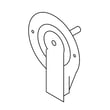
- Temperature swings: often tied to airflow components such as the refrigerator damper control assembly WPW10196393
- Warm refrigerator section: can be related to evaporator airflow, including the refrigerator evaporator fan motor WPW10128551
- No ice or slow ice: sometimes linked to water supply problems or a failing refrigerator water inlet valve assembly WP2315576
Why it matters
A refrigerator that is running longer than normal to hold temperature uses more energy and puts extra stress on the compressor and sealed refrigerant system. Simple upkeep (coils, gaskets, airflow) is the most reliable way to extend service life.
Last updated: January 2026
What size is Kenmore refrigerator model 59676053702?
Kenmore refrigerator model 59676053702 is a bottom-mount refrigerator; the exact exterior dimensions (width, height, depth) vary by the specific configuration in this model family, so we recommend confirming the measurements in the 59676053702 owner’s manual before ordering parts or planning a fit.
How to get the right size measurement (fast and accurate)
Use these steps so you measure the cabinet opening correctly and avoid clearance issues:
- Measure width at the front of the opening (left to right) in at least 2 spots.
- Measure height from floor to the lowest overhead cabinet or trim.
- Measure depth from the back wall to the front edge of counters (note door and handle depth separately).
- Plan for ventilation space: allow about 1/2 inch at the top and behind the refrigerator.
- If installed next to a wall, allow about 2 1/2 inches on the hinge side for door swing.
Typical size range for Kenmore bottom-mount refrigerators
If you are estimating before you measure, most Kenmore bottom-mount units of this style fall into these common ranges:
| Measurement | Typical range (approx.) | What affects it most |
|---|---|---|
| Width | 29 to 33 inches | Cabinet class and door style |
| Height | 67 to 70 inches | Hinge design, leveling legs |
| Depth | 33 to 36 inches | Handles, door thickness |
Why clearances matter (more than the “box size”)
Even when the refrigerator fits the opening, tight clearances can cause warm temperatures, moisture issues, or doors that do not open fully. The ventilation and hinge-side spacing guidelines in the manual help the sealed system and airflow work as designed.
Related parts that can affect fit and door swing
If you are troubleshooting doors not closing or rubbing after a move or reinstall, these parts are commonly involved:
- Door bins and interior load can change door alignment and closing force.
- Door gaskets can create drag if twisted or not sealing evenly.
- Handles can add depth and change how the door clears nearby cabinets.
Last updated: January 2026
What are the common problems with Kenmore Elite refrigerators?
Common problems on the Kenmore Elite 59676053702 bottom-mount refrigerator include not cooling as expected, running longer than normal, unusual operating noises, doors that do not close fully, and ice or water issues. Many fixes are basic maintenance or a single failed part; our 59676053702 owner's manual troubleshooting section helps narrow it down fast.
Most common symptoms and what they usually mean
- Not cooling or weak cooling: controls off, new installation cooldown time, airflow restriction, or a failed fan
- Runs “all the time”: warm room, frequent door openings, large food load, or door left ajar
- Noises (pulsating, hissing, rattling): often normal refrigerant flow and fan/compressor operation
- Door will not close: food packages blocking, bin or shelf out of position, crisper cover not seated
- Ice tastes bad or looks gray: new plumbing, old ice in bin, food odor transfer, minerals in water
Quick checks we recommend first (before replacing parts)
- Confirm the refrigerator control is ON and temperature settings are reasonable.
- If it is a new installation, allow 24 hours to cool completely (setting “coldest” will not speed this up).
- Make sure doors close fully and seals are making contact all the way around.
- Verify shelves, bins, and the crisper cover are fully seated so the door can shut.
- For ice issues, discard old ice, wash the bin, and wait 24 hours for fresh ice.
Parts that commonly solve these problems on model 59676053702
If the quick checks do not help, these model-matched parts are common fixes:
| Symptom | Likely system | Example model-matched part |
|---|---|---|
| Warm fresh food section, poor airflow | Air circulation | Refrigerator evaporator fan motor WPW10128551 |
| Fresh food too warm, freezer OK | Air damper | Refrigerator damper control assembly WPW10196393 |
| No water to ice maker/dispenser | Water supply | Refrigerator water inlet valve assembly WP2315576 |
| Erratic temps | Sensing/control | Refrigerator temperature sensor 12002355 |
Why it matters
Cooling, noise, and ice complaints often trace back to airflow, door closure, or water pressure. Fixing those basics first prevents unnecessary part replacement and helps the refrigerator maintain stable temperatures.
Last updated: January 2026