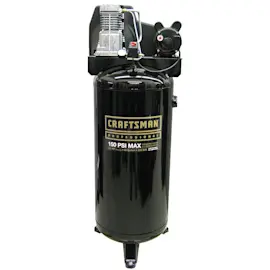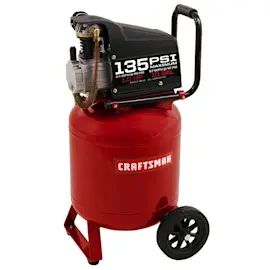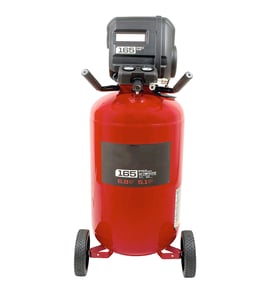

How do I find my compressor model number?
For your Craftsman twin-cylinder tank compressor, the model number is usually printed on a data plate or sticker attached to the tank or frame. Once you find it, match it exactly (including all digits) when searching parts for model 106175541.
Where to look on a Craftsman air compressor
Check these common spots first:
- On the air tank near the front or side (often close to the drain valve area)
- On the tank foot/base or lower rim of the tank
- On the main frame or handle assembly
- Near the motor or pump mounting area (on a label, not stamped into the casting)
- On the rear of the unit near the power cord or pressure switch cover
What the label usually shows (and what to write down)
Most compressor ID labels include more than one number. Use this quick guide so you capture the right one.
| Label item | What it means | What to do with it |
|---|---|---|
| Model number | Identifies the exact compressor design | Use it to look up diagrams and parts |
| Serial number | Identifies your specific unit | Keep it for service history |
| Voltage/amps | Electrical rating | Use it to confirm power requirements |
| Max PSI | Pressure rating | Use it to set safe cut-out/cut-in targets |
Tips to avoid ordering the wrong part
These steps prevent the most common mix-ups:
- Copy the model number exactly as printed (no spaces added, no digits dropped)
- If the label is worn, take a clear photo and zoom in to confirm characters
- Do not use tank size (gallons) or max PSI as a substitute for the model number
- If you see multiple numbers, prioritize the one labeled “MODEL”
- Use the model number when searching on Sears PartsDirect
Why it matters
Craftsman compressors can look similar across different production runs, but parts like the pressure switch, regulator, check valve, and pump components vary by model. Using the exact model number keeps the parts match accurate and prevents fit and wiring issues.
Last updated: February 2026
Is it worth it to repair a compressor?
Yes, it’s worth repairing a Craftsman 106175541 twin-cylinder tank compressor when the problem is limited to a serviceable item (leaking fittings, a bad pressure switch, worn check valve, or a failing regulator) and the total repair cost stays well below the price of a comparable replacement unit.
Quick way to decide (cost vs. condition)
Use this checklist to make a clear call before you spend money:
- Repair it if the tank is solid (no rust-through), it builds pressure normally, and the issue is isolated (air leak, won’t shut off, won’t restart).
- Replace it if the tank is corroded, the pump has severe internal damage (metal noise, seized pump), or it needs multiple major components at once.
- Repair it if you can fix it with basic electrical and air-system troubleshooting (pressure switch, cord, capacitor, unloader valve).
- Replace it if it repeatedly trips breakers, overheats, or has chronic low output after basic fixes.
Common repairs that are usually “worth it”
These are typical, lower-risk fixes on a twin-cylinder tank compressor:
- Tightening or resealing leaking quick-connects, drain valve, or fittings
- Replacing a pressure switch (won’t start, won’t stop, won’t restart)
- Replacing a tank check valve (hard start, air hissing at the unloader)
- Replacing a regulator or gauge (bad outlet pressure control)
- Fixing damaged wiring or a loose connection (no power, intermittent run)
Related DIY help: how to use a multimeter to test electrical parts video
When repair is not the smart move
Tank and pump condition matter more than age alone.
| What you find | What it usually means | Best choice |
|---|---|---|
| Tank rust, pitting, or leaks | Structural safety issue | Replace the unit |
| Loud knocking, grinding, or seized pump | Major pump wear or failure | Replace or major rebuild |
| Runs constantly but won’t reach cut-out | Significant air leak or weak pump | Diagnose first; replace if pump is weak |
| Breaker trips repeatedly | Electrical fault or motor issue | Diagnose; replace if motor is failing |
Why it matters
A compressor repair only pays off when it restores reliable pressure build and safe operation. On a tank compressor, the tank’s condition is the deciding factor because it affects safety and long-term value.
Last updated: February 2026
What are the 4 types of compressors?
The four common compressor types are reciprocating (piston), rotary screw, centrifugal, and axial. Craftsman model 106175541 is an air compressor; when you are identifying parts or troubleshooting, matching the compressor design helps you focus on the most likely wear points and service checks.
The 4 compressor types (plain-English overview)
- Reciprocating (piston): Pistons move up and down in cylinders to compress air; common in many portable and shop air compressors.
- Rotary screw: Two meshing screws compress air continuously; common in commercial and industrial shops needing steady airflow.
- Centrifugal (dynamic): A high-speed impeller accelerates air and converts velocity into pressure; used for high-volume systems.
- Axial (dynamic): Air is compressed through multiple stages of rotating and stationary blades; used in very high-flow, specialized applications.
Quick comparison
| Type | Compressor family | Typical use | What you notice most |
|---|---|---|---|
| Reciprocating (piston) | Positive displacement | Home, garage, intermittent tool use | Higher noise and vibration; strong pressure capability |
| Rotary screw | Positive displacement | All-day shop air | Smooth, continuous air delivery |
| Centrifugal | Dynamic | Large facilities | High airflow at scale |
| Axial | Dynamic | Specialized high-flow systems | Complex, multi-stage design |
Why it matters for troubleshooting and parts
Compressor type points you toward the most common failure areas:
- Reciprocating: valves, head gasket, piston rings, check valve, pressure switch, unloader line leaks
- Rotary screw: inlet valve control, oil management, air-oil separator, cooling issues
- Centrifugal/axial: typically serviced as engineered systems with specialized maintenance
Helpful DIY reference
For basic electrical testing that applies to many “won’t start” or “trips breaker” complaints, use how to use a multimeter to test electrical parts video.
Last updated: February 2026
What is the most common cause of air compressor failure?
The most common cause of failure on a Craftsman 106175541 twin-cylinder tank compressor is poor maintenance that leads to overheating and accelerated wear. Dirty intake filtration, incorrect or low oil (on oil-lubricated pumps), and ignored air leaks make the pump work harder until valves, bearings, or the motor fail.
Most common failure drivers (and what they look like)
- Restricted airflow and overheating: hot pump head, frequent thermal shutdown, slow recovery.
- Dirty or wrong lubrication (if oil-lubricated): louder knocking, higher operating temperature, rapid wear.
- Clogged intake filter: reduced CFM, longer run times, excess heat.
- Air leaks (tank, fittings, hose, check valve): compressor runs often, pressure drops when idle.
- Electrical issues (power cord, switch, capacitor, motor): hums but will not start, trips breaker, intermittent starts.
Quick checks we recommend before parts replacement
- Listen and look: hissing (leak), clicking at the pressure switch, or motor hum.
- Leak test: spray soapy water on fittings, regulator, drain valve, and check valve area.
- Confirm ventilation: keep the pump and motor cooling fins clear; do not run in a tight enclosure.
- Check duty cycle: long continuous runs overheat small twin-cylinder tank compressors.
- Basic electrical test: verify outlet power and inspect wiring for damage using safe testing practices.
Symptom-to-cause guide
| Symptom | Most likely cause | What to do first |
|---|---|---|
| Runs constantly, will not reach cut-out | Air leak or worn valves | Find leaks; then evaluate valve/pump condition |
| Trips breaker on start | Weak capacitor, tight pump, low voltage | Reduce load, check power, inspect start components |
| Slow tank fill | Clogged intake filter or leak | Check filter and fittings |
| Gets very hot quickly | Poor airflow, low oil (if applicable), overuse | Improve ventilation; verify lubrication; reduce run time |
Why it matters
Overheating is usually the final pathway to failure: restrictions, leaks, and poor lubrication all increase run time and temperature, which shortens motor life and damages pump components.
For safe DIY electrical troubleshooting habits, we recommend are diy appliance repairs safe.
Last updated: February 2026