Owner’s manual
 Error Codes


What's the lifespan of a bottom freezer fridge?
Most bottom-freezer refrigerators, including the Samsung RF267AERS, typically last 15 to 20 years with normal use and basic maintenance. Real-world lifespan depends most on compressor run time, door-seal condition, airflow, and keeping the defrost and ice maker systems working correctly.
- Condenser cleanliness: Dust buildup makes the compressor work harder.
- Door gasket seal: Air leaks cause longer run times and moisture issues.
- Defrost performance: Poor defrosting can lead to frost buildup and warm temps.
- Ice maker and water system health: Leaks, clogs, and freezing can create repeat repairs.
- Ventilation and loading: Blocked air vents and overpacking reduce cooling efficiency.
Use these habits to reduce wear on the sealed system and electronics:
- Keep food clear of air vents so air circulates freely.
- Make sure doors and the freezer drawer close fully; use the door alarm feature if equipped.
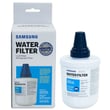
- Replace the water filter on schedule; for this model, a common replacement is the Samsung refrigerator water filter DA29-00003G.
- If ice production is slow after a water hookup, allow the typical startup time noted in the owner's manual.
- Address puddles, frost, or unusual noises early instead of running the unit “as-is.”
Many issues feel serious but are often a single-part fix.
| Symptom | Often a repair/maintenance issue | More likely end-of-life concern |
|---|---|---|
| Warm fridge or freezer | Airflow blocked, defrost issue, dirty condenser | Sealed system/compressor failure |
| Frost buildup | Defrost thermostat/heater circuit | Sealed system restriction (less common) |
| No ice | Water supply, filter, ice maker issue | Control or sealed system issue (rare for ice-only symptom) |
| Condensation around doors | Door not fully closed, gasket leak | Cabinet insulation issue (uncommon) |
A bottom-freezer design has more airflow paths, sensors, and often an ice maker and water filtration system. Keeping airflow clear and seals tight reduces compressor stress, which is the biggest driver of overall refrigerator lifespan.
Last updated: February 2026
What is the difference between force defrost FD and RD?
On Samsung model RF267AERS, RD (refrigerator defrost) runs a defrost cycle focused on the fresh food (refrigerator) evaporator, while FD (forced defrost) is a service-style defrost that’s used to aggressively clear frost conditions that can affect cooling and ice production. For control details, use the RF267AERS owner's manual.
- RD (refrigerator defrost): Targets frost buildup tied to the refrigerator section’s cooling system.
- FD (forced defrost): Used when you need a stronger, broader defrost to clear heavy frost symptoms.
- Normal defrost: Happens automatically during regular operation; you typically do not need to start it.
| Symptom you’re trying to fix | Better choice | Why |
|---|---|---|
| Refrigerator section warming, freezer seems OK | RD | Focuses on refrigerator-side frost restriction |
| Heavy frost symptoms, airflow issues, or repeated icing problems | FD | More aggressive clearing for stubborn frost conditions |
| Ice maker not producing ice due to icing conditions | FD | Often used to help clear ice-related freeze-ups |
- The refrigerator may beep or show the mode on the display.
- You may hear fans stop and restart as the unit manages airflow.
- Water may drain to the pan as frost melts; keep towels handy if you’ve had leaking or puddling.
Frost on an evaporator coil blocks airflow; that can make temperatures drift away from the recommended settings (freezer around -19°C and refrigerator around 3°C) and can also contribute to ice maker performance problems. The right defrost mode helps restore airflow so the refrigerator can cool normally again.
Last updated: February 2026
What is the most common problem with Samsung refrigerators?
The most common problems we see with Samsung refrigerators like model RF267AERS are cooling issues and ice maker problems. In day-to-day use, that usually traces back to airflow restrictions from frost buildup (defrost system), a weak fan, or an ice maker that stops cycling or jams.
- Fresh food section gets warm while the freezer still seems cold
- Frost or ice buildup on the back wall or around vents
- Ice maker stops making ice, makes small cubes, or clumps/jams
- Water leaks or puddles (often from a drain issue)
- Doors not sealing well, leading to temperature swings
- Confirm temperatures and airflow: Make sure vents are not blocked by food packages.
- Look for frost buildup: Heavy frost points to a defrost problem (heater, thermostat, or sensor).
- Verify water supply for ice: This model needs 20 to 125 psi water pressure for proper ice maker operation (a common cause of slow or no ice). See the owner's manual.
- Inspect door sealing: A poor seal can mimic a cooling failure by letting humid air in.
- Reset basics: After unplugging, wait at least 5 minutes before plugging back in (helps protect components and can clear minor control glitches). See the owner's manual.
If your symptoms match, these are frequent repair paths for RF267AERS:
| Symptom | Likely system | Example part for this model |
|---|---|---|
| Frost buildup, warm fridge | Defrost system | Refrigerator defrost bi-metal thermostat DA47-00243K |
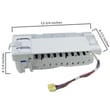
| No ice or inconsistent ice | Ice maker system | Samsung refrigerator ice maker DA97-07365G |
| Leaking/puddles | Drain system | Refrigerator cabinet drain tube assembly DA97-04049H |
| Poor cooling control | Temperature sensing | Kenmore pro refrigerator temperature sensor DA32-10105X |
| Door not sealing, moisture | Door seal | Samsung refrigerator door gasket DA63-06542A |
Cooling and ice maker complaints often share the same root cause: moisture and airflow problems. Catching frost buildup, drain issues, or low water pressure early helps prevent food spoilage, ice jams, and repeated temperature swings.
Last updated: February 2026