 Error Codes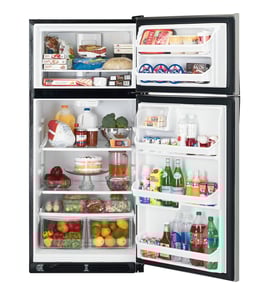




Which is better, top mount or bottom mount refrigerator?
A top-mount refrigerator like the Maytag MTB1954ARA is usually the better choice if you want lower upfront cost, strong reliability, and good energy efficiency. A bottom-mount is usually better if you want everyday convenience because fresh food sits at eye level.
Quick comparison
| Feature | Top-mount (freezer on top) | Bottom-mount (freezer on bottom) |
|---|---|---|
| Fresh food access | You bend more | More at eye level |
| Freezer access | Easier | You bend more |
| Typical price | Lower | Higher |
| Energy use | Often lower | Often slightly higher |
| Repairs | Often simpler | More complex layouts are common |
When a top-mount is the better fit
- You want a dependable, straightforward refrigerator layout
- You use the freezer often (frozen foods, ice storage)
- You want to keep purchase and repair costs down
- You have limited kitchen space and want a simpler door swing setup
- You prefer fewer features and fewer systems to maintain
When a bottom-mount is the better fit
- You cook often and want fresh food at comfortable reach
- You store lots of produce and use crisper drawers frequently
- You want wider shelves and more “grab-and-go” organization
- You don’t access the freezer as often
Why it matters
“Better” comes down to how you use the refrigerator every day. Top-mount models prioritize simplicity and value; bottom-mount models prioritize ergonomics and fresh-food convenience. If your decision includes filtration or water/ice features, maintenance habits matter too; see how to replace the water filter in a Maytag refrigerator.
Last updated: January 2026
What is the upper part of a fridge called?
On a Maytag top-mount refrigerator like model MTB1954ARA, the upper section is typically the freezer compartment. That’s the area designed to hold frozen foods and, on many models, it also houses the ice maker and freezer airflow components.
Common names you’ll hear
- Freezer compartment (most common for top-mount refrigerators)
- Freezer section
- Upper freezer
- Freezer cabinet (less common)
- Freezer liner (refers to the interior plastic “box”)
What the upper freezer section usually contains
In most top-mount refrigerators, the upper compartment is more than just storage. It often includes:
- Evaporator coil area (where cooling is produced)
- Evaporator fan (moves cold air through the freezer and into the fresh food section)
- Air damper or air passages (controls how much cold air reaches the refrigerator section)
- Ice maker (if equipped)
- Freezer temperature control or sensor (varies by design)
Quick comparison: “upper part” vs other sections
| What you mean by “upper part” | Typical name | What it does |
|---|---|---|
| Top compartment with frozen food | Freezer compartment | Freezes food; supplies cold air |
| Lower compartment with milk/produce | Fresh food compartment | Keeps food cold (not frozen) |
| Top outside surface | Refrigerator top panel | Cosmetic surface, not a cooling area |
Why it matters
Using the right term helps when troubleshooting symptoms like warm refrigerator temperatures, frost buildup, or no ice. For example, many cooling complaints start in the freezer because that’s where the refrigerator makes cold air before distributing it.
If you’re tracking a cooling or airflow issue, we recommend starting with how to fix your evaporator cooling fan.
Last updated: January 2026
Are all refrigerators 70 inches high?
No. Refrigerators are not all 70 inches high; height varies by style and capacity. For a Maytag top-mount refrigerator like model MTB1954ARA, many comparable units land in the mid-60s to around 70 inches tall, but you should measure your exact opening before buying or moving a fridge.
Typical refrigerator height ranges (what we see most often)
Refrigerator height depends heavily on the configuration (top-mount, side-by-side, French door) and whether it has hinges that sit above the cabinet.
- Top-mount (freezer on top): often about 60 to 69 inches
- Side-by-side: often about 65 to 71 inches
- French door: often about 67 to 72 inches
- Compact/mini: often under 36 inches
- Built-in: varies widely; commonly 80 to 84 inches
How to measure correctly (so the fridge fits)
Measure the space, not the old refrigerator. We recommend measuring in three places and using the smallest number.
- Measure height from floor to the lowest overhead cabinet/soffit
- Measure width wall-to-wall (or cabinet-to-cabinet)
- Measure depth from the back wall to the front edge of counters
- Add clearance for door swing and handles
- Leave airflow space (commonly 1 inch at the top and 1 inch behind, if your layout allows)
Quick fit checklist
| What you’re checking | What to watch for | Why it matters |
|---|---|---|
| Height | hinge height, leveling legs | prevents rubbing on cabinets and allows leveling |
| Depth | counter depth vs standard depth | avoids doors sticking out too far |
| Width | trim, side panels, door swing | prevents binding and improves access |
Why it matters
A refrigerator that is even 1 inch too tall can force the cabinet to tilt forward, pinch the water line, or prevent proper airflow. Correct sizing also helps the Maytag MTB1954ARA cool efficiently and reduces door seal wear.
For water and ice setups that can affect clearance behind the unit, use our guide: how to replace the water filter in a Maytag refrigerator.
Last updated: January 2026





