Installation guide
 Owner’s manual
 Error Codes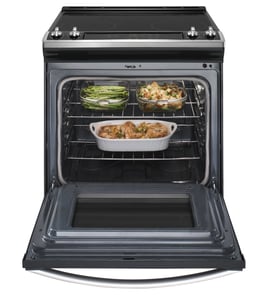



How do I find the year of my KitchenAid serial number?
On your KitchenAid electric range model KFEG500ESS1, the model and serial tag is located on the oven frame behind the top right side of the oven door. Once you have the serial number, use KitchenAid’s serial-date coding (varies by format) to identify the manufacturing year and week; the KFEG500ESS1 owner's manual shows you exactly where to find the serial tag.
We recommend opening the oven door and checking the oven frame area:
- Look on the oven frame behind the top right side of the oven door
- Write down both the model number and serial number
- Take a clear photo of the tag for reference during parts lookup or service
- If the tag is hard to read, use a flashlight and wipe dust or grease gently
KitchenAid serial numbers are commonly encoded to include a manufacture date (year and week). The exact position of the year code depends on the serial format used for that production run.
Typical decoding approach:
- Identify the letter(s) and number(s) at the start of the serial number
- Look for a year code (often a letter or digit) and a week code (often two digits)
- Match the year code to the correct year chart for KitchenAid ranges
- Confirm the result by checking whether the week number (01 to 52) makes sense
| Item | What it tells you | Where to find it |
|---|---|---|
| Model number | Exact configuration for parts and wiring | Oven frame tag (top right area) |
| Serial number | Manufacturing date code (year/week) | Oven frame tag (top right area) |
Knowing the manufacturing year helps us narrow down the correct version of parts and documentation for your KFEG500ESS1, especially for components that can change over time (for example, an electronic control, wire harness, or surface element switch). If you are ordering parts, you can also search by model on this page or on Sears PartsDirect.
Last updated: February 2026
What is the lifespan of a KitchenAid oven?
A KitchenAid electric range oven like model KFEG500ESS1 typically lasts 10 to 15 years with normal household use and basic care. Lifespan is driven most by heating-element wear, door seal condition, and control-board heat exposure; good cleaning habits and correct installation help it reach the upper end.
- How often you cook and at what temperatures (daily high-heat use shortens life)
- Self-clean frequency (high heat stresses wiring, sensors, and electronic controls)
- Power quality and connections (loose terminal block connections can overheat)
- Cooktop and oven ventilation (heat buildup is hard on the control area)
- Routine cleaning and spill control (reduces corrosion and component damage)
- Use self-clean only when truly needed; use gentler cleaning methods for routine messes.
- Keep the oven cavity and door edges clean so the door closes tightly.
- If baking gets uneven or preheat becomes slow, check the bake system early; a weak element can overwork other components.
- Replace small wear items promptly (for example, a burned-out oven light) to avoid cooking “blind” and overheating food.
- Follow leveling and anti-tip requirements in the installation guide.
| Symptom | What it often points to | Example part for this model |
|---|---|---|
| Oven will not heat or heats poorly | Failed bake element | Bake element W10779716 |
| Surface element not heating | Radiant element or control switch | Range radiant surface element W11171119 |
| Dead display or erratic controls | Electronic control issue | (See parts list for the correct control option) |
| Burning smell at back, intermittent power | Loose/damaged power connection | Range terminal block WPW10245259 |
Knowing the typical 10 to 15 year lifespan helps us decide whether a repair (like a bake element or terminal block) is a smart investment versus planning for replacement, especially when electronic controls start acting up.
For model-specific operating and care guidance, use the owner's manual. For replacement parts beyond the examples above, we recommend searching by model number on Sears PartsDirect.
Last updated: February 2026
What model KitchenAid do I have?
For a KitchenAid electric range like model KFEG500ESS1, the model and serial number label is on the oven frame behind the top right side of the oven door. Open the oven door and look along the frame; that tag is the official ID you should use for parts, manuals, and troubleshooting. See the KFEG500ESS1 owner's manual.
Check these spots in order:
- Open the oven door and inspect the oven frame on the top right side
- Look for a printed label that lists Model Number and Serial Number
- Wipe the area with a dry cloth if the label is dusty or greasy
- Write the model number exactly as shown (letters and numbers)
Using the exact model number helps us match the correct KitchenAid parts and diagrams.
Common next steps:
- Use the model number to choose the correct replacement part (for example, a bake element W10779716)
- Confirm your control features and settings in the installation guide
- Use the model number and any displayed fault code with KitchenAid slide-in electric range error codes
| Item on the label | What it’s used for | Example for this page |
|---|---|---|
| Model number | Identifies the exact range design and parts | KFEG500ESS1 |
| Serial number | Identifies the production unit and date info | Varies by unit |
KitchenAid ranges can look similar across series, but parts like a bake element, radiant surface element, or electronic control must match the exact model. Using the oven-frame label prevents ordering the wrong part and speeds up troubleshooting.
Last updated: February 2026
How do I tell what size my KitchenAid mixer is?
This page is for the KitchenAid KFEG500ESS1 electric range, not a stand mixer. If you meant “size” of your KFEG500ESS1 range, use the model/serial rating plate location and the installation dimensions listed in the installation guide; you can also use the model number to look up parts on Sears PartsDirect.
Use the installation dimensions (and the rating plate location) to confirm fit in your cabinet opening.
- Find the model/serial rating plate on the oven frame behind the top right side of the oven door (or on the frame behind a top corner of the door or either side of the drawer).
- Compare your space to the listed width, height, and depth.
- Confirm electrical requirements before moving the range.
- Level the range after positioning; do not use the cooktop as the leveling reference.
| Measurement | Typical listing for this model | What to measure at home |
|---|---|---|
| Width | About 29 7/8 in. | Cabinet opening side-to-side |
| Overall height (max.) | About 46 7/8 in. | Floor to top (with leveling legs) |
| Max depth with handle | About 27 3/4 in. | Wall to front of handle |
KitchenAid stand mixer “size” usually means bowl capacity (quarts). We identify it by the mixer model number on the ID label, then match that model to the correct bowl and beater style.
- Check the ID label on the underside of the base or rear housing.
- Record the full model number (often starts with KSM).
- Check the bowl for a stamped capacity (for example, 4.5 QT, 5 QT, 6 QT).
- Note whether it is tilt-head or bowl-lift.
For ranges, correct dimensions prevent install and clearance problems. For mixers, matching by model number prevents buying a bowl or beater that will not fit.
Last updated: February 2026