Installation guide
 Owner’s manual
 Error Codes


What are the most common problems with Kenmore refrigerators?
The most common issues we see on Kenmore refrigerators like model 10656786603 are cooling problems, ice maker and water dispenser troubles, moisture or frost buildup, leaks, and unusual noises. Many of these come down to airflow, temperature control settings, door sealing, or water supply problems; the owner's manual troubleshooting section walks through the quickest checks.
Most common symptoms and what usually causes them
- Not cooling or warm temperatures: doors opened often, large food load, controls not set correctly, blocked vents, or airflow problems.
- Freezer too warm or not enough ice: heavy ice usage, door openings, or temperature settings needing adjustment.
- Ice maker not making ice: water supply shutoff not fully open, kinked water line, ice maker switched off, or new install needing time.
- Moisture inside the refrigerator: humid room conditions or doors left open.
- Noisy operation: normal sounds from the compressor, fans, refrigerant flow, or the defrost cycle.
Quick checks we recommend first (in order)
- Confirm power and controls: make sure the unit is plugged into a grounded 3-prong outlet and the controls are turned on.
- Give it time after setup: allow 24 hours after installation for full cooling (and up to 72 hours for full ice production).
- Adjust temperatures correctly: change the refrigerator or freezer control one setting at a time, then recheck in 24 hours.
- Reduce warm air intrusion: minimize door openings and make sure doors close fully.
- Check the water supply line: verify the shutoff valve is fully open and the line is not kinked.
Common problem-to-fix guide
| Problem you notice | What to check first | Likely next step |
|---|---|---|
| Refrigerator too warm | Door openings, food load, control setting | Adjust control one setting colder; recheck in 24 hours |
| Ice maker not producing | Water shutoff open, line kinked, ice maker ON | Restore water flow; allow 24 to 72 hours |
| Water dispenser slow or no water | Filter condition, water supply | Replace the refrigerator water filter EDR3RXD1 or diagnose supply/valve |
| Buzzing or gurgling sounds | Water valve fill, defrost cycle | Normal operation unless performance is affected |
Why it matters
Catching the simple causes first (settings, door sealing, water supply, and post-install cool-down time) prevents unnecessary part replacement and helps protect food temperatures and ice production.
Last updated: February 2026
What is the ER if error on a Kenmore 10656786603 Elite refrigerator?
The ER IF error on a Kenmore 10656786603 side-by-side refrigerator points to an ice fan (freezer ice compartment fan) airflow problem. That fan pushes cold air through the freezer and into the ice maker area; when airflow is blocked or the fan is failing, the refrigerator can’t keep the ice area cold enough.
What to check first (quick fixes)
- Power reset: unplug the refrigerator (or turn off the breaker) for 5 minutes, then restore power.
- Make sure the freezer door closes fully and seals tightly.
- Look for ice buildup on the freezer back wall or around the ice room air duct (a common sign of a defrost or airflow issue).
- Clear any packages blocking freezer vents and air channels.
- If the ice bin is jammed or clumped, dump the ice and reinstall the bin.
Likely causes and what they mean
| What’s happening | What it usually indicates | What to do next |
|---|---|---|
| Fan noise is loud, intermittent, or stops | Ice fan motor or blade issue | Inspect for obstructions; plan for fan service if it won’t run consistently |
| Frost/ice on freezer back panel | Defrost system problem restricting airflow | Check defrost symptoms and airflow; follow troubleshooting steps in the manual |
| Weak or no airflow to ice area | Blocked duct or failing fan | Remove blockage; verify fan operation |
| Ice maker slows, ice melts or clumps | Ice compartment not staying cold | Address airflow first; then recheck ice production |
Parts that commonly relate to ice and airflow symptoms
If troubleshooting points to a fan or ice system issue, these model-matched parts are commonly involved:
- Refrigerator evaporator fan motor WP2315549 (moves cold air through the freezer)
- Refrigerator evaporator fan blade WP2169142 (damaged blades can reduce airflow and cause noise)
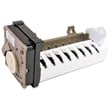
- Refrigerator ice maker WPW10190965 (if the fan issue is resolved but ice production is still poor)
Why it matters
On model 10656786603, the ice system depends on steady freezer airflow. When the ice fan can’t move enough cold air, you can see ER IF, reduced ice production, clumping, or melting in the bin, even if the freezer temperature seems close to normal.
Helpful references for this model family
- Use the troubleshooting section in the owner's manual to match symptoms (ice, airflow, temperature) to the next best check.
- If your display is showing other codes along with ER IF, use Kenmore 106 model refrigerator error codes to interpret them.
Last updated: February 2026
What is the cubic foot of my Kenmore refrigerator model 10656786603?
The exact cubic foot capacity for Kenmore side-by-side refrigerator model 10656786603 is listed on the model’s rating label and in the specifications section of the owner's manual. For most Kenmore 106-series side-by-sides, total capacity commonly falls in the 22 to 26 cu. ft. range.
Where to find the exact capacity on your refrigerator
Check these spots first (they are the fastest way to get the exact number for your unit):
- Inside the fresh food compartment on a side wall
- On the ceiling of the fresh food compartment near the light housing
- Behind the crisper drawers on the cabinet wall
- On the hinge-side door frame area (fresh food side)
Look for wording like “Total capacity”, “cu. ft.”, or a data plate with multiple specs.
What “cubic feet” means (and why it matters)
Cubic feet is the total interior storage volume of the refrigerator and freezer combined. It matters because it helps you:
- Compare storage space between models
- Choose the right replacement refrigerator size for your kitchen
- Estimate how much food the compartments can realistically hold
- Match accessories and organization bins to the available space
Typical capacity range for this style
If you need a quick planning number while you locate the label, use this guide:
| Refrigerator type | Typical total capacity |
|---|---|
| Side-by-side (standard depth) | 22 to 26 cu. ft. |
| Side-by-side (counter depth) | 20 to 23 cu. ft. |
Related tip: don’t confuse capacity with installation space
Capacity is not the same as the space the refrigerator needs to fit. For installation clearance guidance (ventilation and door swing space), use the installation guide.
Last updated: February 2026
Where is the model number on a Kenmore side by side refrigerator?
On a Kenmore side-by-side refrigerator like model 10656786603, the model number is printed on the appliance identification label (the same label that lists the serial number). We use that model number to match the correct parts, diagrams, and troubleshooting info.
Most common places to check
Look for a paper or foil label in one of these spots:
- Inside the fresh food (refrigerator) compartment on a side wall
- Along the ceiling of the fresh food compartment near the light housing
- On the frame around the door opening (door jamb area)
- Behind the crisper drawers (check the liner walls just above them)
- On the back exterior panel (less common, but possible)
What the label looks like
The label typically includes both a model number and a serial number.
| Item on label | What it’s used for | Example format |
|---|---|---|
| Model number | Identifies the exact refrigerator design for parts fit | 10656786603 |
| Serial number | Identifies production details (date/plant) | Letters plus numbers |
Why it matters
Kenmore model numbers can look similar across different side-by-side refrigerators, but parts like the water filter, ice maker, and water inlet valve must match the exact model. Using 10656786603 helps ensure you get the right replacement the first time.
Quick tip while you’re looking
If you’re already inside the refrigerator, avoid moving shelves quickly; tempered glass can break if it’s bumped or exposed to sudden temperature changes. For handling and safety notes, follow the guidance in the owner's manual.
Last updated: February 2026