Owner’s manual
 View engine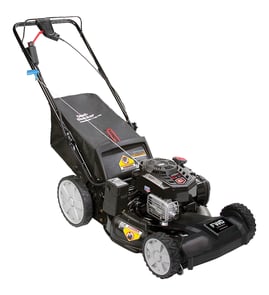

Should I use 87 or 91 gas for lawn mower?
For the Craftsman rotary lawn mower model 917387402, we recommend using fresh 87-octane (regular) unleaded gasoline for normal mowing. Higher octane (like 91) does not add power or improve reliability in this mower; fuel freshness and proper maintenance matter more. See the 917387402 owner's manual for fueling and safety steps.
What to use (and what to avoid)
- Use 87 octane unleaded gasoline from a busy station (fresher fuel).
- Avoid stale gas (old fuel is a common no-start cause).
- Avoid fuel contaminated with water or dirt (also a common no-start cause).
- If you store fuel, use a stabilizer and keep the can clean and rust-free.
- Wipe up spills and let the engine cool before refueling.
Quick comparison: 87 vs 91 in a walk-behind mower
| Fuel choice | What you get | Best use case |
|---|---|---|
| 87 octane (regular) | Correct octane for typical small engines | Everyday mowing |
| 91 octane (premium) | Higher knock resistance, not more power | Only if required by the engine (uncommon) |
If your mower is hard to start after sitting
Stale fuel is one of the most common reasons a mower will not start. If the mower ran fine last season and now will not start:
- Drain old fuel and refill with fresh gas
- Check the air filter and spark plug condition
- Inspect the blade area for binding (a damaged blade adapter can contribute to starting issues)
- Follow safe service steps (stop engine, disconnect spark plug wire)
If you are servicing the blade during maintenance, use the correct hardware and tighten securely; the lawn mower mulching blade 532406713 is a common wear item on this model.
Why it matters
Using the right fuel helps prevent hard starting, rough running, and carburetor problems. In small engines, fresh, clean gasoline and routine tune-up items typically make a bigger difference than stepping up from 87 to 91 octane.
Last updated: January 2026
How much does it cost to repair a hydrostatic transmission on a lawn mower?
Hydrostatic transmission repairs are typically a riding-mower cost; the Craftsman 917387402 is a 22-inch walk-behind rotary lawn mower and does not use a hydrostatic transmission. If you’re pricing a hydrostatic repair for a different mower, typical costs range from a fluid/service-level repair to a full transmission replacement.
Typical hydrostatic repair cost ranges (riding mowers)
Hydrostatic systems are expensive because the pump and motor are a matched assembly and labor time is high.
- Basic service (fluid, filter, purge, linkage adjustment): often $150 to $500
- Moderate repair (leaks, hoses, fan, pulleys, belt issues): often $200 to $900
- Full hydrostatic transaxle replacement: commonly $800 to $2,500 installed (parts and labor)
What drives the price up or down
- Whether the unit is serviceable (fluid/filter) or sealed (replacement only)
- Labor time to remove the transaxle and set belt tension and linkages
- Related wear items (drive belt, idlers, pulleys, axle seals)
- Whether the failure is loss of drive vs. noise/overheating/leaking
- Availability of OEM parts for your exact model
Quick check: are you sure it’s hydrostatic?
Use this as a fast ID guide.
| If your mower has… | It usually is… | Typical repair direction |
|---|---|---|
| A hand lever for speed with no “gears” | Hydrostatic (riding mower) | Service or transaxle replacement |
| A shift lever with fixed gears | Gear drive | Cheaper internal repair or swap |
| A walk-behind self-propel lever | Belt drive (walk-behind) | Belt/cable/pulley troubleshooting |
Why it matters
Pricing the wrong drive type leads to overbuying parts. On the Craftsman 917387402 walk-behind mower, most “won’t move” complaints are usually belt, cable, or wheel-drive issues, not a hydrostatic transmission.
For model-specific drive and maintenance details, use the 917387402 owner’s manual.
Last updated: January 2026
Is it okay to pull a self-propelled mower backwards?
Yes, it’s okay to pull a Craftsman rotary lawn mower model 917387402 backward for repositioning; the drive wheels typically freewheel when you roll the mower back. For safety, we recommend releasing the drive control and keeping the blade control engaged only when you’re ready to mow, per the 917387402 owner’s manual.
Safe way to back up a self-propelled mower
- Release the self-propel/drive lever (so the transmission is not trying to push).
- Keep both hands on the handle and walk, don’t run.
- Back up only far enough to reposition; then resume mowing forward.
- Never pull the mower toward you while the blade is engaged.
- Stop the engine before leaving the mower or crossing gravel, walks, or driveways.
What to avoid (to prevent damage and injury)
The biggest risk is not the drive system; it’s blade contact and loss of footing. The manual warns against cutting by pulling the mower toward you and stresses stopping the engine before inspecting or servicing.
Quick guidance table
| Situation | What we recommend | Why |
|---|---|---|
| Backing up to turn around | Roll backward with drive released | Prevents drive strain and sudden lurching |
| Clearing a clog or checking the blade area | Stop engine, disconnect spark plug wire | Prevents accidental starting |
| Mowing near slopes | Mow across the slope, not up and down | Reduces slip risk |
If it feels hard to pull backward
A mower that is difficult to roll can point to drag at the deck or blade area, or a drive system that is not fully disengaging.
- Check for grass buildup under the deck.
- Verify the drive lever fully returns to the “off” position.
- Inspect the blade area for damage after hitting an object.
- If you see blade-related hardware looseness, inspect the blade mounting stack (blade, adapter, washers, bolt).
If you’re servicing the blade mount on this model, use the correct hardware such as the washer blade 532401630 and tighten fasteners securely.
Why it matters
Backing up is normal during trimming and turning, but safe technique prevents the most common mower injuries and helps avoid vibration, poor cut, and premature wear in the blade adapter and drive components.
Last updated: January 2026
What model number is the Craftsman 917387402?
The model number for this Craftsman walk-behind rotary lawn mower is 917.387402 (often written without the dot as 917387402). You’ll find the model and serial number on a decal attached to the rear of the mower housing; confirm it there before ordering parts.
Where to find the model number on the mower
Check these common locations on Craftsman walk-behind mowers:
- Rear of the mower deck or housing (decal on the back of the unit)
- Near the height-adjuster area on the deck
- On the handle support area (less common)
- In the documentation for the mower
For diagrams and the exact identification notes for this unit, use the 917387402 owner's manual.
Why the dot matters (917.387402 vs 917387402)
Both formats refer to the same mower model; the dot is a formatting style used on many Craftsman labels and manuals.
| You might see it as | What it means | When to use it |
|---|---|---|
| 917.387402 | Same model number | Reading the mower decal or manual |
| 917387402 | Same model number | Searching parts listings and online forms |
Tips to avoid ordering the wrong part
When you’re matching parts like a blade, blade adapter, or control cable, the model number alone is not always enough; the serial number can matter for production changes.
- Write down the full model number and serial number from the decal
- Match the part name and diagram position in the manual
- Replace blade hardware if it’s worn or damaged
- Use the correct torque when reinstalling the blade (the manual lists blade bolt torque)
If you’re servicing the cutting system, common related parts for this model include the lawn mower mulching blade 532406713 and the lawn mower blade adapter 581547901.
Why it matters
Using the correct model number ensures you get parts that fit your Craftsman 917387402 mower correctly, especially for deck components, handle hardware, and engine control parts.
Last updated: January 2026