



How much oil does a Craftsman snowblower hold?
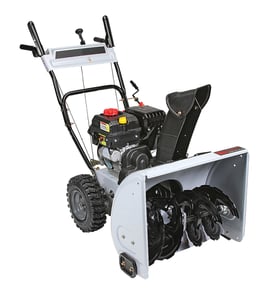
Most Craftsman snow throwers like model C950-52735-0 hold about 20 to 37 fl oz of engine oil, depending on the engine size. The correct fill level is the amount that brings the oil to the FULL mark on the dipstick without overfilling.
How to fill to the correct level
- Park the snowblower on a level surface and let the engine cool.
- Remove the dipstick, wipe it clean, then reinsert it fully.
- Add oil in small amounts (a few ounces at a time).
- Recheck the dipstick after each top-off.
- Stop when the oil reaches the FULL mark.
Oil type and cold-weather tips
For most 4-cycle snowblower engines, 5W-30 is the go-to viscosity for winter operation because it flows well in low temperatures.
| Condition | Typical choice | Why it matters |
|---|---|---|
| Normal winter use | 5W-30 | Easier starting and faster lubrication in cold weather |
| Very cold starts | Synthetic 5W-30 | Better cold-flow and protection at low temps |
Why it matters
Oil capacity is not just a number; it protects the crankshaft, piston, and bearings. Too little oil accelerates wear, and too much oil can cause smoking, fouled spark plug symptoms, and messy blow-by.
Related maintenance that helps prevent oil issues
If your snowblower is hard to start or runs rough after an oil change, basic tune-up checks often solve it:
- Verify the oil level is exactly at FULL (not above).
- Check the spark plug condition and gap.
- Inspect the air intake and filter condition.
- Confirm fresh fuel and proper choke operation.
If you are doing seasonal service, our video guide on how to change snowblower oil video walks through the process step-by-step.
Last updated: February 2026
How to find Craftsman snowblower model?
The Craftsman snow thrower model number is printed on the model tag (rating label) attached to the machine. On Craftsman model C950-52735-0, the tag is typically on the rear of the frame between the wheels or on the side of the frame near the auger housing.
Where to look on the snowblower
Check these common model-tag locations first:
- Rear of the snowblower frame between the wheels
- Side of the frame near the auger housing
- Near the engine mounting area on the frame rail
- On the handle support or lower handle frame (less common)
What the model number looks like (and why it matters)
For parts lookup, the model number is usually a mix of letters, numbers, and dashes. For this unit, it appears as C950-52735-0. Using the exact model number helps us match the correct parts diagrams and avoid ordering the wrong items.
| What to capture | Example for this model | Why we need it |
|---|---|---|
| Model number | C950-52735-0 | Identifies the exact snowblower version |
| Product type | Snow thrower | Narrows parts categories |
| Brand | Craftsman | Helps match compatible assemblies |
Tips if the label is dirty or hard to read
- Brush off packed snow and wipe the tag with a dry rag first
- Use a flashlight at an angle to make stamped or faded text easier to see
- Take a close-up photo and zoom in to confirm characters like 5/S or 0/O
- Write the number down exactly, including dashes
If you are trying to match parts after you find the model number
Once you have the model number, use it to select the correct parts list for your machine. For routine tune-ups, one commonly replaced item is the air filter; you can match it by model using the parts list, including the filter 394358S.
Why it matters
Snowblowers often have multiple versions that look similar but use different belts, friction wheels, carburetor parts, or controls. The correct model number keeps repairs accurate and prevents repeat teardown.
Last updated: February 2026
How to start a gas craftsman snowblower?
To start your Craftsman gas snowblower model C950-52735-0, we use the choke and primer to enrich fuel for a cold start, then start the engine (electric or recoil) and gradually open the choke as it warms up. This prevents flooding and stalling.
Before you start (quick safety and setup)
- Move the snowblower outdoors to a well-ventilated area.
- Make sure the auger and drive controls are disengaged.
- Check fuel level and use fresh gasoline (old fuel causes hard starting).
- Verify the spark plug wire is firmly connected.
- If your unit has an electric start, use a properly rated outdoor extension cord.
Cold start steps (most common)
- Set the choke to FULL/ON.
- Set throttle to FAST (if equipped).
- Prime the engine (if equipped): press the primer bulb 1 to 3 times.
- Start the engine:
- Electric start: plug in, press the start button.
- Recoil start: pull the starter handle with a smooth, firm pull.
- As the engine runs, move the choke toward OFF in small steps over 30 to 60 seconds.
Warm start steps (engine recently ran)
- Choke OFF or half choke.
- Prime 0 to 1 time.
- Start using electric or recoil.
If it will not start (fast checks)
- Flooded engine (gas smell, wet plug): choke OFF, throttle FAST, prime 0 times; pull several times.
- No fuel getting through: check for clogged fuel cap vent or stale fuel.
- Restricted air flow: inspect and replace the air filter if dirty; use the filter 394358S.
Primer and choke: what to use when
| Condition | Choke setting | Primer presses |
|---|---|---|
| Cold engine | Full/ON | 1 to 3 |
| Cool engine | Half | 1 to 2 |
| Warm engine | Off | 0 to 1 |
Why it matters
Correct choke and priming settings give the engine the right fuel-air mix. Too much priming or too much choke after it starts commonly causes flooding, rough running, and plug fouling.
Last updated: February 2026