Installation guide
 Owner’s manual
 Error Codes



How to identify a Kenmore washer model?
Your Kenmore washer model number is printed on the appliance’s model and serial tag; for Kenmore models like 11026112310, it’s commonly under the lid on top-load washers, inside the door opening on front-load washers, or on the back panel near the power cord. Use that exact number to match parts and instructions in the owner's manual.
Where to look on a Kenmore washer
Check these common locations first (use a flashlight if needed):
- Top-load washer: under the lid, around the tub opening or on the underside of the lid
- Front-load washer: inside the door opening, along the door frame
- Any style: back panel near the power cord, or near the control console
- Sometimes: behind the control panel cover (after power is disconnected)
What the model number looks like (and why it matters)
Kenmore model numbers are often 10 to 12 characters and may start with 110 (as in 11026112310). The full model number is what we use to pull the correct parts list, diagrams, and repair information.
Model number vs. serial number
| Item | What it tells you | Used for |
|---|---|---|
| Model number | The exact washer design and parts fit | Ordering parts, manuals, diagrams |
| Serial number | Production details (date/sequence) | Service history, manufacturing info |
Tips to avoid ordering the wrong part
Before ordering a replacement part for your Kenmore washer, we recommend:
- Write the model number exactly as shown (include all digits)
- Take a clear photo of the model tag for reference
- Match the part to the model-specific parts list (not just by appearance)
- Use the manual to confirm access steps and safety notes before disassembly
Why it matters
Kenmore washers can look similar across multiple series, but internal components (like the drive system, lid lock, or water inlet valve) vary by model. Using the correct model number helps ensure the right fit and prevents repeat repairs.
Last updated: February 2026
Is it worth repairing a Kenmore washing machine?
Yes, repairing a Kenmore washer is worth it when the problem is a common wear item or a single failed part, especially on a solid platform like Kenmore model 11026112310. If the repair involves multiple major drive or tub components, replacement usually makes more financial sense.
Quick decision checklist
- Repair is usually worth it if the washer:
- Still fills, drains, and spins but is noisy, slipping, or off-balance
- Has a clear single-part failure (belt, actuator, lid lock, splutch)
- Has no tub leaks and no burning smell
- Has a repair cost that stays under about half the price of a comparable new washer
- Replacement is usually the better choice if the washer:
- Has repeated breakdowns in a short period
- Has a leaking outer tub or severe basket damage
- Needs several high-cost parts at once (gear case plus control plus basket)
Common repairs that are often cost-effective on model 11026112310
These are frequent “fix-it” parts for drive, shifting, and safety interlock issues:
- Washer drive belt WPW10006384 for slipping, squealing, or weak spin
- Washer actuator WPW10006355 for shifting problems (won’t agitate or won’t spin)
- Washer lid lock assembly W10404050 for lid won’t lock, won’t start, or stops mid-cycle
- Washer drive pulley and splutch assembly W10721967 for grinding, poor agitation, or spin issues
When a repair starts to look expensive
Major assemblies can push the total cost up quickly.
| Repair type | Typical symptom | Cost impact | Usual recommendation |
|---|---|---|---|
| Drive system wear part | Slips, squeals, intermittent spin | Lower | Repair |
| Control or UI issue | Dead panel, erratic cycles | Medium to high | Compare costs |
| Gear case or tub issue | Loud roaring, oil leak, severe vibration | High | Often replace |
Why it matters
A targeted repair can restore performance and extend the washer’s life for years, but stacking multiple major repairs often costs more than the value you get back. We use the same approach technicians use: confirm the failure, price the parts, then decide based on total cost and overall condition.
Helpful documentation
For safety steps and service cautions (including guidance to only service what you understand and have the skills to carry out), use the owner's manual.
Last updated: February 2026
What is the average lifespan of a Kenmore washer?
A Kenmore washer typically lasts 10 to 15 years under normal household use. For Kenmore model 11026112310, regular maintenance (especially using HE detergent correctly and keeping the washer clean) is what most directly helps you reach the high end of that range.
Typical lifespan and what changes it
Most washers land in the same general window, but these factors move the needle the most:
- Load size and balance: frequent overloading and chronic out-of-balance loads shorten life.
- Detergent habits: always use HE detergent and avoid over-dosing to reduce residue and odor buildup.
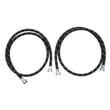
- Water supply care: replace inlet hoses about every 5 years and inspect for bulges, cracks, kinks, and leaks.
- Drain and spin health: slow draining and weak spinning increase strain on the drive system.
- Leveling and installation: a washer that is not level vibrates more and wears suspension and drive parts faster.
Maintenance checklist we recommend for 11026112310
Use these as your baseline habits; they prevent the most common wear-related failures:
- Keep the lid closed when not in use and follow the cleaning guidance in the owner's manual.
- Use warm or hot water occasionally (when fabric allows) to help reduce buildup.
- Inspect fill hoses regularly; replace them at the 5-year mark.
- Make sure the washer is level and stable; re-level if it starts walking or banging.
- Address new noises early (squeal, grinding, thumping) before they damage other components.
Common wear items vs. major repairs
Here is a practical way to think about “normal aging” versus “big-ticket” repairs:
| Category | Examples on this model | What it usually means |
|---|---|---|
| Normal wear items | Belt, lid lock, actuator | Often repairable and worth fixing |
| Drive system wear | Splutch/pulley, drive block | Can cause poor spin or agitation |
| Major mechanical | Gear case, outer tub | Higher cost; compare repair vs. replacement |
If you are chasing spin or agitation problems, the washer drive belt WPW10006384 and washer drive pulley and splutch assembly W10721967 are two common wear points on this style of Kenmore top-load washer.
Why it matters
Knowing the typical 10 to 15-year lifespan helps you decide whether to invest in maintenance now (hoses, cleaning, leveling) or plan for a larger repair later, especially if symptoms show up after a decade of use.
Last updated: February 2026