Owner’s manual
 Error Codes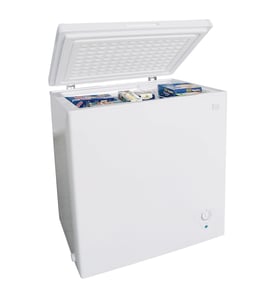


How many cubic feet is a Kenmore freezer model 25316542101?
The exact cubic-foot capacity for Kenmore chest freezer model 25316542101 is listed on the unit’s rating/serial plate and in the product literature for that specific model. We use the model’s 25316542101 owner's manual to confirm operating details, but capacity is best verified from the model/serial information on the freezer itself.
Where to find the capacity (fastest ways)
- Check the rating/serial plate; on chest models it’s typically on the left exterior wall.
- Look for a line that includes “cu. ft.” or “capacity”.
- Compare the plate information to the model number 25316542101 to ensure it matches.
- If the label is worn, use the serial number to help confirm the exact configuration.
What “cubic feet” means for a chest freezer
Cubic feet is the freezer’s internal storage volume. It helps you plan food storage, choose baskets/dividers, and estimate energy use.
Typical chest freezer capacity ranges
| Chest freezer size class | Typical capacity (cu. ft.) | Common use |
|---|---|---|
| Compact | 5 to 9 | Apartment, overflow storage |
| Medium | 10 to 16 | Family weekly shopping |
| Large | 17 to 25 | Bulk buying, hunting, large households |
Why it matters
Knowing the cubic-foot capacity helps you avoid overfilling (which can restrict airflow and cooling performance) and makes it easier to compare replacement freezers or accessories like dividers.
Last updated: January 2026
What are the most common issues with 25316542101?
The most common issues we see with the Kenmore 25316542101 chest freezer are warm temperatures, excessive frost, and lid sealing problems. These usually trace back to airflow and loading habits, a failing temperature control, or a worn lid gasket; the owner's manual covers correct settings and care.
Common symptoms and what they usually mean
- Freezer not cold enough: thermostat setting, dirty condenser area, poor ventilation, or a sealed-system/compressor issue
- Runs constantly: lid not sealing, frequent openings, warm food load, or thermostat out of calibration
- Heavy frost buildup: lid gasket leak, lid not closing fully, humid room air entering
- Interior light issues (if equipped): door switch or bulb problem
- Hard to open lid: normal vacuum effect after closing; worsens if gasket is deformed
Quick checks we recommend first
- Confirm the control is set for normal freezing and allow 24 hours after any adjustment.
- Make sure the lid closes squarely; check for packages preventing full closure.
- Inspect the gasket for gaps, tears, or hardened sections; clean it with mild soap and water.
- Verify the freezer has breathing room around it and the room temperature is within normal indoor range.
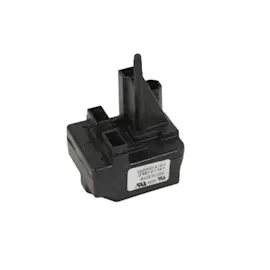
- If the unit clicks but will not start cooling, focus on the start components and compressor circuit.
Parts commonly involved on this model
| Symptom | Likely part area | Example part for 25316542101 |
|---|---|---|
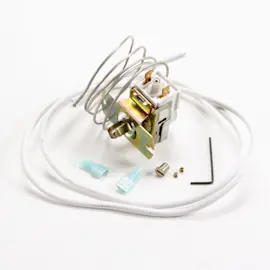
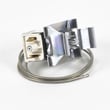
| Warm temps or erratic temps | Temperature control | Freezer temperature control thermostat 216714601 |
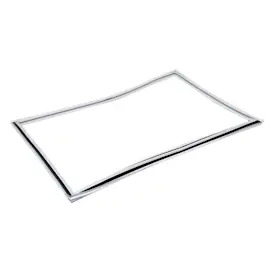
| Frost from air leaks | Lid seal | Freezer lid gasket 216481211 |
| Light stays off/on (if equipped) | Switch or bulb | Freezer door switch 216822900 or refrigerator light bulb 241552802 |
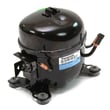
| No cooling, loud hum/click | Compressor system | Compressor 5304507765 |
Why it matters
Catching a lid seal leak or control problem early prevents food thawing, reduces frost buildup, and lowers run time. That protects the compressor and helps the freezer hold safe temperatures.
Last updated: March 2026
What can cause a chest freezer to stop working?
A Kenmore chest freezer model 25316542101 can stop working due to a power supply problem, the temperature control being set to OFF, a loose plug, or a tripped breaker. It can also stop cooling from airflow issues, a bad thermostat, or a sealed-system/compressor problem; use the 25316542101 owner's manual troubleshooting steps first.
Most common causes to check first
- Outlet has no power, or the freezer is on a GFCI circuit that tripped
- Plug is loose in the outlet
- House fuse is blown or the circuit breaker tripped
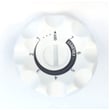
- Temperature control is set to OFF
- Power outage (the yellow “Power On” light should be on when power is present)
Cooling-system and control issues (when it has power but will not freeze)
If the freezer has power but temperatures are unsafe, the red temp alarm light can blink and the buzzer may sound until the freezer reaches a safe temperature again.
- Dirty condenser area restricting heat release
- Lid not sealing (warm air leaks in and the freezer struggles)
- Failed temperature control thermostat (common “no cooling” cause)
- Compressor start or compressor failure
Parts that commonly relate to “not running” or “not cooling”
| Symptom | What it often points to | Example model-matched part |
|---|---|---|
| No cycling or poor temperature control | Temperature control issue | Freezer temperature control thermostat 216714601 |
| Runs but won’t maintain temp | Lid seal leak | Freezer lid gasket 216481211 |
| Warm, no cooling, sealed-system symptoms | Compressor or sealed system | Compressor 5304507765 |
Quick diagnostic steps (safe, no tools)
- Confirm the outlet works by plugging in a lamp; reset the breaker if needed.
- Verify the control knob is not set to OFF; allow several hours after changes.
- Keep the lid closed; frequent opening quickly warms the cabinet.
- Check the lid gasket for gaps, dirt, or cracking; clean and recheck the seal.
Why it matters
A “stopped working” freezer can be a simple power/control setting issue, but it can also be an unsafe-temperature event. Using the alarm indicators and the troubleshooting chart helps you decide whether it is a quick fix or a repair involving the thermostat, gasket, or compressor.
Last updated: January 2026