Owner’s manual
 Error Codes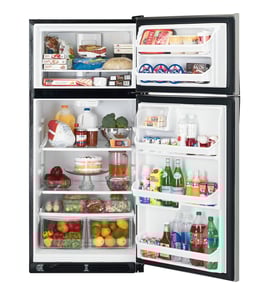




What are the disadvantages of a top mount fridge?
A top-mount (top freezer) refrigerator like the Kenmore 79569293902 typically makes fresh-food access less convenient because the refrigerator section sits lower, and it usually offers fewer premium organization and dispenser features than many bottom-freezer designs.
Common disadvantages to expect
- More bending for daily use: fresh foods are below waist level, so you reach down more often.
- Less “eye-level” organization: shelves and drawers can feel harder to see and sort compared with some bottom-freezer layouts.
- Fewer built-in features: many top-mount models skip exterior water and ice dispensers.
- Odors can travel between sections: because air circulates between freezer and refrigerator, smells can transfer if food is not wrapped well.
- Airflow can be easier to block: overpacking vents can interrupt cooling and cause temperature or moisture issues.
What helps reduce the downsides
We recommend these practical habits for top-mount refrigerators:
- Keep frequently used items on the upper refrigerator shelves to reduce bending.
- Leave space around interior vents; do not pack food tightly against vent openings.
- Wrap strong-smelling foods and clean spills quickly to limit odor transfer.
- Use bins or drawer organizers to group items and improve visibility.
- Confirm your control settings and allow time for temperatures to stabilize after changes.
Quick comparison: top mount vs. bottom freezer
| Feature | Top mount (top freezer) | Bottom freezer |
|---|---|---|
| Fresh-food access | Lower, more bending | Higher, easier access |
| Organization | Often simpler | Often more flexible |
| Dispenser options | Less common | More common on many models |
| Airflow sensitivity | Can be affected by blocked vents | Also affected, but layouts vary |
Why it matters
Top-mount refrigerators can cool very effectively, but day-to-day comfort depends on how often you access fresh food and how well you maintain airflow. Keeping vents clear and food wrapped helps your Kenmore 79569293902 maintain stable temperatures and reduce odor transfer.
For model-specific use and care details (controls, airflow guidance, storage features), use the owner's manual.
Last updated: February 2026
Where is the model number located on a Kenmore refrigerator?
On Kenmore refrigerator model 79569293902, the model and serial number are printed on an identification label located on the right-hand side of the refrigerator compartment (inside the fresh food section). Use that label whenever you order parts or look up service information.
How to find it quickly
- Open the fresh food (refrigerator) door, not the freezer door.
- Look along the right interior wall of the refrigerator compartment.
- Check near the front edge where the door gasket seals.
- Use a flashlight if the label is hard to see.
- Write down both the model number and serial number exactly as shown.
What the label helps you do
Having the correct model and serial number helps us match the right Kenmore parts and diagrams for your exact build.
| You need | Where to get it | Why it matters |
|---|---|---|
| Model number | ID label inside refrigerator compartment | Ensures correct part fit |
| Serial number | Same ID label | Helps match production version |
Why it matters
Kenmore model numbers can look similar across top-mount refrigerators, but internal components (like the electronic control board, door gasket, or temperature sensor) can vary by production run. Using the ID label prevents ordering the wrong replacement part.
For more details on recording and using the identification label information, see the owner's manual.
Last updated: February 2026
Can I run my Kenmore refrigerator without a water filter?
Yes. Your Kenmore refrigerator model 79569293902 can run without a water filter, but water quality can drop and sediment can clog the refrigerator’s water valve screen over time. If your home water has sand or particles, we recommend adding filtration in the water line.
What to expect with no filter installed
- Water and ice can taste or smell worse (chlorine and minerals are not reduced).
- Sediment can restrict water flow, which can affect the ice maker fill and dispenser flow.
- You may see more scale buildup in water-related components.
- Water pressure requirements can differ by setup (filtered vs unfiltered).
Water pressure guidelines (important)
The water line section in the owner's manual lists these typical requirements:
| Setup | Typical required water pressure |
|---|---|
| Without a water filter | 20 to 120 PSI |
| With a water filter | 40 to 120 PSI |
If you remove a filter and notice weak flow, confirm your shutoff valve is fully open and the supply line is not kinked.
When you should use a bypass or add inline filtration
Many refrigerators need a bypass plug or correct filter head configuration to prevent leaks and keep water flowing correctly when a cartridge is removed.
Use this checklist:
- If water leaks at the filter housing, install the correct bypass plug for the filter head design.
- If flow is slow and your water has sediment, add an inline filter near the refrigerator.
- If you have reverse osmosis, allow the storage tank to refill after heavy use.
- If the refrigerator will be in freezing temperatures, have a qualified technician drain the water supply system (on some models) to prevent water line damage.
Why it matters
Running unfiltered water can shorten the life of water system components by letting grit and mineral scale reach the inlet valve and ice maker. Keeping clean water flow helps prevent nuisance issues like slow dispensing and small or hollow ice.
Last updated: February 2026
What is the upper part of a fridge called?
On a Kenmore 79569293902 top-mount refrigerator, the upper compartment is the freezer. It is the section designed to keep foods frozen, and it also supplies cold air that helps cool the fresh food (refrigerator) section.
What you will typically find in the upper (freezer) section
Common freezer-area components on this style of refrigerator include:
- Freezer shelf (for organizing frozen foods)
- Freezer door racks (for smaller items)
- Ice bin (on some models)
- Ice maker (on some models)
- Freezer air vents (move cold air through the freezer and into the refrigerator section)
For the exact feature layout and names used for your model, check the owner's manual.
Why the freezer matters for overall cooling
In a top-mount design, the freezer is not just for frozen food; it is also the main source of cold air for the entire appliance. The manual explains that cool air enters through the bottom of the freezer section, circulates through freezer vents, and some of that air moves into the refrigerator section through a top vent.
Quick tip: keep vents clear
Blocked vents can cause temperature and moisture problems. Use these best practices:
- Keep food packages away from freezer vents
- Avoid overpacking the freezer so air can circulate
- Let the refrigerator run a few hours after setup before loading it with food
- Make temperature changes gradually and wait about 24 hours between adjustments
Freezer vs. refrigerator: what is the difference?
| Compartment | Main job | Typical temperature range |
|---|---|---|
| Freezer (upper) | Keeps food frozen; supplies cold air | About 0°F to 5°F |
| Refrigerator (lower) | Keeps fresh food cold (not frozen) | About 34°F to 40°F |
Why it matters
When the freezer is too warm, the refrigerator section often warms up too because airflow between compartments is reduced. Keeping the freezer organized and vents open helps your Kenmore refrigerator maintain stable temperatures.
Last updated: February 2026
What are the common problems with Kenmore 79569293902 refrigerators?
Common problems on the Kenmore 79569293902 top-mount refrigerator include warm temperatures (fresh food or freezer), excess run time, doors that do not seal or close fully, frost buildup, water puddles from a drain issue, and fan-related noise. Many of these start with airflow, temperature settings, or door sealing checks in the owner's manual.
Most common symptoms and what they usually point to
- Refrigerator or freezer too warm: controls set too warm, frequent door openings, blocked air vents, or a failing temperature sensor
- Ice not made fast enough: freezer too warm, heavy ice usage, blocked vents, or door openings
- Compressor runs a lot: warm room, lots of door openings, dirty condenser coils, or doors not closing completely
- Doors will not close completely: unit not level, bins or shelves out of position, packages blocking the door, or gasket issues
- Frost or ice crystals on frozen food: door not sealing or door opened often
- Water leaks or puddles: commonly a clogged or misrouted drain tube
Quick checks we recommend first (in order)
- Confirm temperature settings: adjust the refrigerator control first, then wait 24 hours before judging results; adjust the freezer next if needed.
- Check airflow: keep items from blocking vents and the airstream.
- Inspect door closing and sealing: push doors firmly shut; make sure bins, pans, and shelves are fully seated.
- Clean condenser coils: dirty coils reduce heat transfer and can make the compressor run longer.
- Look for drain issues: if you see water under the fridge or inside the fresh food section, inspect the drain path and consider replacing the refrigerator drain tube 5251JA3003D.
Common problems and the best “next step”
| Problem you notice | Best next step | Parts that often relate |
|---|---|---|
| Fresh food too warm | Raise refrigerator control 1 step; wait 24 hours | Refrigerator sensor 6500JB2001B |
| Freezer too warm or slow ice | Raise freezer control 1 step; wait 24 hours | Airflow related parts vary |
| Door not sealing | Clean gasket contact surfaces; verify alignment and leveling | Refrigerator door gasket ADX52752627 |
| Water puddles | Clear/inspect drain; verify tube routing | Refrigerator drain tube 5251JA3003D |
| Noisy operation | Identify if noise is from inside (evaporator area) or back (condenser area) | Refrigerator evaporator fan blade 5901JJ1003A |
Why it matters
Temperature swings and poor door sealing force longer run times, which can lead to frost, food spoilage, and higher energy use. Starting with settings, airflow, and door closure solves many “not cooling” complaints without replacing major components.
Last updated: February 2026