Owner’s manual
 Error Codes


What is the most common problem with GE refrigerators ice maker?
On the GE PWE23KSKJSS, the most common ice maker problem is “no ice” caused by water supply restriction (a clogged filter or kinked line) or freezer temperature that is too warm for ice production. Next most common are a frozen fill tube or a failing ice maker control.
Quick checks we recommend first
- Confirm the freezer is set cold enough for ice making (target 0°F; ice makers often struggle above about 10°F).
- Make sure the ice maker is turned on and the bin is seated correctly.
- Replace the water filter if flow is slow or the filter is overdue; use the correct filter for this model.
- Check the household shutoff valve is fully open and the supply line is not kinked.
- Look for a frozen fill tube (ice buildup where water enters the ice maker).
Most common causes and what you’ll notice
| Symptom | Most likely cause | What to do next |
|---|---|---|
| No ice at all | Restricted water flow (filter/line) | Replace filter; verify strong dispenser flow |
| Small or hollow cubes | Low water pressure or restricted filter | Replace filter; check supply valve and line |
| Ice maker jams or clumps | Freezer too warm or door not sealing | Lower temp; check door closure and gasket |
| No water to ice maker but dispenser works | Frozen fill tube or ice maker issue | Thaw fill tube; then monitor for refreeze |
Parts that commonly solve “no ice” on this model
If basic checks do not restore ice production, these model-matched parts are common next steps:
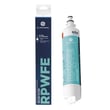
- GE refrigerator water filter RPWFE (restricted flow is the top cause)
- Refrigerator temperature sensor WR55X10025 (bad sensing can lead to warm temps or erratic cycling)
Why it matters
Ice makers depend on two things: cold enough freezer temperatures and steady water flow. Fixing those first prevents unnecessary part replacement and usually restores normal cube size and harvest timing.
For model-specific control settings and diagnostics, follow the PWE23KSKJSS manual.
Last updated: January 2026
What is the most common problem with GE profile refrigerators?
The most common GE Profile refrigerator complaint is not cooling properly (fresh food warm, freezer warming, or temperatures swinging). On the GE PWE23KSKJSS, the usual causes are airflow or defrost issues, a failing evaporator fan, or a temperature-sensing/control problem; we use the PWE23KSKJSS manual to confirm the correct checks and settings.
Most common symptoms and what they usually point to
- Fresh food warm, freezer OK: restricted airflow, iced evaporator cover, or a weak fresh food fan system
- Freezer warm, fresh food warm: condenser airflow problem, sealed system issue, or control problem
- Temps swing up and down: temperature sensor drift, door not sealing, or frequent door openings
- Frost buildup on back wall: defrost system problem (heater, thermostat, wiring)
- Noisy humming or rattling: evaporator fan motor/blade, condenser fan area, or vibration from the cabinet
Quick checks we recommend first (no parts needed)
- Verify temperature settings and allow 24 hours after changes.
- Make sure vents are not blocked by food packages.
- Clean dust from the condenser area and confirm the unit has proper clearance.
- Check door gaskets for gaps and confirm doors close fully.
- Look for frost behind the rear freezer panel (a strong clue of a defrost problem).
Common parts involved when “not cooling” is the issue
| Symptom | Likely system | Example part for PWE23KSKJSS |
|---|---|---|
| Frost buildup, airflow reduced | Defrost system | Refrigerator defrost heater WR51X10131 |
| Frost buildup continues | Defrost thermostat | Refrigerator defrost bi-metal thermostat WR50X10108 |
| Warm temps, weak airflow noise | Evaporator fan | Refrigerator evaporator fan motor and blade WR60X10352 |
| Temps inaccurate or erratic | Temperature sensing | Refrigerator temperature sensor WR55X10025 |
Why it matters
Cooling problems can quickly lead to food spoilage and can also force the compressor to run longer than normal. Catching airflow, defrost, or sensor issues early helps restore stable temperatures and reduces strain on major components.
Last updated: January 2026
How to remove bottom grille on GE refrigerator?
On the GE PWE23KSKJSS bottom-mount refrigerator, the bottom grille (toe-kick/base grille) is removed by releasing its fasteners, then pulling the grille away from the cabinet. Use the fastener locations and removal sequence shown in the PWE23KSKJSS owner's manual to match your exact grille style.
Safe, reliable removal steps
- Unplug the refrigerator or switch off the breaker.
- Open the fresh food doors for working room.
- Inspect the grille edges for visible fasteners; remove any you find with the correct screwdriver.
- If there are no fasteners, pull the grille straight outward with even pressure from both ends.
- If it resists, stop and recheck for additional fasteners before applying more force.
Common grille designs and what to do
| What you see on the grille | What it usually means | Best next step |
|---|---|---|
| Screws along the top or bottom edge | Screw-retained grille | Remove screws first, then pull outward |
| No screws, tight fit | Clip-retained grille | Pull straight out evenly from both ends |
| Tabs that hook into slots | Tab-and-slot grille | Lift or angle slightly as shown in the manual |
Reinstalling the bottom grille
- Align the tabs or clips with the matching slots along the base.
- Press evenly until it sits flush.
- Reinstall any screws and tighten until snug.
Why it matters
Removing the bottom grille the right way prevents broken tabs and helps you access the lower front area for routine cleaning and inspection.
Last updated: January 2026