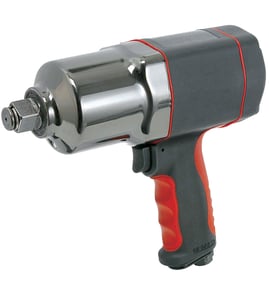

Will a 100 psi air compressor run an impact wrench?
Yes, a 100 PSI air compressor will run most air impact wrenches (including many Craftsman tools like model 875199870) because they’re typically rated around 90 PSI at the tool. The real limiter is air delivery (CFM) and tank size; low CFM causes weak impacts and constant compressor cycling.
PSI is the pressure; CFM is the volume of air the impact wrench needs to hit hard and keep hitting.
- Check the compressor’s SCFM at 90 PSI (or closest rating shown).
- Use a short, large-diameter air hose (commonly 3/8-inch) for better flow.
- Make sure you have a high-flow coupler/fitting if your setup supports it.
- Keep the tool oiled (air tool oil) so the motor and hammer mechanism do not drag.
- Drain the tank and use a filter/regulator to reduce water and pressure drop.
These are common requirements for many 1/2-inch air impact wrenches; your exact tool can vary.
| Use case | Typical air demand (SCFM @ 90 PSI) | What you’ll notice if undersized |
|---|---|---|
| Light duty (lug nuts, short bursts) | 4 to 6 | Works, but slows after a few hits |
| Medium duty (frequent use) | 6 to 8 | Impacts feel weak, compressor runs often |
| Heavy duty (continuous, stubborn fasteners) | 8 to 12+ | Tool stalls, long recovery time |
An impact wrench is a high-demand air tool. If your compressor cannot supply enough CFM at the working pressure, the wrench still spins, but it loses hammering force right when you need torque most.
- Set the regulator so the tool sees about 90 PSI while the trigger is pulled (dynamic pressure).
- If power drops after 2 to 5 seconds, you’re running out of airflow, not pressure.
- If you suspect an electrical supply issue on the compressor (slow recovery, tripping), use our guide: how to tell if a fuse is blown.
Last updated: February 2026
What size impact wrench do I need to remove lug nuts?
For most passenger cars and light trucks, we recommend a 1/2-inch drive impact wrench to remove lug nuts because it delivers the best mix of torque and control. Step up to 3/4-inch drive for heavy-duty trucks and large fasteners; always finish tightening with a torque wrench.
- 1/2-inch drive: cars, crossovers, light trucks, most lug nuts
- 3/8-inch drive: light-duty work (often underpowered for stuck lug nuts)
- 3/4-inch drive: heavy-duty trucks, rusted or oversized lugs, higher torque needs
- 1-inch drive: industrial and fleet equipment (typically overkill for passenger vehicles)
Choosing the right impact wrench is also about torque, sockets, and power source.
- Use black impact-rated sockets (not chrome hand-tool sockets)
- Confirm the lug nut socket size you need (common sizes include 17 mm, 19 mm, 21 mm, 22 mm)
- Pick a wrench with enough breakaway torque for your climate and corrosion level
- If you use cordless, keep a fully charged battery and consider a higher Ah pack
- If you use pneumatic, verify air pressure and CFM at the tool
| Vehicle type | Best drive size | Practical torque target (breakaway) | Notes |
|---|---|---|---|
| Passenger car | 1/2-inch | ~250 to 600 ft-lb | Covers most factory-torqued lugs |
| Light truck/SUV | 1/2-inch | ~400 to 800 ft-lb | Helpful for rust and overtightened lugs |
| Heavy-duty truck | 3/4-inch | ~800 to 1,200+ ft-lb | Larger sockets and higher torque demand |
Using an undersized impact wrench can leave lug nuts stuck and overheat the tool. Using an oversized wrench can increase the risk of damaged studs or over-torqued lug nuts, which is why we always recommend a torque wrench for final tightening.
If you are shopping for parts or confirming you have the correct tool model, use our guide: how to find your appliance model number (and what it means for parts).
Last updated: February 2026
Should I get a 1/2 or 3/4 impact wrench?
For most DIY and automotive work, we recommend a 1/2-inch drive impact wrench; it is the most versatile size for sockets, lug nuts, and general fastener removal. A 3/4-inch drive is best reserved for heavy-duty, high-torque jobs where larger sockets and hardware are common.
- 1/2-inch drive: general-purpose use, most common socket availability, great for wheels and suspension fasteners
- 3/4-inch drive: heavy equipment, large fasteners, higher torque demands, larger and heavier tool and sockets
- 3/8-inch drive (for reference): tight spaces and lighter-duty fasteners (lower torque range)
- Fastener size you work on most: larger hardware pushes you toward 3/4-inch
- Torque needs: 3/4-inch tools typically deliver more torque, but can be overkill for routine work
- Tool size and fatigue: 3/4-inch impacts are usually heavier and harder to maneuver
- Socket cost and availability: 1/2-inch sockets are typically easier to find and more affordable
- Air vs cordless: either can be 1/2 or 3/4; the drive size choice is still about the job, not the power source
| Feature | 1/2-inch drive | 3/4-inch drive |
|---|---|---|
| Best for | Most home and automotive tasks | Heavy-duty and industrial tasks |
| Typical feel | More compact and manageable | Larger, heavier, more powerful |
| Socket ecosystem | Widest selection | More specialized |
Matching drive size to the work helps prevent rounded fasteners, broken sockets, and unnecessary strain on the tool. For a Craftsman impact wrench like model 875199870, a 1/2-inch drive setup covers the broadest range of common repairs and maintenance.
For help confirming your exact model number before ordering accessories or replacement items, use how to find your appliance model number (and what it means for parts).
Last updated: February 2026
Is 800 Nm torque good for an impact wrench?
Yes; 800 Nm is a heavy-duty torque level for an impact wrench and it is strong enough for most automotive lug nuts and many stubborn, rusted fasteners. For Craftsman model 875199870, treat 800 Nm as a comparison point (not a confirmed spec for this model); use the tool’s rating label and finish tightening with a torque wrench.
800 Nm (about 590 ft-lb) is typically used when you need strong breakaway power.
- Removing lug nuts on most cars and many light trucks
- Breaking loose rusted suspension and brake fasteners
- Handling larger bolts where a mid-torque tool struggles
- Faster disassembly for frequent automotive work
- Trailer and hitch hardware removal (within socket and drive limits)
Use this as a practical way to choose a torque class.
| Torque class | Typical range (Nm) | Common use cases |
|---|---|---|
| Light duty | 100 to 300 | Small fasteners, light assembly |
| Medium duty | 300 to 600 | Most passenger-vehicle work |
| Heavy duty | 600 to 1,000+ | Stubborn fasteners, trucks/SUVs |
High torque is most helpful for removal; for installation, correct clamping force matters more than raw impact power.
- Use impact-rated sockets (not chrome hand sockets)
- Start fasteners by hand to prevent cross-threading
- Use the lowest power setting that completes the job
- Stop short on tightening, then torque to spec with a torque wrench
- If power feels low, check battery condition (cordless) or air supply and hose size (pneumatic)
Torque numbers are often quoted for loosening (breakaway). Over-tightening can stretch studs, strip threads, and warp brake rotors; finishing with a torque wrench protects the fastener and the component.
For general tool and repair readiness, see: must have tools for appliance repair.
Last updated: February 2026