Owner’s manual




Are gas pressure washers 2 stroke or 4 stroke?
Most gas pressure washers, including many Craftsman units like model 580754900, use a 4-stroke engine, which runs on straight gasoline (no gas/oil mix). Some smaller or specialty units can be 2-stroke, so we recommend confirming the exact engine type in the 580754900 owner's manual.
Use these checks on your Craftsman pressure washer:
- Oil fill cap/dipstick present: that points to a 4-stroke engine.
- Separate engine oil drain/fill: also indicates 4-stroke.
- Fuel label says “mixed fuel” or shows a ratio (50:1, 40:1): that indicates 2-stroke.
- Oil added to the gas tank: only done on 2-stroke engines.
- Oil added to a separate crankcase: standard for 4-stroke engines.
| Feature | 2-stroke gas pressure washer | 4-stroke gas pressure washer |
|---|---|---|
| Fuel | Gas + oil mixture | Gasoline only |
| Engine oil | Mixed into fuel | Separate crankcase oil |
| Maintenance | Mix ratio accuracy is critical | Regular oil checks and oil changes |
| Common use | Lightweight/specialty | Most homeowner and many pro units |
Using the wrong fuel type is one of the fastest ways to create hard-starting, smoking, or no-start problems. On a 4-stroke engine, mixed fuel can foul the spark plug and cause heavy exhaust smoke; on a 2-stroke engine, straight gas can seize the engine.
If you are troubleshooting low pressure, surging, or leaks after confirming the correct fuel type, these model-related parts are commonly involved:
- Pressure washer chemical hose 705076 (soap pickup and chemical draw)
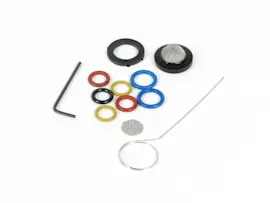
- Craftsman kit-o-ring 706619 (seals that prevent air and water leaks)
- Briggs & stratton quick-connector B3237GS (connection sealing and flow)
Last updated: February 2026
How many PSI is a Craftsman 190cc pressure washer?
For a Craftsman 190cc gas pressure washer, the PSI depends on the exact model and pump setup. For Craftsman model 580754900, confirm the advertised maximum PSI on the unit’s rating decal or in the specifications section of the 580754900 owner's manual.
Use the machine’s identification labels first; they are the most reliable for your exact unit.
- Check the rating decal on the frame, handle area, or pump side for “MAX PSI”
- Look for a pump label that lists pressure and flow (PSI and GPM)
- Match the model number on the decal to Craftsman 580754900
- Verify the spec in the 580754900 owner's manual (specifications or product data section)
- If the decal is missing or unreadable, use the model number to match the correct parts and documentation
“Max PSI” is a peak rating under ideal conditions. Actual cleaning pressure changes with nozzle size, water supply, and pump condition.
| What changes pressure at the wand | What you notice | What to do |
|---|---|---|
| Wrong spray tip (soap tip vs. high-pressure tip) | Low pressure | Switch to a high-pressure tip |
| Restricted water supply (kinked hose, clogged inlet screen) | Surging or weak spray | Restore full flow, clean screen |
| Air leaks at fittings or couplers | Pulsing | Reseat connections, replace seals |
| Worn O-rings | Drips at quick-connects | Replace O-rings |
These steps solve most “low PSI” complaints without guessing a PSI number.
- Fully open the spigot; use a short, unkinked garden hose
- Clean the nozzle and the inlet screen
- Inspect the quick-connect for a solid lock; replace if it will not seal (see briggs & stratton quick-connector B3237GS)
- Replace leaking seals (see Craftsman kit-o-ring 706619)
Knowing the correct PSI helps you choose the right spray tip and prevents pump damage from running with restricted water flow or leaking connections.
Last updated: February 2026
What PSI should my pressure washer be?
For typical home cleaning, we recommend choosing a pressure washer in the 1,300 to 2,800 PSI range; it handles most jobs like washing vehicles, cleaning patios, and rinsing siding. For your Craftsman 580754900 gas pressure washer, confirm the exact rated PSI in the 580754900 owner's manual.
- 1,300 to 1,900 PSI: cars, outdoor furniture, grills, small rugs
- 2,000 to 2,800 PSI: decks, fences, patios, most home concrete
- 2,900 to 3,500 PSI: heavy concrete, paint prep (higher risk of damage)
- 3,600+ PSI: commercial-grade cleaning (not typical for most homeowners)
PSI is the “force,” but GPM (gallons per minute) is the “rinse power.” Most homeowners get the best results with a balanced setup rather than chasing the highest PSI.
| Cleaning need | PSI target | What to prioritize |
|---|---|---|
| Avoid surface damage | 1,300 to 2,200 | Wider spray tip, more distance |
| General outdoor cleaning | 2,000 to 2,800 | Balanced PSI and steady flow |
| Stubborn grime on concrete | 2,800 to 3,500 | Higher PSI plus good detergent use |
Using too much PSI can etch concrete, shred wood fibers on decks, and force water behind siding. Using too little PSI wastes time and can lead to over-spraying one spot.
- Use the correct spray tip (wider fan for delicate surfaces)
- Start farther back, then move closer until cleaning improves
- Make sure the garden hose supply is fully on and not kinked
- Check for leaks at fittings; replace worn seals with a Craftsman kit-o-ring 706619 when connections drip
- If you use detergent, inspect the siphon line; a cracked pressure washer chemical hose 705076 can reduce soap draw and cleaning performance
Last updated: February 2026
What does 2.3 gpm mean on a pressure washer?
2.3 GPM on a pressure washer means the machine delivers 2.3 gallons of water per minute at the spray tip. On your Craftsman pressure washer model 580754900, GPM is your rinsing and cleaning speed; higher GPM typically cleans faster because it moves more water across the surface.
GPM is best thought of as flow. More flow helps lift and carry away dirt, soap, and debris.
- Higher GPM rinses faster and reduces time on large areas (driveways, siding)
- Lower GPM uses less water but can take longer to flush grime away
- GPM works together with PSI; both matter for cleaning performance
- Nozzle choice can change how the spray feels, but it does not “create” more GPM than the pump can supply
- Long hoses and restrictions can reduce effective flow at the gun
| Spec | What it measures | What you notice most |
|---|---|---|
| GPM | Water volume per minute | Speed of rinsing and how quickly dirt washes away |
| PSI | Water force/pressure | Ability to break loose stuck-on grime |
If you are comparing pressure washers, GPM is often the best predictor of how quickly you can finish a job. A 2.3 GPM unit is typically a solid choice for many homeowner tasks because it balances cleaning speed with water use.
For the exact published specs and operating guidance for the Craftsman 580754900, use the 580754900 owner's manual.
Last updated: February 2026
What kind of gas goes in a Craftsman 3000 PSI pressure washer?
For the Craftsman pressure washer model 580754900, use clean, fresh unleaded gasoline with a minimum 87 octane (87 AKI) rating. Avoid old fuel and do not mix oil into the gas unless your engine specifically calls for a fuel mix in the 580754900 owner's manual.
Using the right gasoline helps prevent hard starting, surging, and carburetor varnish.
- Use unleaded gasoline, 87 octane (AKI) or higher
- Use fresh fuel (most starting issues come from stale gas)
- Do not use gasoline mixed with oil unless the engine is a 2-cycle design
- Avoid fuel contaminated with water or dirt
- Do not overfill the tank; leave room for expansion
- Shut the engine off and let it cool.
- Move the pressure washer to a well-ventilated area.
- Wipe dirt away from the fuel cap area.
- Fill with fresh unleaded gas; tighten the cap fully.
| Symptom | Common fuel-related cause | What to do |
|---|---|---|
| Won’t start | Stale gas | Drain tank, refill with fresh 87+ octane |
| Starts then dies | Water in fuel | Replace fuel, check container and cap seal |
| Surges at idle | Varnish in carburetor | Use fresh fuel; service carburetor if needed |
| Low power | Old fuel or wrong octane | Refill with fresh unleaded 87+ |
Gas pressure washers like the Craftsman 580754900 rely on steady engine speed to maintain pump pressure. Fresh, correct-octane fuel reduces deposits and helps the engine run smoothly under load.
Last updated: February 2026