Installation guide
 Owner’s manual
 Error Codes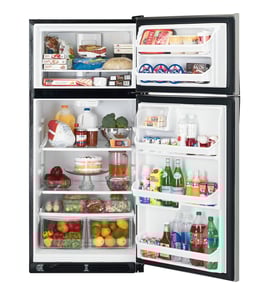


What are the disadvantages of a top mount fridge?
A top-mount refrigerator like the Frigidaire LFTR1814LW3 puts the freezer at eye level and the fresh-food section lower, so daily fridge access often means more bending. Top-mount designs also tend to have fewer built-in organization and dispenser features than many bottom-freezer models. See the LFTR1814LW3 owner’s manual for your model’s specific features and storage layout.
Common disadvantages (what most owners notice)
- Less convenient fresh-food access: you reach down more often for produce, drinks, and leftovers.
- Fewer premium features: many top-mount models skip in-door ice and water dispensers.
- Organization can be simpler: fewer adjustable bins, dividers, and specialty drawers on some models.
- Freezer can feel tighter: top freezers often have less usable space for bulky items.
- Door swing and clearance needs: you still need proper spacing for airflow and door opening.
What to check on the LFTR1814LW3 before deciding
Use these quick checks to see whether the typical drawbacks matter in your kitchen:
| What you care about | Top-mount impact | Practical workaround |
|---|---|---|
| Easy access to fresh food | More bending | Store daily items on upper shelves |
| Ice and water convenience | Often not included | Use ice trays or a countertop dispenser |
| Storage flexibility | Can be more basic | Add bins, organizers, and drawer dividers |
| Fit and airflow | Needs clearance | Follow installation clearances and leveling |
Why it matters
Top-mount refrigerators are often chosen for value and reliability, but comfort and convenience are the tradeoffs. If you open the refrigerator section far more than the freezer, the lower fresh-food placement is usually the biggest day-to-day downside.
Installation details that affect usability
Even with the right style, setup impacts performance and door sealing:
- Allow typical clearances (often 3/8 inch at sides/top and 1 inch at the back) for airflow.
- Level the cabinet so doors close and seal consistently.
- Recheck for water leaks after hookup if your unit uses a water supply.
Those setup steps are outlined in the LFTR1814LW3 installation guide.
Last updated: January 2026
Is a top mount fridge better than a bottom mount?
A top-mount refrigerator like the Frigidaire LFTR1814LW3 is “better” when you want a typically lower purchase cost, simpler layout, and easy access to the freezer; a bottom-mount is “better” when you want the fresh-food section at eye level for everyday use. Use your cooking habits to choose.
Quick comparison
| Feature | Top-mount (freezer on top) | Bottom-mount (freezer on bottom) |
|---|---|---|
| Most-used area | Freezer is easiest to reach | Fresh food is easiest to reach |
| Ergonomics | More bending for produce and crisper drawers | Less bending for fridge items |
| Typical value | Often lower cost and fewer features | Often more features and higher cost |
| Organization | Simple shelves and bins | Often wider fridge shelves, pull-out freezer |
How to decide for your kitchen
- Choose top-mount if you use frozen foods often, want a straightforward refrigerator, or prefer a simpler design.
- Choose bottom-mount if you cook with fresh ingredients daily and want milk, produce, and leftovers at eye level.
- If you have limited space, measure carefully; many top-mount models fit tighter openings.
- If you are sensitive to noise, both styles can be quiet; what matters more is fan and compressor condition.
- If you want fewer door-opening temperature swings in the freezer, top-mount can be a good fit because the freezer is a separate upper compartment.
What matters for performance (either style)
Good cooling and food life depend more on setup and airflow than freezer position. For the LFTR1814LW3, we recommend following the clearance and leveling guidance in the LFTR1814LW3 installation guide, including allowing about 3/8 inch at the sides and top and 1 inch at the back, and leveling the cabinet with a slight tilt back.
Setup checklist
- Level the refrigerator side-to-side and tilt it slightly back so doors close reliably.
- Confirm door seals contact the cabinet on all sides.
- Set temperature controls and wait about 24 hours before making more adjustments.
- Keep vents inside the refrigerator and freezer unblocked.
- Recheck water connections for leaks after 24 hours if an ice maker is connected.
Why it matters
The “better” choice is the one that matches what you reach for most. If you open the fresh-food section far more than the freezer, a bottom-mount reduces bending; if you use the freezer constantly, a top-mount keeps it at a comfortable height.
Last updated: January 2026
What is the most common problem with a Frigidaire refrigerator?
The most common issue we see on Frigidaire refrigerators like model LFTR1814LW3 is a cooling problem (warm fresh food section, weak freezer performance, or temperature swings). In many cases, the fix is basic: correct control settings, good airflow, clean condenser area, and doors sealing tightly per the LFTR1814LW3 installation guide.
Most common symptoms (and what they usually point to)
- Refrigerator is warm but freezer is cold: restricted airflow or an evaporator fan issue
- Freezer is warm and ice cream is soft: condenser airflow problem, dirty coils, or sealed-system concern
- Frost buildup on the back wall of the freezer: defrost system issue
- Food spoils quickly or temps swing: control settings changed too often or door not sealing
- Moisture, sweating, or heavy condensation: door gasket leak or frequent door openings
Quick checks we recommend first (LFTR1814LW3)
- Confirm control settings and wait time: after changing temperature controls, wait 24 hours before adjusting again.
- Check door sealing: the installation checklist calls out that door seals should close completely on all sides.
- Verify leveling: the refrigerator should be level side-to-side and tilted about 1/4 inch front-to-back for proper door closing.
- Listen for the evaporator fan: a failed fan can cause warm temps and uneven cooling.
- Look for frost patterns: heavy frost often points to a defrost heater or defrost thermostat problem.
Parts that commonly relate to cooling complaints
| Symptom | Common area to inspect | Example part for LFTR1814LW3 |
|---|---|---|
| Frosted freezer back wall | Defrost system | Refrigerator defrost heater 242044008 |
| Warm temps, weak airflow | Evaporator fan area | Refrigerator evaporator fan motor 241854301 |
| Warm temps, door not closing well | Door seal | Refrigerator gasket 242193213 |
Why it matters
Cooling problems usually get worse over time: longer run times, higher energy use, and faster food spoilage. Starting with door seal, leveling, and airflow checks helps you avoid replacing parts that are not causing the problem.
Helpful DIY reference
If your Frigidaire is showing a code or you suspect a sensor/control issue, use Frigidaire refrigerator error codes to narrow the troubleshooting path.
Last updated: January 2026
What is the upper part of a fridge called?
In a Frigidaire top-mount refrigerator like model LFTR1814LW3, the upper section is called the freezer compartment (also commonly called the freezer section). It is designed to keep food frozen at 0°F or colder when the refrigerator is operating normally.
Common names you will see
Parts lists and manuals typically use one of these terms:
- Freezer compartment
- Freezer section
- Freezer door (the upper door on a top-mount)
- Fresh food compartment (the lower refrigerator section)
Freezer vs. fresh food compartment
| Area | Location on LFTR1814LW3 style | Target temperature | What it stores |
|---|---|---|---|
| Freezer compartment | Top | 0°F or colder | Frozen foods, ice (if equipped) |
| Fresh food compartment | Bottom | 37°F to 40°F | Refrigerated foods and drinks |
What you will find in the upper (freezer) compartment
Depending on how your LFTR1814LW3 is equipped, the freezer area commonly includes:
- Shelves or wire racks for frozen food storage
- Air vents that move cold air to the fresh food section
- A freezer door gasket that seals the door to prevent warm air leaks
- An ice tray or optional ice maker (if installed)
Why it matters
Using the correct term helps you match diagrams and order the right parts. For example, a poor seal at the freezer door gasket can cause frost buildup, longer run times, and warmer fresh food temperatures.
Model-specific setup tip
The installation checklist for this refrigerator emphasizes that the freezer door should be level and the door seals should close completely. We also recommend waiting 24 hours after changing temperature controls before making more adjustments.
For Frigidaire terminology and control guidance specific to this model, use the LFTR1814LW3 owner’s manual.
Last updated: January 2026