
Are Delta jointers any good?
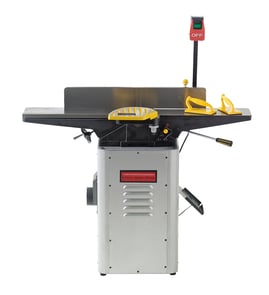
Yes. Delta jointers are a solid, proven choice for most home shops, and the Delta 37-070 6-inch bench jointer is typically a good fit for light to moderate jointing when it is tuned correctly and the knives are sharp. Overall results depend more on condition, setup, and cutterhead/knife quality than the logo on the base.
What “good” means for a Delta 37-070 jointer
A jointer is only as good as its alignment and cutting edges. For a 6-inch bench jointer like the Delta 37-070, “good” usually means it can produce straight, square edges and flat faces on shorter stock without chatter.
Key performance checks:
- Infeed and outfeed tables are coplanar (no twist)
- Fence locks square and stays rigid under pressure
- Knives are sharp and set evenly to the outfeed table
- Cutterhead spins smoothly (no rumble or play)
- Depth-of-cut adjustments move smoothly and hold position
Quick buy-or-fix checklist (used or existing tool)
Before you invest time or money, we recommend checking these common wear points:
- Bearings: listen for growling or vibration at speed
- Cutterhead/knife condition: nicks cause ridges and tear-out
- Fence faces: dents or bowing can prevent square edges
- Table surfaces: rust pits and dings can snag stock
- Drive components: belt condition and pulley alignment (if belt-driven)
Typical expectations: bench jointer vs. floor jointer
| Feature | 6-inch bench jointer (like 37-070) | Larger floor jointer |
|---|---|---|
| Best use | Small projects, edge jointing | Frequent use, longer boards |
| Stock length comfort | Short to medium | Medium to long |
| Setup sensitivity | Higher | Lower |
| Upgrade path | Tune, sharpen, dust collection | More power, longer beds |
Why it matters
Most “bad jointer” complaints come from dull knives, mis-set knife height, or tables that are out of plane. When those basics are corrected, a Delta jointer can produce clean, repeatable joints and reduce sanding and glue-line gaps.
Finding the right parts and diagrams
For the Delta 37-070, we recommend using the model-based diagrams and parts lookup first; then, if you are searching beyond the model list (for example, hardware or accessories), use Sears PartsDirect to search by model number.
Last updated: February 2026
Can I use my jointer as a planer?
No. On a Delta 37-070 6-inch bench jointer, the jointer’s job is to flatten one face of a board and straighten one edge; a planer’s job is to make the opposite face parallel and bring the board to a consistent thickness.
What each tool is designed to do
- Jointer: creates one flat reference face, then one straight, square edge
- Planer (thickness planer): makes the second face parallel to the first and sets final thickness
- Why they are not interchangeable: a jointer does not control thickness across the full board the way a planer does
| Task | Best tool | Result you can count on |
|---|---|---|
| Flatten one face | Jointer | Flat reference face |
| Straighten one edge | Jointer | Edge ready for ripping/gluing |
| Make faces parallel | Planer | Uniform thickness |
| Reduce thickness evenly | Planer | Predictable final dimension |
The right workflow for flat, consistent boards
We recommend this sequence for most lumber:
- Joint one face until it is flat
- Joint one edge square to that face
- Rip the opposite edge on a table saw (using the jointed edge as the reference)
- Plane the opposite face until the board reaches final thickness
Why it matters
If you try to “plane” with a jointer, you can end up with a board that looks smooth but is still tapered, twisted, or inconsistent in thickness. Using the jointer first gives you a true reference surface; the planer then makes the board uniformly thick.
Parts and support
For Delta 37-070 replacement parts and diagrams, start with the parts list for your model; you can also search by model number on Sears PartsDirect.
Last updated: February 2026
Is there a combination jointer and planer?
Yes. Combination jointer/planer machines are common in woodworking; they combine a jointer for flattening and squaring a board face/edge with a planer for bringing the opposite face to a consistent thickness. If you already own a Delta 37-070 6-inch bench jointer, a combo unit is an alternative when you want both functions in one footprint.
What a jointer/planer combo does (and what it does not)
- Jointer mode: flattens one face and squares one edge to that face.
- Planer mode: makes the opposite face parallel and brings stock to final thickness.
- Not a substitute for a table saw: it does not rip boards to width.
- Not a wide planer: many combos have limited width capacity compared to standalone planers.
Quick comparison: combo vs separate machines
| Option | Best for | Tradeoffs |
|---|---|---|
| Combo jointer/planer | Small shops, one-machine workflow | Changeover time between modes; shared cutterhead setup |
| Separate jointer + planer | Faster workflow, dedicated setups | More space; typically higher total cost |
| Delta 37-070 jointer + thickness planer | Keeping your current jointer and adding thicknessing | Two machines to store and maintain |
What to check before buying a combo
- Cutting width and depth of cut you need for your typical lumber.
- Changeover design: how quickly it switches between jointing and planing.
- Dust collection port size and whether your shop vac or collector matches.
- Knife or cutterhead style: straight knives vs helical inserts (maintenance and finish quality).
- Electrical requirements: confirm voltage and amperage for your shop circuit.
Why it matters
A jointer and planer solve different problems; using only one usually leaves boards either flat but not uniform thickness, or uniform thickness but still twisted or cupped. A combo unit gives you both capabilities while saving floor and bench space.
For parts lookups and model searches beyond what is listed for Delta 37-070, we recommend searching by model number on Sears PartsDirect.
Last updated: February 2026