Installation guide
 Owner’s manual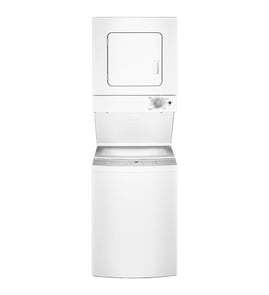

Is there a reset button on a GE stackable washer and dryer?
GE laundry centers like model WSM2700DAWCC typically do not have a dedicated reset button. To reset the controls, we unplug the unit (or switch off the breaker) for a few minutes, then restore power and restart the cycle using the correct control settings in the owner's manual.
How to reset your GE WSM2700DAWCC (safe, basic steps)
- Turn the dryer Cycle Selector to OFF.
- Push the washer Cycle Selector knob in to stop the washer.
- Unplug the laundry center (or turn OFF the circuit breaker).
- Wait 2 to 5 minutes.
- Restore power.
- Close the washer lid and dryer door fully.
- Re-select the cycle and start (washer: pull Cycle Selector out; dryer: press the Start button).
Important notes about “OFF” and stopping a cycle
The manual notes that turning the dryer Cycle Selector to OFF or pushing the washer Cycle Selector knob in does not disconnect power. Unplugging the unit (or shutting off the breaker) is what actually resets power to the controls.
If it still will not start after a reset
Check these common “no start” causes first:
- Washer lid is open (the washer can fill but will not spin with the lid open).
- Dryer door is open (the dryer will not run with the door open).
- Controls are not set correctly (washer Cycle Selector not pulled out, dryer Start not pushed).
- No power at the outlet (tripped breaker or blown fuse).
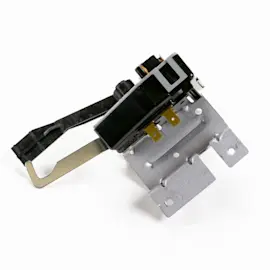
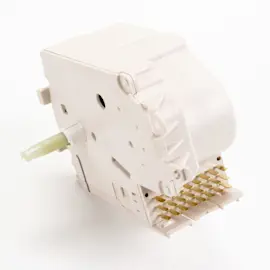
- A failed control component (for example, a worn timer or a damaged start button).
| Symptom | Most likely quick check | What to do next |
|---|---|---|
| Washer won’t run | Cycle Selector not pulled out | Re-set cycle; pull knob out to start |
| Washer won’t spin | Lid not closed | Close lid; restart cycle |
| Dryer won’t run | Door open or Start not pressed | Close door; press Start |
| Both dead | No power | Check breaker/fuses; then reset power |
Why it matters
A power reset clears minor control glitches, but it also helps you confirm whether the issue is a simple setting, a door/lid interlock condition, or a part problem that needs troubleshooting.
Last updated: February 2026
How to wash clothes in a stackable washer?
To wash clothes in your GE WSM2700DAWCC stacked laundry center, add detergent first, load clothes loosely (not above the top row of holes in the wash tub), choose water level and temperature, set the cycle, then pull the cycle selector out to start. Details are in the WSM2700DAWCC owner's manual.
Step-by-step: washing a load
- Prep and sort: empty pockets, close zippers, fasten hooks and buttons, and pretreat heavy soil.
- Add detergent: put in a measured amount before loading.
- Load correctly: load clothes loosely; keep the dry-clothes level no higher than the top row of circular holes in the wash tub.
- Select water level:
- Low: less than 1/3 full
- Med: 1/3 to 2/3 full
- High: over 2/3 full
- Choose temperature and cycle: push the cycle selector in and turn clockwise to the cycle you want.
- Start: pull the cycle selector out.
Loading rules that prevent poor washing and out-of-balance spinning
- Do not pile clothes on the agitator or wrap items around it.
- Mix large items with small ones for better turnover.
- When washing one heavy item (rug, bedspread), add 1 to 2 items to balance.
- Keep large items to no more than about half of the total load.
| What you do | Why it matters |
|---|---|
| Load loosely and below the top row of holes | Improves agitation and rinsing; reduces tangling |
| Match water level to load size | Helps cleaning performance and reduces overflow risk |
| Balance heavy items with a few smaller pieces | Reduces vibration and out-of-balance spin stops |
Using bleach and fabric softener (quick guidance)
- Add bleach only after the washer has filled and agitated for several minutes; use the bleach dispenser and dilute as directed.
- Do not pour undiluted liquid chlorine bleach directly on dry clothes.
- Use fabric softener as directed; avoid pouring it directly on clothing.
Lid lock behavior
Your washer will fill and agitate with the lid closed, and it will not spin with the lid open. During the spin portion, the lid locks automatically and typically unlocks about a minute after the spin ends.
Why it matters
Correct loading, water level selection, and cycle setup are the difference between clean clothes and common complaints like poor agitation, residue, tangling, and out-of-balance spinning in a compact stacked laundry center.
Last updated: February 2026
Why is my GE WSM2700DAWCC not drying?
If your GE WSM2700DAWCC laundry center tumbles but is not drying, the most common causes are restricted airflow (lint filter or exhaust duct), incorrect control settings, or a power supply issue where the dryer runs but has no heat. Use the WSM2700DAWCC owner's manual troubleshooting and care steps to narrow it down.
Quick checks that fix most “not drying” problems
- Clean the lint filter before every load; a coated screen can choke airflow.
- Verify the exhaust vent is clear and the outside damper opens freely.
- Confirm the cycle and temperature settings match the load (low heat can extend dry time).
- Do not overload; dry one washer load at a time.
- If drying one item, add 2 to 3 similar items so it tumbles and dries evenly.
- Check the door is fully closed.
Airflow and venting (most common)
Poor venting is the top reason a dryer heats poorly or takes too long.
| What we see | Likely cause | What to do |
|---|---|---|
| Clothes warm but still damp | Restricted exhaust | Clean ducting; remove kinks in flexible metal duct |
| Dryer runs, long dry times | Outside damper stuck | Clear lint buildup; make sure damper moves easily |
| Loads vary a lot | Improper sorting/overloading | Separate heavy items; reduce load size |
For model-correct venting details, follow the WSM2700DAWCC installation guide.
If the dryer runs but there is no heat
A common electrical cause is a blown fuse or tripped breaker where the motor still runs but the heater does not (many electric dryers use two fuses/breakers).
If airflow and power are good, a failed heating safety device can also stop heat. On this model, parts that can be involved include the dryer thermal limiter WE04X10094 and the thermostat WE4X757.
Why it matters
Restricted airflow can cause overheating, longer dry times, and repeated shutdowns of heating components. Fixing venting and lint buildup first prevents repeat failures and improves drying performance.
Last updated: February 2026
Where do you put laundry detergent in a GE washer?
In the GE WSM2700DAWCC stacked laundry center washer, we put laundry detergent directly into the wash basket (tub), then add the clothes and start the cycle. This style does not use a pull-out detergent drawer; follow the dosing and product-use notes in the WSM2700DAWCC owner's manual.
How to add detergent (simple steps)
- Measure detergent for load size and soil level (use the detergent label).
- Add detergent into the wash basket.
- Load clothes evenly around the basket.
- Select the cycle and start the washer so water begins dissolving detergent.
- Use less detergent if you see excess suds or residue.
Liquid vs. powder: placement and tips
| Detergent type | Where it goes | Tip |
|---|---|---|
| Liquid detergent | Wash basket | Pour onto the bottom of the basket, not onto dry clothes |
| Powdered detergent | Wash basket | Sprinkle evenly; break up clumps so it dissolves |
| HE detergent | Wash basket | Use a smaller dose to prevent oversudsing |
What about bleach and other add-ins?
The manual guidance for this washer is to add laundry products to the wash basket at the correct time for the product.
- Chlorine bleach: add after the wash action starts and detergent is dissolved; dilute and avoid contact with dry fabrics.
- Non-chlorine bleach: add with detergent.
- Pretreat sprays: apply away from the washer to protect the finish.
Why it matters
Correct detergent placement helps it dissolve, rinse cleanly, and reduce residue and oversudsing. That improves cleaning performance and helps protect components such as the washer drive belt WH07X10009 from unnecessary strain caused by heavy suds.
Last updated: February 2026