Owner’s manual
 Error Codes



Are bottom mount fridges better?
A bottom-mount refrigerator like the GE GWE19JMLAFES is better for many households because the fresh-food section sits at eye level, so you reach everyday items more easily and bend less often. The tradeoff is that you access the freezer lower down.
When a bottom-mount fridge is the better choice
- You use fresh food more than frozen food (most day-to-day cooking).
- You want shelves and bins at a more comfortable height.
- You prefer wider refrigerator storage with a pull-out freezer drawer.
- You like features commonly found on these designs (adjustable bins, full-width drawers).
For model-specific features and layout details, use the owner's manual.
When it might not be better
- You access the freezer many times a day (you will bend more).
- You want the simplest, lowest-cost layout (top-freezer models are often simpler).
- You need maximum freezer organization at eye level.
Quick comparison
| Feature | Bottom-mount (like GWE19JMLAFES) | Top-freezer |
|---|---|---|
| Fresh food access | Easier (higher) | Lower |
| Freezer access | Lower (more bending) | Easier (higher) |
| Daily convenience | Strong for fresh-food households | Strong for freezer-heavy households |
Why it matters
Most people open the refrigerator compartment far more than the freezer. Putting fresh food higher reduces bending and makes it easier to see what you have, which can also help reduce food waste.
Last updated: February 2026
How do you put the bottom grill on a GE refrigerator?
On the GE GWE19JMLAFES bottom-mount refrigerator, the bottom grille (base grille/toe grille) typically installs by aligning it with the mounting tabs or screw holes at the bottom front of the cabinet, snapping or sliding it into place, then reinstalling any retaining screws.
Steps to reinstall the bottom grille
- Unplug the refrigerator or switch off power at the breaker (recommended when working around wiring and fans).
- Pull the refrigerator forward a few inches if needed so you can see the lower front edge clearly.
- Line up the grille with the lower front opening so the top edge meets the cabinet first.
- Engage the tabs or clips (if equipped) by pressing the grille evenly from left to right.
- Reinstall screws (if your grille uses them) with a Phillips screwdriver; tighten until snug.
- Confirm airflow clearance; the grille should sit flat and not bow inward.
Quick checks if it will not stay on
- Make sure the grille is not upside down; many base grilles only fit one way.
- Look for broken tabs or cracked corners on the grille.
- Verify the refrigerator is level; a tilted cabinet can make the grille bind.
- Check that no water line, wiring, or insulation is pinched behind the grille.
- If screws are used, confirm the screw holes are aligned before tightening.
What you should see when it is installed correctly
| What to check | What “correct” looks like |
|---|---|
| Fit | Even gap across the front, no sagging corners |
| Attachment | Tabs fully seated or screws installed snug |
| Function | No rattling when the compressor runs |
| Airflow | Lower front vent area is not blocked |
Why it matters
The bottom grille helps protect components and supports proper airflow across the condenser area. If it is loose or missing, you can get extra noise, reduced cooling efficiency, and faster dust buildup.
For model-specific diagrams and any fastener locations used on your exact configuration, use the GWE19JMLAFES owner's manual.
Last updated: February 2026
What is the most common problem with a GE refrigerator?
The most common GE refrigerator complaint is not cooling properly, which customers often notice as warm fresh food, soft ice, or temperature swings. On the GE GWE19JMLAFES, the fastest wins are confirming temperature settings, airflow, and door sealing, then checking common cooling and defrost components.
Quick checks we recommend first
- Confirm the refrigerator is set near 37°F and the freezer near 0°F.
- Make sure vents inside the fresh food section are not blocked by food containers.
- Check that the doors close fully and the gaskets seal all the way around.
- Listen for the evaporator fan; a failed fan can cause warm temps and uneven cooling.
- Look for heavy frost on the freezer back wall (often points to a defrost problem).
- If you have dispenser issues too, review the troubleshooting section in the owner's manual.
Common “most frequent” problem areas (and what they look like)
| Symptom | What you may notice | Parts that commonly relate |
|---|---|---|
| Not cooling or weak cooling | Warm fridge, freezer struggling, temps drift | Temperature sensing, airflow, control issues |
| Frost buildup | Frost on freezer panel, fridge warms over time | Defrost heater, defrost thermostat |
| Noisy operation | Whirring, grinding, or intermittent fan noise | Evaporator fan motor or blade |
| Water/ice issues | Slow water, no ice, dispenser sputters | Water filter, air in water line |
Parts on this model that often solve common symptoms
If your symptoms match, these are model-listed parts we see used frequently in repairs:
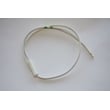
- Cooling feedback issues: GE profile refrigerator temperature sensor WR55X10025
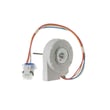
- Airflow and fan noise: rca refrigerator evaporator fan motor WR60X10185 and refrigerator evaporator fan blade WR60X30922
- Defrost-related warming and frost: refrigerator defrost heater WR51X10108 and refrigerator defrost bi-metal thermostat WR50X10069
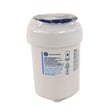
- Water taste/flow complaints: GE refrigerator water filter MWFP
Why it matters
A refrigerator that is “kind of cooling” often gets worse: poor airflow, a weak evaporator fan, or a defrost failure can gradually raise temperatures and increase frost, which reduces efficiency and can lead to food spoilage.
Last updated: February 2026