
What are signs of a failing disposal?
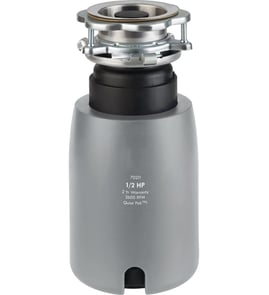
A failing Emerson food waste disposer model E-80-10 typically shows up as poor grinding, unusual noises, frequent shutoffs, leaks, or persistent odors that return quickly after cleaning. These symptoms usually point to a jam, worn internal components, a drain restriction, or an electrical issue.
Common signs your disposal is failing
- Hums but won’t grind (often a jammed impeller or seized motor)
- Clanking or rattling (foreign object in the grind chamber)
- Slow draining or sink backups (partial clog in the disposer outlet or drain trap)
- Frequent resets or sudden shutoffs (overload trip from binding or motor wear)
- Leaks (from the sink flange, dishwasher inlet, or bottom housing)
- Persistent odor that returns within a day or two (food buildup under splash guard or in the grind chamber)
Quick checks you can do safely
- Turn off power at the switch and breaker before inspecting.
- Look inside with a flashlight; remove visible debris with tongs.
- Press the reset button on the bottom if it tripped.
- If it hums, try freeing the jam using the manual turning point (if equipped) or a wooden spoon handle from above.
- Run cold water and test; if drainage is still slow, check the P-trap and disposer outlet for blockage.
Symptom-to-likely-cause guide
| What you notice | Most common cause | What to do next |
|---|---|---|
| Humming only | Jam or seized motor | Clear jam; retest; replace if it won’t turn freely |
| Loud metal clank | Object in chamber | Remove object; check for damage |
| Slow drain | Clog downstream | Clear trap/outlet; avoid chemical drain cleaners |
| Leaking from bottom | Internal seal failure | Plan to replace the disposer |
Why it matters
Catching these signs early helps prevent sink backups, cabinet water damage, and repeated overload trips that can shorten motor life.
For general DIY safety and tool prep before troubleshooting wiring or power issues, use our guide: are diy appliance repairs safe.
Last updated: February 2026
How to reset Emerson garbage disposal?
To reset your Emerson E-80-10 food waste disposer, turn power off, clear any jam, then press the red reset (overload) button on the bottom of the unit until it clicks in. Restore power and test with a quick on and off.
Reset steps (safe, reliable order)
- Turn the disposer switch OFF.
- Shut OFF power at the breaker (recommended before putting hands near the grind chamber).
- Look under the disposer and find the reset button (usually red and centered on the bottom).
- If the unit is jammed, use a wooden spoon handle or disposer wrench (if your unit has one) to free the impellers; never use your fingers.
- Press the reset button firmly; it should click and stay in.
- Restore power, run cold water, then turn the disposer on for 5 to 10 seconds.
If the reset button keeps popping out
A reset that trips again usually means the motor is still overloaded.
| What you notice | Most common cause | What to do next |
|---|---|---|
| Hums but won’t grind | Jammed impellers | Free the jam, then reset again |
| Completely dead (no sound) | No power to disposer | Check breaker, switch, and wiring |
| Runs, then stops quickly | Overheating or hard jam | Let it cool 10 to 15 minutes, clear jam, reset |
| Slow grinding | Buildup or dull grind components | Flush with cold water; avoid fibrous foods |
Quick checks that prevent repeat trips
- Run cold water before, during, and after grinding.
- Feed waste gradually; avoid packing the chamber.
- Avoid common jam makers: bones, fruit pits, corn husks, celery, onion skins, and large amounts of potato peels.
- If you suspect an electrical issue, use a multimeter to confirm power safely; see how to use a multimeter to test electrical parts video.
Why it matters
The reset button protects the motor from overheating and damage. Resetting without clearing a jam can cause repeated trips and can shorten the life of the disposer.
Last updated: February 2026
Are all E-80-10 garbage disposals interchangeable?
No. An Emerson E-80-10 food waste disposer is not automatically interchangeable with every other disposal; interchangeability depends on the mounting system (sink flange and mount), discharge outlet alignment, electrical hookup style, and overall size. When those match, a swap is usually straightforward.
What must match for a true “drop-in” replacement
To replace an E-80-10 without reworking plumbing or the sink mount, we look for these items to line up:
- Mounting style: 3-bolt mount vs. other mount rings and flange designs
- Discharge outlet position: height and angle where the outlet meets the drain trap
- Dishwasher inlet (if used): presence and location of the knockout port
- Electrical connection: cord-and-plug vs. hardwired junction box
- Body size: diameter and height so it clears the cabinet and plumbing
Quick compatibility checklist (what you can verify at the sink)
Use this as a fast way to decide whether you can reuse what you already have.
| Item to compare | If it matches | If it does not match |
|---|---|---|
| Sink mount / flange | Replacement can often twist-lock into the existing mount | Plan to replace the mount and reseal the flange |
| Discharge outlet height | Trap and drain tube usually reconnect | Expect to adjust or rebuild the drain piping |
| Power connection type | Wiring is simple and code-compliant | You may need a cord kit or to rewire the connection |
| Dishwasher port | Hose reconnects normally | You may need a different model or reroute the hose |
Why it matters
If the mount or discharge geometry is different, the “new” disposer can turn into a bigger project: leaks at the sink flange, a misaligned P-trap, vibration noise, or an unsafe electrical connection.
Best next step for the E-80-10
We recommend confirming the exact model number and then comparing mount type and outlet height before you buy. Our guide how to find your appliance model number (and what it means for parts) helps you verify you are shopping the correct Emerson model and parts list.
Last updated: February 2026