Owner’s manual
 View engine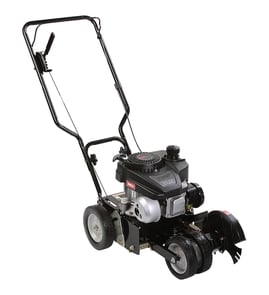



How to replace an edger blade?
To replace the blade on your Craftsman edger model 536772360, disconnect the spark plug wire, remove the blade locknut while holding the backing nut, swap in the new blade, then torque the locknut to 40 to 45 ft-lb as shown in the 536772360 owner's manual.
Safety first (do this every time)
- Shut off the engine and wait for all moving parts to stop
- Disconnect the spark plug wire and keep it away from the plug
- Wear gloves and eye protection (the blade edge and debris are hazards)
- Work on a flat surface so the edger cannot roll
- Inspect for damage if the blade hit a rock, curb, or other object
Step-by-step: blade replacement
- Disconnect spark plug wire.
- Locate the blade and hardware on the drive shaft.
- Hold the nut behind the blade with a wrench to keep the shaft from turning.
- Remove the blade locknut (the manual shows the correct wrench-holding method).
- Remove the old blade.
- Install the new blade in the same orientation.
- Reinstall and tighten the blade locknut to 40 to 45 foot-pounds.
- Reconnect the spark plug wire.
What to check before you run it
- Blade spins freely by hand (with spark plug wire still disconnected)
- No wobble at the blade or drive shaft
- No rubbing on the blade guide or guard
- Belt area is clear of debris
Blade care guidance
The manual notes the blade does not require sharpening. Replace it when both sides are severely worn, nicked, or bent.
| Condition you see | What we recommend |
|---|---|
| Minor nicks or dents | Keep using it; normal wear |
| Bent blade or heavy damage | Replace the blade before operating |
| Abnormal vibration | Stop engine and inspect blade, locknut, and drive components |
Why it matters
A properly installed blade and correctly torqued locknut helps prevent vibration, protects the belt and spindle, and keeps your Craftsman edger cutting a clean edge.
Last updated: February 2026
How often should you change your edger blade?
On the Craftsman 536772360 lawn edger, we replace the blade whenever it’s damaged, excessively worn, or no longer cuts a clean trench at your normal depth setting. In heavy use, that can mean as often as every 1 to 2 weeks; in lighter use, it’s typically much less frequent. See the 536772360 owner’s manual for the blade replacement procedure and safety steps.
Quick signs it’s time to replace the blade
- The edger won’t hold cutting depth even after adjusting the depth control lever
- The cut edge looks ragged or the edger “skips” along the sidewalk
- You notice abnormal vibration while edging
- The blade is visibly rounded, chipped, bent, or cracked
- You struck a rock, root, or other foreign object during use
Safety first (before you inspect or change the blade)
The manual’s safety guidance is clear: stop the engine and prevent accidental starting before servicing.
- Release the engine stop lever and shut the engine off
- Disconnect the spark plug wire and keep it away from the plug
- Wait for all moving parts to stop completely
- Inspect for damage after any impact before operating again
Replacement timing guide
Use this as a practical schedule; your soil type and edging depth make a big difference.
| Usage pattern | Typical replacement timing | What drives it |
|---|---|---|
| Heavy, frequent edging (dusty or sandy soil) | Every 1 to 2 weeks | Fast abrasive wear |
| Weekly homeowner use | Every 1 to 2 months | Normal wear |
| Occasional touch-ups | 1 to 2 times per season | Low hours, light wear |
Why it matters
A worn blade reduces effective cutting depth and increases strain on the belt and pulleys. Replacing the blade at the right time helps the edger cut cleanly, reduces vibration, and protects drive components.
Last updated: February 2026
What size blade is a Craftsman 536772360 edger?
The Craftsman edger model 536772360 uses a 9-inch blade. This blade size is part of the standard cutting assembly for this model and is the measurement you want when ordering a replacement blade or confirming cutting width in the 536772360 owner's manual.
How to confirm you are measuring the right “blade size”
When customers ask about blade size, they usually mean the blade diameter (edge-to-edge across the circle).
- Measure across the blade from one cutting tip to the opposite tip
- Measure the metal blade itself, not the blade guard opening
- Check that the blade is not heavily worn or chipped at the tips
- Verify your model number is 536772360 before ordering parts
Replacement part guidance
For this model, the blade is listed in the blade assembly parts breakdown. If you are replacing related hardware at the same time, these common fasteners are also shown for the blade assembly.
| What you are replacing | What to match | Example part from this model |
|---|---|---|
| Blade diameter | 9-inch | (Blade is listed in the manual parts list) |
| Blade retaining nut | Thread and size | Edger hex nut 46023MA |
| Blade lever (engagement) | Fit and linkage style | Craftsman blade lever 1701069MA |
Why it matters
Using the correct 9-inch blade on a Craftsman 536772360 lawn edger helps maintain proper cutting depth, keeps the blade guard clearance correct, and reduces vibration that can damage the spindle pulley, washers, and mounting hardware.
Last updated: February 2026
Is an edger blade reverse thread?
On the Craftsman edger model 536772360, the edger blade retaining nut is typically a standard (right-hand) thread: you loosen it by turning counterclockwise and tighten it by turning clockwise. For the exact blade replacement steps and hardware order, use the 536772360 owner's manual.
Quick check: which way should it turn?
Use this as a fast, reliable rule when you are standing at the blade end of the edger.
- Loosen: turn the nut left (counterclockwise)
- Tighten: turn the nut right (clockwise)
- If the nut feels “locked,” apply penetrating oil and hold the blade from turning (with a block of wood), then try again
- If the blade spins with the nut, re-check that you are turning the wrench the correct direction from your viewing angle
Safe blade removal steps (recommended)
Before you touch the blade area, follow the safety steps used throughout the manual.
- Stop the engine and wait for all moving parts to stop
- Disconnect the spark plug wire and keep it away from the plug
- Raise the blade off the ground using the depth control lever
- Remove the blade nut and washers, then slide the blade off the arbor
- Reinstall in the same order and tighten securely
Common blade hardware for this model
These are parts shown in the 536772360 blade assembly parts list; matching the correct hardware helps the blade clamp properly.
| Item | What it does | Example part for 536772360 |
|---|---|---|
| Blade retaining nut | Clamps blade to the arbor | Edger hex nut 46023MA |
| Flat washer | Spreads clamping force | Edger flat washer 22265MA |
| Blade lever | Engages blade drive system | Craftsman blade lever 1701069MA |
Why it matters
If you assume reverse threads and force the nut the wrong way, you can strip threads on the arbor or damage the nut and washers. Correct thread direction also helps you torque the blade securely so it does not loosen during edging.
Last updated: February 2026
What engine is on a Craftsman edger?
The Craftsman lawn edger model 536772360 is equipped with a 500 Series engine; the repair parts list also identifies the engine as 10T5020121 E1. For the most accurate tune-up and service specs, match parts to the engine’s model and type code shown on the engine label and in the 536772360 operator’s manual.
How to confirm the exact engine ID on your machine
Use these checks so you order the right spark plug, air filter, and carburetor parts:
- Find the engine ID label on the recoil starter housing or valve cover area
- Write down the full engine model and type code (not just “500 Series”)
- Compare your label to the engine listing in the manual and illustrated parts list
- Use the engine ID when shopping for maintenance parts
- If the label is dirty, wipe it clean and take a clear photo for reference
What we know for model 536772360 (quick reference)
| Item | What it tells you | Where to use it |
|---|---|---|
| 500 Series engine | Engine family used on this edger | General identification and service section |
| 10T5020121 E1 | Engine identifier shown in the parts list | Matching engine-related parts diagrams |
| 9 inch blade | Blade size | Selecting the correct blade style and depth settings |
Why it matters
Engine families can share the same “Series” name while using different filters, plugs, and governor linkages. Using the exact engine ID prevents wrong-part returns and helps the edger start, idle, and cut correctly.
Last updated: February 2026