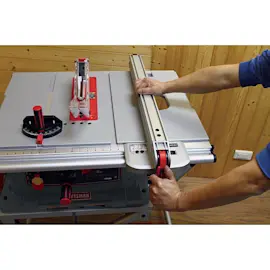
Owner’s manual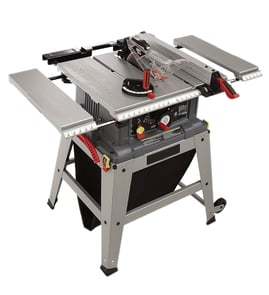

Can you cut a 4x4 with a 10-inch table saw?
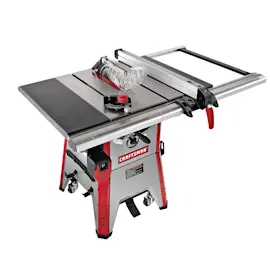
Yes. With the Craftsman 137228010 10-inch table saw, you can cut a 4x4 (actual thickness about 3-1/2 inches), but the saw’s maximum cutting depth at 90° is 3 inches, so a full cut typically requires flipping the stock and making a second pass. Confirm your setup in the owner's manual.
What to expect on this model
The 137228010 is designed around a 10-inch blade and lists these key limits:
| Cut setup | Max depth (typical for this model) | What that means for a 4x4 |
|---|---|---|
| 90° (straight cut) | 3 inches | You will not cut through in one pass |
| 45° (bevel cut) | 2 inches | A 4x4 bevel cut takes multiple passes and careful control |
Safe, practical way to do it (two-pass method)
We recommend this approach for a controlled cut:
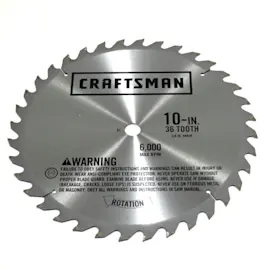
- Use a sharp rip blade (fewer teeth than a fine crosscut blade) to reduce bogging.
- Set blade height only as high as needed for the first pass (avoid excessive blade exposure).
- Keep the rip fence parallel to the blade; misalignment increases burn and kickback risk.
- Use the guard, spreader, and anti-kickback pawls whenever the cut allows.
- Make the first pass, then rotate or flip the 4x4 to complete the cut with a second pass.
- Support long stock with the table extension and stable outfeed support; do not use another person as a “stand.”
Common problems and quick checks
If the cut stalls, burns, or wanders, these checks usually fix it:
- Blade slows down: lighten feed pressure; verify the blade is sharp and clean.
- Bad angle or wandering cut: re-check fence alignment and blade-to-miter-slot alignment.
- Kickback tendency: confirm the spreader and pawls are installed and working; keep the work tight to the fence.
- Can’t raise the blade enough: inspect the blade height mechanism for sawdust buildup and binding.
For step-by-step help, use how to replace a table saw blade if you suspect a dull or incorrect blade.
Why it matters
A 4x4 pushes a 10-inch saw near its depth limit. Using a controlled two-pass cut, proper support, and kickback prevention hardware helps protect the motor, improves cut quality, and reduces the chance of the workpiece being thrown back.
Last updated: February 2026
Are table saw miter gauges universal?
No. Table saw miter gauges are not truly universal; they must match your saw’s miter slot size and profile. For the Craftsman 137228010 table saw, the safest approach is to confirm the slot dimensions and any anti-lift features in the owner's manual before buying a replacement or “universal” gauge.
What “universal” usually means
Most aftermarket miter gauges are built around the most common full-size table saw slot standard, but fit still depends on your table’s actual groove size and how the bar rides in the slot.
Common fit factors to check:
- Slot width and depth (the bar must slide freely without side-to-side slop)
- Bar shape (straight bar vs. T-slot style)
- Anti-lift tabs or set screws (some gauges use expansion discs or screws to remove play)
- Left vs. right slot use (some setups cut best from a specific groove)
- Clearance at 45° bevel (gauge head and fence must not contact the blade or guard)
How to verify fit on Craftsman 137228010
Use a caliper or accurate rule and measure the miter slot in several places (front, middle, back). Then compare those measurements to the gauge bar specs.
Recommended checks before you order:
- Unplug the saw and remove the miter gauge
- Clean pitch and sawdust from the slot walls
- Measure slot width and depth
- Slide the existing gauge bar and note any binding or wobble
- Confirm the gauge can be used safely for crosscuts (the manual calls for using the miter gauge for crosscutting)
Quick compatibility guide
| What you see on your saw | What it means for compatibility | What to do |
|---|---|---|
| Standard rectangular slot | Many “universal” gauges may fit | Match bar width and depth closely |
| T-slot or undercut slot | Some gauges will not fit | Buy a gauge specifically rated for T-slots |
| Excess wobble in slot | Inaccurate angles and burning | Choose a gauge with adjustable expansion |
| Binding or tight spots | Unsafe feeding and poor control | Recheck measurements; avoid forcing the bar |
Why it matters
A loose or mismatched miter gauge can cause inaccurate angle cuts, twisting during the cut, and higher kickback risk. Your manual also emphasizes using the miter gauge for crosscutting and the rip fence for ripping, which depends on stable, predictable guidance.
For angle accuracy troubleshooting after installation, use table saw bad angle cuts.
Last updated: February 2026
How do I get rid of an old table saw?
If your Craftsman table saw model 137228010 still runs, the easiest way to get rid of it is to sell it or give it away. If it’s broken, we recommend removing sharp and electrical components first, then recycling the metal and taking the motor/electrical parts to an approved e-waste option.
Safe prep before disposal
Before you move, donate, or scrap a table saw, make it safe to handle.
- Unplug the saw and remove the switch key (if equipped)
- Lower the blade fully and lock adjustments (height and bevel)
- Remove the blade and package it (cardboard over teeth or a heavy cloth)
- Remove loose accessories (rip fence, miter gauge, guard, inserts)
- Vacuum out sawdust; heavy buildup can be a fire hazard during transport
For model-specific handling and blade removal steps, follow the safety and blade-change procedure in the owner's manual.
Best disposal options (from most to least value)
- Sell or donate (working saw): Local classifieds, community reuse groups, or a tool donation program
- Part out (some parts usable): Keep fence, miter gauge, blade guard, and inserts together for the next owner
- Recycle as scrap metal (non-working saw): Steel/aluminum frame and table typically qualify as scrap
- E-waste for motor/electrics: Motor, switch, wiring, and capacitors should go through an e-waste stream
- Junk removal: Use if you cannot transport it safely
What to separate and where it usually goes
| Component | What to do | Why it matters |
|---|---|---|
| Saw blade | Wrap and label as sharp metal | Prevents cuts to you and waste handlers |
| Metal stand/table | Scrap metal recycling | Keeps bulky metal out of landfill |
| Motor, switch, wiring | E-waste drop-off | Contains electrical components best handled separately |
| Sawdust | Bag and dispose per local rules | Reduces fire risk and mess |
Why it matters
Table saws combine sharp steel, heavy cast/formed metal, and electrical components. Separating the blade and routing the motor/electrics to e-waste helps prevent injuries and keeps more material recyclable.
Last updated: February 2026
How to date a Craftsman table saw?
For Craftsman table saw model 137228010, you date the saw by using the serial number on the ID label (not the cutting-capacity specs). The 137228010 owner's manual helps you confirm you have the correct model and shows where key assemblies are, but the manufacture date comes from the serial/date code on the saw.
Step 1: Find the ID label and record the numbers
Look for the identification label on the saw base, frame, or near the switch and motor area. Write down:
- Model number: 137228010
- Serial number (letters and numbers exactly as shown)
- Electrical ratings (volts/amps) and any factory code
- Any printed date (some labels include month and year)
Step 2: Decode the serial number using common Craftsman patterns
Craftsman date coding varies by production run and supplier, so we use the serial format on your label.
- If the label shows a printed date, use that as the manufacture date.
- If the serial includes a YYWW-style block (year, then week), the first 2 digits are the year and the next 2 are the production week.
- If the serial begins with letters or a longer factory code, use the factory code plus serial to narrow the era; the model number confirms you are decoding the right tool.
What the manual is good for (and what it is not)
The manual is the best way to positively identify the saw as MODEL NO. 137.228010 and match it to the correct parts diagrams.
| Use the manual for | Example | Why it helps |
|---|---|---|
| Model confirmation | “MODEL NO. 137.228010” | Ensures you are decoding the correct saw |
| Setup and safety | Guard, fence, miter gauge procedures | Prevents unsafe operation while inspecting |
| Maintenance guidance | Cleaning sawdust, checking cord | Keeps the saw reliable while you troubleshoot |
Why it matters
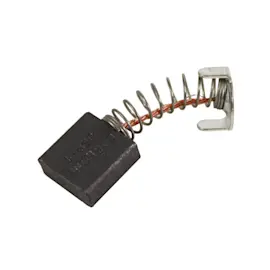
Dating the saw helps you match compatible items like a switch, power cord, motor brushes, blade guard style, and stand hardware; it also helps you follow the correct safety instructions for your exact Craftsman table saw.
Related help
If you are tuning the saw after identification, our table saw common question article covers common setup checks that affect accuracy.
Last updated: February 2026