
Where are Chicago pneumatic impact wrenches made?
Chicago Pneumatic impact wrenches are made in multiple countries depending on the exact model and production run. For the Chicago Pneumatic CP-734 pneumatic impact wrench, many units are marked Made in Japan, but you should confirm the country of origin on your tool’s nameplate or housing label.
How to confirm where your CP-734 was made
Check the markings on the tool itself; that is the most reliable identifier for your specific unit.
- Look for a stamped or printed label on the handle, motor housing, or hammer case
- Check both sides of the tool; origin markings are sometimes small
- Look for wording such as “Made in …” or “Country of origin …”
- If the label is worn, clean the area and re-check under good lighting
- Match the marking to your exact model number: CP-734
Common locations you may see (what it means)
Country of manufacture can vary by model family, year, and factory.
| What you see on the tool | What it tells you | What it does not tell you |
|---|---|---|
| “Made in Japan” | Final assembly/manufacture occurred in Japan | Exact production date or internal component sourcing |
| No origin marking visible | Label may be worn, painted over, or located elsewhere | That it was “not marked” originally |
Why it matters
Country of origin is mainly useful for identification and record-keeping. For repairs, what matters most is the exact model number (CP-734) and the specific internal part you need (for example, hammer mechanism parts, rotor blades, or anvil components).
Helpful related resource
If you are trying to identify the correct model information before ordering parts, use: how to find your appliance model number (and what it means for parts)
Last updated: February 2026
What is the main component of an impact wrench?
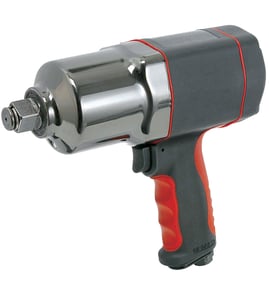
The main working component in a pneumatic impact wrench like the Chicago Pneumatic CP-734 is the impact mechanism (the hammer-and-anvil assembly). It converts the motor’s rotation into repeated impacts, which is what creates high torque for loosening and tightening fasteners.
What the “impact mechanism” includes
In most air impact wrenches, the torque-producing system is built around these core parts:
- Hammer(s): accelerate and strike to create impact blows
- Anvil: transfers the hammer blows to the drive (square) output
- Drive (square) output: where your socket attaches
- Motor/rotor and vanes: spin using compressed air to power the mechanism
- Trigger and air valve: control airflow and tool speed
How it works (simple breakdown)
- Compressed air spins the motor.
- The hammer mechanism “winds up” and then strikes the anvil.
- Those rapid strikes deliver torque in pulses, helping break stubborn lug nuts and rusted bolts loose.
Quick comparison: impact wrench vs standard air ratchet
| Tool type | How it makes torque | Best for |
|---|---|---|
| Pneumatic impact wrench (CP-734) | Hammer impacts an anvil in pulses | Stuck fasteners, lug nuts, high-torque jobs |
| Pneumatic ratchet | Continuous rotation through gears | Faster run-down, light to medium torque |
Why it matters
When an impact wrench feels weak, inconsistent, or noisy, the impact mechanism is often the first place we focus because it is the part of the tool that actually creates the torque pulses.
For model identification and matching the correct parts list to your tool, use how to find your appliance model number (and what it means for parts).
Last updated: February 2026
What is the difference between pneumatic torque wrench and impact wrench?
A pneumatic torque wrench applies torque through a geared drive and uses a reaction arm to counter the turning force, so it’s built for controlled, repeatable tightening. A pneumatic impact wrench like the Chicago Pneumatic CP-734 delivers torque in hammering bursts, prioritizing speed for loosening and running fasteners.
How each tool makes torque
- Pneumatic torque wrench: Continuous, geared torque multiplication; the tool “pushes” steadily.
- Impact wrench (CP-734): A hammer-and-anvil mechanism “strikes” in pulses.
- Torque control: Torque wrench is designed to hit a target torque; impact wrench torque varies with air pressure, time on the trigger, and joint condition.
- Reaction handling: Torque wrench needs a reaction point; impact wrench typically does not.
Reaction arm: the biggest practical difference
A pneumatic torque wrench uses a reaction arm that must brace against a solid surface (for example, a nearby nut, flange, or fixture). That reaction arm is what lets the tool apply high, controlled torque without twisting your wrists.
Quick comparison
| Feature | Pneumatic torque wrench | Pneumatic impact wrench (CP-734) |
|---|---|---|
| Best for | Precise tightening | Fast removal and installation |
| Torque delivery | Smooth, continuous | Pulsed, hammering |
| Needs reaction arm | Yes | No |
| Repeatability | High | Moderate to low |
Which one should you use?
- Use a pneumatic torque wrench when you must meet a specific torque spec (critical bolted joints).
- Use the CP-734 impact wrench when you need speed (lug nuts, rusted fasteners, general service work).
- For final tightening after using an impact wrench, finish with a calibrated torque tool when the job requires a spec.
Why it matters
Choosing the right tool helps prevent under-tightening (loose fasteners) and over-tightening (stretched studs, damaged threads). It also improves safety and consistency when working on wheels, suspension hardware, and industrial assemblies.
For more help finding the correct model number when ordering parts or looking up diagrams, use how to find your appliance model number (and what it means for parts).
Last updated: February 2026
What is the best pneumatic impact wrench?
The best pneumatic impact wrench is the one that matches your work (lug nuts vs. heavy equipment), your air supply, and your preferred size and weight. If you already own a Chicago Pneumatic CP-734, the “best” choice is the wrench that delivers full power with the least air loss and downtime through proper setup and maintenance.
How we recommend choosing the “best” air impact wrench
Use these factors to compare any pneumatic impact wrench, including the Chicago Pneumatic CP-734:
- Drive size: 1/2-in drive is the most common for automotive; 3/4-in and 1-in are for heavier fasteners.
- Real-world torque: look for strong breakaway torque for stuck fasteners, not just “max torque” marketing.
- Air requirements: most 1/2-in impacts perform best around 90 PSI at the tool with adequate CFM.
- Tool weight and balance: lighter composite housings reduce fatigue; metal housings often feel more durable.
- Anvil type: hog ring is faster for socket changes; pin detent holds sockets more securely.
- Serviceability: easy access to lubrication points and common wear items (trigger valve, hammer mechanism, seals).
Quick comparison guide (what “best” means by job)
| Your main use | What to prioritize | Typical fit |
|---|---|---|
| Tire rotations, light automotive | Compact size, good control, moderate torque | 1/2-in impact |
| Rusted suspension, crank bolts | High breakaway torque, strong hammer mechanism | High-torque 1/2-in |
| Fleet, truck, heavy equipment | Sustained torque, durability, higher air demand | 3/4-in or 1-in |
| Tight spaces | Short length, lighter weight | Compact 1/2-in |
Setup tips that make any impact wrench perform like the “best”
These steps often matter more than brand when a tool feels weak:
- Set the regulator so you get 90 PSI at the tool while pulling the trigger (pressure drops under flow).
- Use a short, larger-ID air hose when possible; long, small hoses starve the tool.
- Add air tool oil regularly (or use an in-line oiler) to protect the motor and hammer mechanism.
- Use impact-rated sockets; worn chrome sockets can slip and reduce effective torque.
- If power is inconsistent, check for water in the air line and drain the compressor tank.
Why it matters
“Best” is about results: the right torque for the fastener, consistent power from your compressor and hose setup, and fewer repairs. A well-supplied, well-lubricated CP-734 can outperform a higher-rated wrench that is starved for air.
For more DIY repair and maintenance tips we recommend starting with are diy appliance repairs safe.
Last updated: February 2026