Installation guide
 Owner’s manual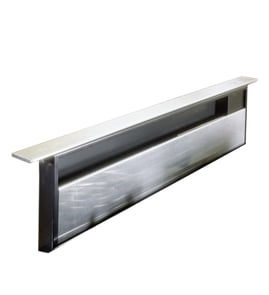

What are the pros and cons of downdraft extractors?
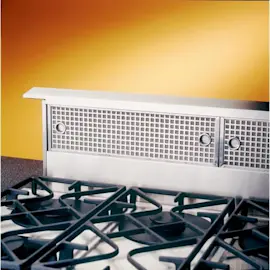
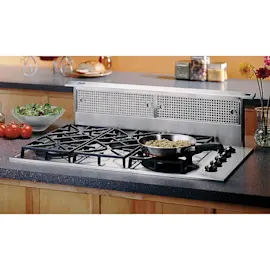
Downdraft extractors like the Dacor RV30 pull smoke and odors down at the cooktop, keeping sightlines open for islands and open kitchens. The tradeoff is that capture can be less effective than an overhead hood for tall, rising plumes, and installation requires careful duct planning and cabinet space.
- Clean look for island cooktops: the vent stays low and out of the visual field.
- Works well for light to moderate cooking: especially when pans are centered near the intake.
- Flexible exhaust options: the RV30 can be configured to exhaust through the bottom or either side, depending on the blower setup.
- Good fit for approved cooktops: the installation guidance specifies using these raised vents only with approved Dacor cooktops.
- Less capture for high-heat or tall cookware: steam and smoke naturally rise, so a downdraft can miss some plume before it is pulled down.
- Cabinet space and duct routing: you need room for the chassis, duct connection, and elbows; the shortest, most direct duct route performs best.
- Duct length limits matter: long runs and multiple elbows reduce airflow; equivalent duct length adds up quickly.
- Top cap clearance and use habits: you cannot set cookware or objects on the vent top cap or interfere with vent movement.
| Feature | Downdraft (RV30 style) | Overhead hood |
|---|---|---|
| Visual impact | Minimal | More visible |
| Best at capturing | Low-level smoke near intake | Rising heat, steam, and smoke |
| Install complexity | Higher (cabinet + duct planning) | Often simpler duct path |
| Space tradeoff | Uses base cabinet volume | Uses upper space |
Downdraft performance depends heavily on real-world installation details (duct size, elbows, exhaust direction) and how you cook (burner location, pan height). Getting the duct route right is often the difference between “works fine” and “barely pulls.”
- Keep the duct run as short and straight as possible.
- Minimize 90° elbows; each one adds significant equivalent length.
- Use the correct exhaust configuration (bottom or side) for your cabinet layout.
- Avoid blocking the intake; do not place items on the top cap.
- Confirm cooktop compatibility and cutout requirements before installation.
For model-specific installation clearances, exhaust locations, and duct length guidance, use the RV30 installation guide.
Last updated: February 2026
Does a downdraft need to vent outside?
Yes. For the Dacor RV30 downdraft ventilation system, a ducted (vented) installation must exhaust air to the outdoors for safe, effective removal of smoke, heat, and odors; the installation instructions specifically state that ducted fans must always be vented outside.
A ducted RV30 setup pulls air down through the vent, moves it through metal ductwork, and discharges it outside the home (through a wall or floor route).
- Vent termination is outdoors, not into an attic, crawl space, garage, or inside a wall/ceiling cavity
- Use metal ductwork (not plastic or foil)
- Keep the duct run as short and direct as possible
- Seal joints with sheet metal screws plus approved tape (do not rely on tape alone)
- Do not reduce duct size along the run (upsizing is OK)
Some cooking ventilation products can be configured to recirculate air back into the kitchen using filters. For the RV30, the provided installation guidance is focused on ducting to the outdoors for proper exhausting.
| Option | Where the air goes | Best for | Key tradeoff |
|---|---|---|---|
| Ducted (recommended) | Outdoors | Strongest smoke and odor removal | Requires duct routing to an exterior wall or through the floor |
| Ductless (recirculating) | Back into kitchen | Situations where exterior ducting is not possible | Less effective at removing heat and moisture; relies on filter maintenance |
Venting a ducted downdraft outdoors reduces grease buildup and lingering odors, and it helps prevent exhaust air from being dumped into hidden spaces where it can create moisture and air-quality problems.
We recommend following the RV30 duct planning and safety requirements in the RV30 installation guide, including guidance on routing, sealing joints, and exhausting outdoors.
Last updated: February 2026
How much does downdraft ventilation cost?
A Dacor downdraft ventilation system like model RV30 has two main costs: the vent system itself and the installation work (ducting, electrical, and cabinet modifications). Total cost is driven more by your kitchen layout and duct run than by the vent alone; use the installation guide to plan requirements.
Downdraft projects usually include several line items.
- Downdraft vent system (the raised vent assembly)
- Blower configuration (some setups use an optional cabinet or remote blower)
- Ductwork materials (duct, elbows, transitions, wall or roof cap)
- Electrical work (a dedicated circuit or new wiring, as required)
- Cabinet and countertop labor (cutout, mounting, and finishing)
These are common market ranges for downdraft ventilation projects; your final total depends on duct length, number of elbows, and how much cabinetry must be modified.
| Cost item | Typical range | What changes the price most |
|---|---|---|
| Downdraft vent unit | $800 to $2,500 | Brand, size, finish, included controls |
| Ducting materials | $75 to $500 | Duct size, elbows, transitions, cap type |
| Electrical labor | $150 to $600+ | Access to wiring, panel capacity, local rates |
| Installation labor | $400 to $1,500+ | Countertop/cabinet modifications, complexity |
The RV30 installation instructions highlight factors that commonly add labor time and materials.
- The RV30 is a 30-inch class raised vent; cutout and chassis dimensions must match the cabinet opening.
- The vent uses adjustable anchor legs to accommodate different cabinet heights.
- The duct layout is calculated using an equivalent-feet method; elbows and transitions reduce allowable straight duct length.
- Electrical service for the raised vent is installed by a licensed electrician.
Downdraft performance depends heavily on duct design and blower setup. Planning the duct route and electrical connection up front helps prevent weak airflow, excess noise, and costly rework.
Last updated: February 2026