Owner’s manual
 Error Codes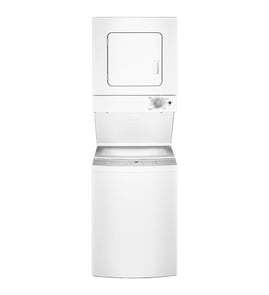



How many cubic feet is a Kenmore 41793802200 washer?
The Kenmore 41793802200 washer is a compact, top-load washer used in a stacked laundry center; washers in this Kenmore 417-series design class are typically about 3.9 cu. ft. capacity. For the exact rated capacity for your specific unit, confirm it in the 41793802200 owner's manual.
Use the manual and the model/serial tag to match the published spec to your exact configuration.
- Check the Specifications or Features section in the 41793802200 owner's manual
- Look for the model and serial label on the washer cabinet (commonly under the lid or on the frame)
- Follow the load guidance in the manual: keep the dry load below the top row of holes in the wash tub
- If loads finish too wet, reduce load size and redistribute items before the spin cycle
| Capacity range | What it handles well | Best practice |
|---|---|---|
| 3.2 to 3.5 cu. ft. | Medium mixed loads | Avoid overfilling with towels |
| About 3.9 cu. ft. | Larger mixed loads | Load loosely; do not pack |
| 4.0+ cu. ft. | Extra-large loads | Balance bulky items carefully |
Using the correct capacity helps prevent overloading, improves cleaning and rinsing, and reduces out-of-balance spinning. It also helps you choose the right detergent amount and cycle settings for Kenmore high-efficiency wash action.
If you are chasing “small capacity” symptoms that are really a drain issue (slow drain, wet loads), inspect the drain path and consider the washer drain pump 137221600 when diagnosing poor draining.
Last updated: February 2026
How to read Kenmore model numbers?
Kenmore model numbers are read left to right; the first 3 digits are the manufacturer prefix, and the remaining digits identify the specific product design and version. For Kenmore stacked laundry center model 41793802200, the 417 prefix is the key identifier we use to match the correct parts and service information in the 41793802200 owner's manual.
On Kenmore model 41793802200, the model and serial numbers are recorded from the serial plate located inside the dryer door.
- Open the dryer door and look along the door opening for the serial plate
- Write down the full model number and serial number exactly as shown
- Keep the numbers with your purchase records for future parts lookup
- Use the full model number (not just the 3-digit prefix) when ordering parts
Kenmore model numbers typically follow this pattern:
| Section | Example | What it tells you |
|---|---|---|
| Manufacturer prefix | 417 | Who built the unit (used for parts system matching) |
| Base model + version | 93802200 | The specific design, features, and production variation |
Many Kenmore laundry centers share the same prefix, but use different components (timers, switches, pumps, thermostats) depending on the exact version.
- Prevents ordering a similar-looking but incompatible part
- Helps match wiring and control layouts correctly
- Improves accuracy for troubleshooting steps and error code lists
- Ensures the right diagrams apply to your exact unit
If your unit displays a fault or won’t run correctly, the 417 series identifier is also used for washer and dryer error code references, which can speed up diagnosis.
Last updated: February 2026
How to unclog drain hose on Kenmore washer?
On the Kenmore 41793802200 stacked laundry center, unclogging the drain hose starts with eliminating kinks, then clearing lint or small items from the hose end and the pump inlet. Once the drain path is open, the washer should drain and spin normally again.
- Unplug the laundry center before servicing
- Turn off both water supply faucets
- Keep towels and a shallow pan ready for spills
- Wait about 1 minute for the lid lock to release after a spin
- Wear gloves; debris in the drain path can be sharp
- Check for a kink: Pull the unit forward and straighten the hose; the manual lists a kinked hose as a common cause of slow draining.
- Remove standing water: Bail out water or use a wet/dry shop vacuum at the standpipe before disconnecting anything.
- Inspect the hose end: Pull the hose from the standpipe and remove lint buildup at the outlet.
- Flush the hose: Run water through it (outside or into a tub). Use a small drain snake if needed.
- Check the pump inlet: Clear coins, socks, and lint where the tub-to-pump hose meets the pump housing.
- Reinstall and test: Run a short drain/spin and confirm strong flow.
| Symptom | Likely cause | Fix |
|---|---|---|
| Drains slowly | Kink or partial clog | Straighten and flush hose |
| Won’t drain | Blockage at pump inlet | Clear debris at pump path |
| Backs up at wall | Standpipe/house drain clogged | Clear standpipe or use a plumber |
A restricted drain hose leaves clothes too wet and can overwork the drain pump. Keeping the drain path clear helps prevent repeat drain problems.
For model-specific access and routing details, use the 41793802200 owner's manual. If the hose is split, soft, or collapsing, replace it with the correct washer drain hose 134592700.
Last updated: February 2026