Owner’s manual
 Error Codes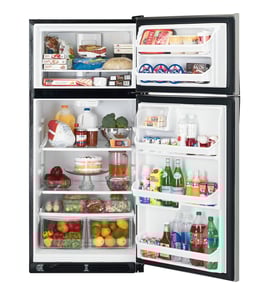






How many cubic feet is the Kenmore refrigerator model 10674252402?
The Kenmore top-mount refrigerator model 10674252402 has a total capacity of 21.9 cubic feet. For the most accurate confirmation for your exact configuration (shelves, ice maker, and bins), check the specifications section in the 10674252402 owner's manual.
Capacity details (what “21.9 cu. ft.” means)
Refrigerator capacity is the combined internal storage volume of the fresh food compartment and the freezer compartment.
- Capacity is measured as usable interior space, not exterior size.
- Shelves, crisper pans, and door bins reduce usable space for bulky items.
- An installed ice maker can reduce freezer storage volume.
- Airflow space matters; overpacking can reduce cooling performance.
Quick reference table
| Spec | What to expect | Why it matters |
|---|---|---|
| Total capacity | 21.9 cu. ft. | Helps compare models and plan food storage |
| Type | Top-mount refrigerator | Freezer on top, fresh food below |
| Best practice | Leave airflow gaps around items | Improves temperature stability and reduces frost |
Why it matters
Knowing the cubic feet helps you match the refrigerator to household needs, compare replacement models, and avoid overloading the compartments. Good airflow inside the cabinet supports consistent cooling and helps prevent warm spots.
Last updated: February 2026
How to read Kenmore model numbers?
Kenmore model numbers are structured so the first three digits identify the manufacturer, the next group identifies the base design, and the remaining digits indicate feature or production variations. For Kenmore refrigerator model 10674252402, the 106 prefix is the key manufacturer identifier; confirm the full model and serial from the label location shown in the 10674252402 owner's manual.
Where to find the model number on this refrigerator
On Kenmore top-mount refrigerators like 10674252402, the model and serial label is typically inside the fresh food (refrigerator) compartment on an interior wall.
- Open the refrigerator door and look along the side walls
- Check near the crisper area and lower side walls
- Write down the full model number and serial number exactly as shown
- Record the purchase date for service and parts matching
- Use the full model number when ordering parts like an ice maker assembly or door gasket
How to interpret a Kenmore model number (quick breakdown)
Most Kenmore model numbers follow this pattern:
| Section | Example | What it tells you |
|---|---|---|
| Manufacturer prefix | 106 | Who built the unit for Kenmore |
| Base model digits | 74252 | Core platform and configuration |
| Variation digits | 402 | Feature set, color, or production revision |
Why it matters for parts and troubleshooting
Using the full model number prevents mismatches when you are selecting parts and diagnosing symptoms.
- Ensures the correct fit for electrical parts (control board, run capacitor)
- Helps match door seal and trim variations (gasket panels)
- Improves accuracy for ice maker and water system parts
- Speeds up service calls because the tech can pull the right diagrams
Related help for Kenmore 106 refrigerators
If you are trying to decode a display issue or fault condition, use the Kenmore 106 model refrigerator error codes reference alongside your model number.
Last updated: February 2026
What are the disadvantages of a top mount fridge?
Top-mount refrigerators like Kenmore model 10674252402 keep the freezer on top and fresh food below; the main disadvantages are less convenient access to the refrigerator section, fewer organization features than many bottom-freezer designs, and fewer built-in dispenser options on many models. See the 10674252402 owner's manual for your exact feature set.
Common disadvantages (what you notice day to day)
- More bending for fresh food: the refrigerator compartment sits lower, so you reach down more often.
- Less “eye-level” organization: produce drawers and lower shelves can be easier to forget about.
- Fewer premium features on many top-mounts: external water and ice dispensers are less common.
- Odors can transfer between sections: because air circulates between freezer and refrigerator, smells can move from one section to the other if foods are not wrapped well.
- Airflow can be easier to block: overpacking can block vents and cause temperature and moisture problems.
How to reduce the downsides
We recommend these practical habits for the 10674252402 style top-mount layout:
- Keep everyday items on the upper refrigerator shelves to reduce bending.
- Leave space around air vents; do not pack food tightly against vent openings.
- Wrap foods tightly and clean spills quickly to limit odor transfer.
- If you have an ice maker, plan for rear clearance for the water line and avoid storing items on top of the ice maker.
- Use clear bins to improve visibility in lower shelves and crisper areas.
Quick comparison: top-mount vs. bottom-freezer
| Feature | Top-mount refrigerator | Bottom-freezer refrigerator |
|---|---|---|
| Fresh food access | Lower, more bending | Higher, more convenient |
| Freezer access | Easy, at eye level | Lower drawer, more bending |
| Typical organization | Simpler shelving | Often more drawers/bins |
| Dispenser options | Less common | More common on many models |
Why it matters
Layout affects comfort and food freshness. When vents are blocked, airflow is reduced and temperature and moisture issues can show up; when foods are not covered, odors can move between compartments due to shared air circulation.
Last updated: February 2026
What's the average lifespan of a Kenmore refrigerator?
Most Kenmore refrigerators last 12 to 15 years on average with normal household use. For your Kenmore 10674252402 top-mount refrigerator, consistent cleaning, good airflow around the cabinet, and fixing small issues early are the best ways to reach (or beat) that range; see the 10674252402 owner's manual.
What affects refrigerator lifespan most
- Condenser cleanliness: dust buildup makes the compressor run hotter and longer.
- Door seal condition: air leaks force longer run times and can cause frosting.
- Temperature settings: overly cold settings increase run time and wear.
- Ventilation space: tight clearances trap heat and reduce efficiency.
- Usage habits: frequent door openings and overloading reduce cooling recovery.
Quick maintenance checklist (10 minutes)
- Vacuum dust from the front grille and condenser area (if accessible).
- Confirm doors close fully and do not pop open.
- Wipe and dry door gaskets; keep them clean so they seal.
- Keep food from blocking interior air vents.
- Level the refrigerator if it wobbles (helps doors align and seal properly).
Common “wear items” vs. major repairs
| Item type | Examples | Typical impact on lifespan |
|---|---|---|
| Wear/adjustment | Door gaskets, leveling, light switch | Often restores efficiency and prevents strain |
| Cooling/airflow | Fans, defrost parts | Prevents warm temps and frost buildup |
| Major sealed system | Compressor, refrigerant tubing | Usually the biggest cost decision |
Why it matters
A refrigerator that runs longer than it should (from dirty coils, poor airflow, or a weak door seal) puts extra load on the compressor and can shorten overall service life. Keeping the cabinet stable and the gaskets clean also helps prevent temperature swings and moisture problems.
Last updated: February 2026