Owner’s manual
 Error Codes


Are LG refrigerators expensive to repair?
Repairs on an LG LRMDS3006D refrigerator can be expensive when the problem involves the sealed cooling system (compressor, condenser, evaporator, refrigerant work) or electronic controls; those jobs often require specialized tools and a trained technician. Smaller issues like filters, switches, and some ice maker problems are usually more affordable.
What typically drives repair cost on LRMDS3006D
The owner’s manual for this model confirms it uses LED interior lighting (service by a qualified technician) and includes a water filter and air filter maintenance schedule; those details hint at where costs can vary between DIY maintenance and technician-only repairs. See the LRMDS3006D manual.
Common cost drivers include:
- Sealed system work: compressor, refrigerant leaks, brazing, evacuation and recharge
- Electrical/electronic diagnosis: control board or wiring harness troubleshooting
- Labor time and access: built-in installs, tight clearances, or heavy door removal
- Multiple symptoms: cooling plus ice/water issues can mean more than one failed component
- Service call fees: trip charge plus diagnostic fee before parts and labor
Typical “more affordable” vs “more expensive” repairs
Here’s a practical way to think about it:
| Repair type | Examples | Typical cost impact |
|---|---|---|
| Maintenance / simple replacement | water filter, air filter, some dispenser issues | Lower |
| Mid-level component repair | ice maker, fan motor, inlet valve | Medium |
| Sealed system / major electrical | compressor, refrigerant system, main PCB | Higher |
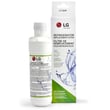
If your issue is odor control or the filter reminder is on, replacing the fresh air filter is usually straightforward; a compatible option for this model is the LG kenmore refrigerator air filter ADQ73214408.
Quick checks before paying for service
These steps can prevent an unnecessary service call:
- Confirm the unit is not in Display/Demo Mode (cooling disabled)
- Verify doors fully close and gaskets seal (warm air causes longer run time)
- Check freezer is set near 0°F and refrigerator near 37°F
- If ice maker is on, confirm the water supply valve is fully open and pressure is adequate
- Clean condenser cover and vents (restricted airflow can mimic bigger failures)
Why it matters
On a French door bottom-mount refrigerator like the LRMDS3006D, a “no cool” complaint can range from a simple airflow/maintenance issue to a sealed system failure. Identifying which category you’re in helps you avoid overspending and gets you to the right fix faster.
Last updated: January 2026
Can I replace fridge parts myself?
Yes. On the LG LRMDS3006D refrigerator, we can usually replace many “bolt-on” or “snap-in” parts ourselves (filters, bins, switches, some fans) with basic tools and careful steps from the LRMDS3006D owner’s manual. For sealed-system repairs (refrigerant, compressor work), we recommend a qualified technician.
Good DIY repairs vs. pro-only repairs
DIY-friendly (typical):
- Replacing the refrigerator water filter and flushing the dispenser
- Replacing the fresh air filter
- Swapping a door bin, shelf support, or handle hardware
- Replacing a door switch or dispenser switch
- Cleaning condenser vents and checking for airflow restrictions
Usually pro-only (typical):
- Sealed-system work (refrigerant leaks, brazing, evacuating/charging)
- Compressor replacement and system diagnosis
- Internal LED lighting service on many models
Parts on this model that are commonly DIY
If your symptom points to one of these, it is often a reasonable DIY job on LRMDS3006D:
- Water filter: LG lt1000p refrigerator water filter ADQ74793501
- Fresh air filter: LG kenmore refrigerator air filter ADQ73214408
- Dispenser not responding: LG refrigerator dispenser switch 6600JB3001C
Before you start (quick checklist)
- Unplug the refrigerator or turn off power at the breaker.
- Shut off the water supply if you are working on water lines, the filter head, or the inlet valve.
- Protect floors and doors; use gloves to avoid sharp edges.
- Take photos of wire connectors and routing before disconnecting anything.
- Confirm the part is listed for LG LRMDS3006D before ordering.
DIY decision guide
| Repair type | Skill level | Typical tools | Risk level |
|---|---|---|---|
| Filters, bins, shelves | Easy | None to screwdriver | Low |
| Switches, simple motors | Medium | Screwdriver, nut driver | Medium |
| Compressor or refrigerant system | Advanced | Specialized | High |
Why it matters
DIY repairs can save time and money, but choosing the right repair level protects the cooling system and helps prevent water leaks, electrical issues, or repeat failures.
Last updated: January 2026
How big is a 300l fridge?
A “300L fridge” refers to capacity (300 liters), not a fixed exterior size. For the LG LRMDS3006D refrigerator, the owner’s manual lists the cabinet dimensions as about 35 3/4 inches wide and about 70 1/4 inches tall to the top of the hinge; depth varies depending on whether the doors and handles are included. See the LRMDS3006D owner’s manual for the full dimensions and clearances.
What 300 liters means (capacity)
300 liters is the internal storage volume. It does not tell you the outside width, height, or depth because those vary by style (French door, bottom-mount, counter-depth vs standard-depth) and insulation thickness.
Common ways 300L is described:
- 300 L = 0.3 cubic meters of storage
- 300 L = 300,000 cubic centimeters
- Capacity is split between fresh food and freezer sections
- Shelves, bins, and ice maker space reduce “usable” space
LRMDS3006D size reference (from the manual)
For LG LRMDS3006D, the manual provides these key exterior measurements:
| Measurement | Approximate size |
|---|---|
| Width | 35 3/4 in |
| Height to top of hinge | 70 1/4 in |
| Depth with handle | 38 1/8 in |
| Depth without handle | 35 3/4 in |
Clearance guidance from the manual:
- Allow at least 24 inches in front to open doors
- Allow about 2 inches behind for airflow and connections
Why it matters
If you are fitting a refrigerator into a kitchen opening, the outside dimensions and required clearances matter more than liters. Capacity helps compare storage volume, but installation fit depends on width, height, depth, and door swing.
Last updated: January 2026
How do you reset the bottom ice maker?
On the LG LRMDS3006D, the “bottom” ice maker is the freezer (Craft Ice) icemaker. To reset it, we turn the icemaker power switch OFF, wait about 30 seconds, then turn it back ON and allow time for a new harvest cycle to start (ice production can take hours). For model-specific details, use the LRMDS3006D manual.
Quick reset steps (freezer/bottom icemaker)
- Open the freezer drawer and locate the Craft Ice icemaker.
- Flip the icemaker power switch to OFF (O).
- Wait 30 seconds.
- Flip the switch back to ON (|).
- Close the drawer fully and avoid frequent openings.
- Wait for ice production to resume (first ice after a reset can take 24 to 48 hours depending on conditions).
If it still won’t make ice
These checks solve most “no ice” complaints after a reset:
- Confirm the household water shutoff valve is fully open.
- Verify freezer temperature is set to 0°F (-18°C).
- Make sure the ice bin is seated correctly and not overfilled.
- Check for frost or debris blocking the ice-detecting area.
- If water flow is slow, replace the water filter and flush the system (see how to change the water filter in an LG refrigerator).
What “reset” can and can’t fix
| Situation | Reset helps? | What usually fixes it |
|---|---|---|
| Icemaker paused after being turned off | Yes | Power switch OFF/ON reset |
| New install or recently moved fridge | Sometimes | Wait for temps to stabilize |
| Low water pressure or kinked line | No | Correct supply issue |
| Worn or failed icemaker module | No | Replace the icemaker |
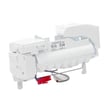
If you suspect the icemaker itself has failed, use a model-compatible replacement such as the refrigerator ice maker AEQ73449909.
Why it matters
A simple power-cycle reset clears minor logic stalls, but ice production still depends on proper freezer temperature, steady water pressure, and a fully closed freezer drawer.
Last updated: January 2026
How many years does an LG refrigerator last?
Most LG refrigerators, including the LG LRMDS3006D, typically last 10 to 15 years with normal household use and basic maintenance. Lifespan depends most on compressor run time, door seal condition, condenser cleanliness, and keeping temperatures set correctly (see the LRMDS3006D owner's manual).
What affects lifespan the most
A refrigerator usually reaches the higher end of its lifespan when these items stay in good shape:
- Condenser coils stay clean so the compressor does not overwork
- Door gaskets seal tightly to prevent warm air leaks
- Air vents stay unblocked inside the fresh food and freezer sections
- Water filter and air filter are maintained to keep airflow and water flow normal
- Doors are opened less often and not left ajar
Maintenance schedule we recommend
Use this simple schedule to help your LRMDS3006D run longer.
| Task | How often | Why it helps |
|---|---|---|
| Clean condenser cover and vents | Every 6 months | Reduces compressor strain |
| Replace air filter | About every 6 months | Helps control odors and airflow |
| Replace water filter | About every 6 months | Prevents low flow and ice maker issues |
| Check door gasket seal | Every 3 to 6 months | Prevents warm air leaks |
If you need a compatible replacement, use the LG lt1000p refrigerator water filter ADQ74793501 and follow the steps in how to change the water filter in an LG refrigerator.
Signs your refrigerator is nearing end-of-life
These symptoms often show up more as a refrigerator ages:
- Compressor runs almost constantly even with normal room temperature
- Temperatures drift (food freezing in fresh food section or soft ice cream)
- Excessive noise changes (new rattling, buzzing, or loud fan sounds)
- Water dispensing slows even after a filter change
- Frost buildup or recurring condensation from door sealing issues
Why it matters
A refrigerator that is working harder than it should uses more electricity and is more likely to have cooling or ice maker problems. Simple upkeep (especially coil cleaning and filter changes) is one of the best ways to protect the compressor and extend service life.
Last updated: January 2026
What is the most common problem with LG refrigerators ice?
On the LG LRMDS3006D, the most common ice problem is reduced or no ice production caused by a water supply issue (low pressure, shutoff valve not fully open, or a restricted filter) or a simple ice bin/chute blockage. We recommend starting with the checks in the LRMDS3006D manual.
Quick checks that fix most “no ice” complaints
- Confirm the icemaker power switch is set to ON.
- Make sure the household water shutoff valve is fully open.
- Verify freezer temperature is set to 0°F (-18°C) for normal ice production.
- Empty the ice bin and break up clumped cubes; clumps can stop dispensing and confuse the ice level sensor.
- Clear frost or ice fragments from the dispenser chute (dispensing cubed ice regularly helps reduce frost buildup).
- Replace the water filter if flow is slow or the filter indicator is on; for this model, a common replacement is the LG lt1000p refrigerator water filter ADQ74793501.
What “common” looks like on this model
The LRMDS3006D uses an in-door ice system and can stop making ice when the bin is full, the sensor area has frost/debris, or water flow is restricted.
| Symptom | Most likely cause | First action to take |
|---|---|---|
| No ice at all | Icemaker switched off or no water supply | Turn icemaker ON; confirm shutoff valve is open |
| Slow ice production | Freezer too warm or restricted water flow | Set freezer to 0°F; replace filter |
| Ice won’t dispense | Clumped ice or frosted chute | Break up ice; clear chute |
Why it matters
Ice makers are very sensitive to freezer temperature and water flow. A partially clogged filter or low water pressure can reduce ice output long before you notice a problem with drinking water.
When a part is likely involved
If you have good water pressure, a fresh filter, and correct temperatures but still get no ice, the icemaker itself may be failing. For model-matched replacement options, see the refrigerator ice maker AEQ73449909.
Last updated: January 2026