Owner’s manual
 Error Codes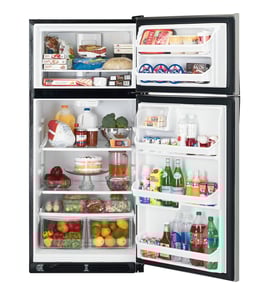






What is the top part of a fridge called?
On a Kenmore 10664952401 top-mount refrigerator, the top section is the freezer compartment (often just called the freezer). It’s the area designed to keep foods frozen and it also supplies cold air that helps cool the fresh-food section.
What the freezer does (and why it affects the fridge)
The freezer is more than storage for frozen food; it’s also where the cooling airflow starts.
- Cold air enters and circulates through the freezer first
- Some of that air moves into the refrigerator section through vents
- Blocking vents with food packages can cause warm temperatures and moisture issues
- Odors can transfer between sections because air circulates between them
Common names you may see in the manual
Depending on the section you’re reading, the freezer may be referenced in a few ways. Check the owner's manual for the exact terms used for your shelves, vents, and features.
| What you call it | What it usually means | Where it is |
|---|---|---|
| Freezer | Freezer compartment | Top section |
| Freezer section | Cooling and frozen storage area | Top section |
| Freezer features | Shelves, floor, bins, etc. | Top section |
Why it matters
If the freezer vents are blocked or the freezer door is opened often, the refrigerator section can warm up because the fridge depends on freezer airflow for cooling. Keeping vents clear helps both compartments hold steady temperatures.
Last updated: February 2026
How to tell cubic feet of Kenmore refrigerator by model number?
For Kenmore model 10664952401, the model number by itself usually does not reliably tell the exact cubic-foot capacity. The most accurate way is to look up the capacity in the specifications section of the owner's manual, or calculate it from the interior measurements (refrigerator and freezer compartments).
Fast ways to find the cubic feet
- Check the specifications section in the owner's manual for listed capacity.
- Look for a tech/spec sheet if your unit has one stored behind the toe grille or inside the cabinet (varies by design).
- Measure the usable interior of each compartment and calculate cubic feet.
- If you only need a ballpark, most Kenmore 106 top-mount refrigerators commonly fall in the roughly 18 to 22 cu. ft. range (exact capacity varies by configuration).
How to calculate cubic feet (simple method)
- Empty enough space to measure accurately.
- Measure the interior (not the outside cabinet) of the refrigerator compartment:
- Height (inches)
- Width (inches)
- Depth (inches)
- Multiply:
H x W x D = cubic inches - Convert to cubic feet:
cubic inches ÷ 1728 = cubic feet - Repeat for the freezer compartment and add the two results.
Quick reference table
| What you measure | Use this formula | Notes |
|---|---|---|
| One compartment | (H x W x D) ÷ 1728 | Use interior, usable space |
| Total capacity | Fridge cu. ft. + Freezer cu. ft. | Matches how capacity is typically stated |
Why it matters
Capacity helps you compare refrigerator sizes, choose storage bins and organizers, and estimate how much food you can safely store. For example, freezer loading guidance is often expressed per cubic foot of freezer space.
Last updated: February 2026
What is the average life expectancy of a Kenmore refrigerator?
Most Kenmore refrigerators, including model 10664952401, typically last 12 to 15 years with normal household use. Consistent cleaning, good airflow around the cabinet, and keeping the doors sealing properly are the biggest factors that help you reach (or beat) that range; see the owner's manual for model-specific care guidance.
What affects refrigerator lifespan the most
- Condenser airflow and cleanliness: dust buildup and poor ventilation make the system run hotter and longer.
- Door gasket condition: leaks force longer run times and can lead to frost and temperature swings.
- Room temperature and humidity: warm or humid conditions increase run time.
- How often doors are opened: frequent openings add heat load and extend compressor run time.
- How full it is and what you store: large warm loads (like groceries) temporarily increase run time.
Quick maintenance checklist (high impact)
- Vacuum dust from the condenser area and keep clearance for airflow.
- Confirm doors close fully and do not bounce back.
- Clean the gasket sealing surfaces; if gaskets stick, clean them and apply a thin coat of paraffin wax.
- Keep temperatures stable (avoid frequent control changes).
- Level the refrigerator if it wobbles or doors do not self-close smoothly.
What “normal run time” looks like
Your refrigerator running a lot is not automatically a sign it is failing. The manual notes that at normal room temperatures, the motor commonly runs about 40% to 80% of the time, and it can run even more in warmer conditions.
| Situation | What you may notice | What it means |
|---|---|---|
| Hot room or poor airflow | Longer run times | Normal load increase; improve ventilation/cleaning |
| Doors opened often | Compressor runs more | Normal; reduce door openings |
| Large grocery load | Extended cooling cycle | Normal for several hours |
Why it matters
Longer run times increase wear on the sealed refrigeration system (compressor, refrigerant tubing) and can shorten overall life. Keeping the cabinet sealed and the unit breathing well is the simplest way to protect performance over the years.
Last updated: February 2026
What are the most common problems with Kenmore refrigerators?
The most common issues we see on Kenmore refrigerators like model 10664952401 are no-cool or warm temperatures, the unit not running at all, excessive running, unusual noises, moisture buildup, and ice maker complaints. Many of these trace back to airflow, control settings, door sealing, or a failed electrical or cooling component; use the owner's manual troubleshooting steps first.
Common symptoms and what they usually point to
- Refrigerator or freezer too warm: blocked air vents, frequent door openings, warm room conditions, or temperature controls set incorrectly
- Unit will not run: power cord unplugged, tripped breaker or blown fuse, temperature control set to OFF, or the unit is in a defrost cycle
- Runs too much: doors opened often, large food load, doors not fully closing, or settings not matched to room conditions
- Lights do not work: loose or burned-out bulb, or a failed door switch such as the refrigerator light switch W11384469
- Moisture buildup inside: high humidity, doors opened often, or air vents blocked
- Ice maker slow or not making enough ice: freezer not cold enough yet, recent installation (needs time), or shutoff arm in the OFF position
Quick checks we recommend first (fast, no tools)
- Confirm the refrigerator is plugged into a grounded 3-prong outlet and the breaker is on.
- Make sure the temperature control is not set to OFF; adjust in small steps and wait 24 hours between changes.
- Check that air vents are not blocked by food packages.
- Push doors fully closed; reorganize items that prevent sealing.
- If the ice maker is new or recently reconnected, allow up to 72 hours for full ice production.
Helpful “normal vs. problem” guide
| What you notice | Often normal | More likely a problem |
|---|---|---|
| Motor runs a lot | Warm room, doors opened often, large food load | Doors not sealing, controls set too cold, airflow blocked |
| Moisture inside | Humid room, frequent door openings | Vents blocked, door not closing fully |
| Ice production is low | First 72 hours after install or hookup | Freezer too warm, shutoff arm up |
Why it matters
Catching airflow and door-seal issues early helps your 10664952401 cool evenly, reduces run time, and prevents frost, moisture, and ice maker performance problems.
Last updated: February 2026
What are the disadvantages of a top mount fridge?
Top-mount refrigerators like Kenmore model 10664952401 trade convenience for simplicity: you bend more to reach fresh food, the freezer can feel tighter to organize, and many top-freezer designs skip dispenser-style features. Use the owner's manual to match these tradeoffs to your kitchen and habits.
Common disadvantages (what you notice in daily use)
- More bending for fresh food: the refrigerator section sits below the freezer.
- Freezer organization can feel limited: upper freezers often have less “zone” separation than drawer-style bottom freezers.
- Fewer built-in feature options on many top-mounts: external water and ice dispensers are less common.
- Odor transfer is easier if food is uncovered: air circulates between compartments, so smells move if items are not wrapped.
Model-specific notes from the Kenmore 10664952401 manual
Your manual calls out a few realities of top-mount airflow and installation that can feel like “downsides” if you are not expecting them:
- Airflow depends on keeping vents clear; blocking vents can cause temperature and moisture problems.
- Odors can transfer between sections because air circulates between the freezer and refrigerator.
- Clearance matters for ventilation and door swing: allow 1/2 inch (1.25 cm) space on each side and at the top; when next to a fixed wall, leave 2 inches (5.08 cm) minimum clearance on each side for the door to swing open (some installations need more).
Quick comparison: top-mount vs bottom-freezer
| Feature | Top-mount (10664952401 style) | Bottom-freezer |
|---|---|---|
| Fresh-food access | Lower; more bending | Higher; easier access |
| Freezer access | Upper; easy reach | Lower; may require bending |
| Odor management | Needs tight wrapping due to shared airflow | Similar, but layout varies |
| Installation near wall | Needs door-swing clearance | Needs door-swing clearance |
Why it matters
Most frustrations with top-mount refrigerators come from ergonomics (bending) and airflow habits (overpacking, blocked vents). Setting up shelves for quick access and keeping vents open prevents warm spots and moisture issues.
Last updated: February 2026