Owner’s manual
 View engine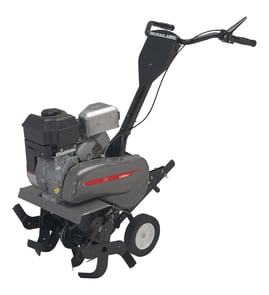



Where is the model number on a Craftsman tiller?
On a Craftsman tiller, the model number is printed on the tiller’s identification label; for Craftsman model 917292403, check the tine shield/guard area first, then look around the engine and handle column if you do not see it. Confirm the exact format in the 917292403 owner's manual.
Common places to check on a front-tine tiller
- Tine shield or tine guard (near the front where the tines are)
- Handle column or control panel area
- Frame rail near the transmission housing
- Engine area (near the recoil starter or engine shroud)
- Under dirt buildup; wipe the area clean to reveal the label
What the label looks like (and what to write down)
The label typically includes a model number and may also include a serial number. For this Craftsman tiller, the manual shows the model as 917.292403 (you may also see it written without the dot as 917292403).
| What you see | What it means | Use it for |
|---|---|---|
| 917.292403 | Model number format used in the manual | Matching parts diagrams and repair parts lists |
| 917292403 | Same model number without punctuation | Searching parts and manuals |
| Serial number | Unique ID for your specific unit | Verifying production details when ordering |
Why it matters
Using the exact model number helps us match the correct Craftsman tiller parts (like belts, pulleys, and tine hardware) so you avoid ordering a similar-looking part that will not fit.
Last updated: January 2026
Which is better, rear or front tine tiller?
For most homeowners, a rear-tine tiller is better for breaking new ground and working hard, compacted soil; a front-tine tiller is better for smaller gardens, lighter soil, and easier storage. Your Craftsman 917292403 is a front-tine tiller with a 26-inch tine width, so it’s built for general garden prep and cultivating rather than heavy sod busting (see the 917292403 owner's manual).
Quick comparison: front tine vs rear tine
| Feature | Front-tine tiller (like 917292403) | Rear-tine tiller |
|---|---|---|
| Best for | Existing beds, seasonal soil prep, cultivating | New ground, hard soil, larger areas |
| Handling | More “pull” and bounce in hard soil | More stable, less operator effort |
| Typical cost/weight | Lower, lighter | Higher, heavier |
| Maneuvering/storage | Easier in tight spaces | Needs more room |
How we recommend choosing
- Choose front tine if you till a few times per season, have lighter soil, and want a simpler machine.
- Choose rear tine if you regularly break new ground, have clay or compacted soil, or need maximum traction and control.
- If you mainly fight weeds between rows, either style works, but front tine is usually plenty.
Getting the best results from a front-tine tiller
Your 917292403 will perform best when you set it up for the conditions:
- Start shallow in hard soil; then make deeper passes.
- Avoid extremely dry soil (tines won’t penetrate) and extremely wet soil (it clumps).
- Use wider turns and leave an untilled row between passes to reduce “pull.”
- Adjust handle height for comfort and control.
- Adjust tine arrangement (width) to match the job.
Why it matters
Matching tiller style to soil and garden size reduces operator fatigue, improves tilling depth consistency, and helps prevent excessive bouncing and belt strain. For front-tine models, correct depth stake and tine setup make the biggest difference.
For step-by-step tine service, use how to replace the tines on a front tine tiller.
Last updated: January 2026
How to use a tiller with front tines?
To use the Craftsman front-tine tiller model 917292403, we set the depth stake and wheel height first, start the engine at a slower throttle until we get comfortable, then engage the forward tine control so the tines pull the machine into the soil. Use the handles to control speed and bite.
Set up the depth stake and controls
The depth stake is the main “how deep” and “how fast” control on a front-tine tiller; it acts like a brake so the tines can dig instead of the tiller racing forward.
- Lower the depth stake below the wheels for digging.
- Start shallow for the first pass; lower the stake more on later passes.
- Use the throttle control to manage engine speed.
- Use the forward tine control to start forward movement and tine rotation.
- Use the reverse tine control only when you need to back out.
For control locations and operating steps, follow the 917292403 owner's manual.
Basic operating technique (what to do while tilling)
- Begin with throttle in a slow position (about mid-way between FAST and IDLE).
- To help the tiller move forward, lift the handles slightly (this lifts the depth stake out of the ground a bit).
- To slow the tiller down and increase bite, press down on the handles.
- If the tiller shakes or you are straining, adjust wheel height and the depth stake for the soil conditions.
Quick reference: what each control does
| Control | What it affects | What you change |
|---|---|---|
| Depth stake | Forward speed and digging depth | Stake position (higher or lower) |
| Throttle control | Engine speed | Throttle lever position |
| Forward tine control | Forward movement and tine rotation | Engage or release |
| Reverse tine control | Reverse movement | Engage or release |
Safety and shutdown essentials
- Wear eye protection; tilling can throw debris.
- To stop: release the forward tine control (and reverse tine control if used), then move the throttle control to STOP.
- Never use the choke to stop the engine.
Why it matters
Correct depth stake and handle technique keeps the tiller stable, prevents “running away” across hard ground, and helps the tines penetrate for better soil prep and cultivating.
Last updated: January 2026
What tiller is made in the USA?
Some Mantis tiller models are made in the USA. If you are comparing brands while maintaining a Craftsman 917292403 front-tine tiller, use the Craftsman 917292403 owner's manual to follow the correct fuel, oil, and tune-up specs for your exact engine and configuration.
How to confirm a tiller is USA-made before you buy
Use these checks to verify origin on the exact model you are considering.
- Read the country-of-origin label on the frame tag or engine shroud
- Match the exact model number and model year; origin can change by production run
- Check whether it says “made” versus “assembled” in the USA
- Confirm parts and service support availability in the United States
- Keep a copy of the warranty statement and serial number for future reference
If you already own a Craftsman 917292403
Country of manufacture does not change the maintenance steps that keep your tiller reliable. The manual for model 917292403 lists product specifications (fuel type, oil viscosity by temperature, and spark plug details) and also highlights common wear items.
- Follow the manual’s product specifications section for fuel, oil, and spark plug requirements
- Replace normal wear items as needed (tines, spark plugs, air cleaners, belts)
- Disconnect the spark plug wire before adjustments or repairs
| Topic | What to check | Where to find it |
|---|---|---|
| Fuel and oil specs | Correct type and viscosity for your conditions | Product specifications in the manual |
| Tune-up items | Spark plug, air filter, belt condition | Maintenance section and parts diagrams |
| Wear parts | Tines and drive belt condition | Parts list and inspection steps |
Why it matters
“Made in USA” is a buying preference; day-to-day performance comes from using the correct specifications and replacing wear parts on time. Staying aligned with the manual helps prevent hard starting, poor tilling, and premature belt or tine wear.
Last updated: January 2026