Owner’s manual
 Error Codes


How to remove bottom grille on GE refrigerator?
On the GE PWE23KSKBSS bottom-mount refrigerator, the bottom grille (base grille/toe grille) typically comes off by releasing its retaining tabs or removing a couple of screws, then pulling the grille straight out. We recommend following the model-specific steps in the PWE23KSKBSS owner's manual to avoid cracking the grille or bending the mounting points.
Before you start
- Unplug the refrigerator or switch off power at the breaker (safer around wiring and fans).
- If the unit is tight to the wall, pull it straight out a few inches; avoid rolling over the power cord or water line.
- Protect the floor with cardboard or a thin panel.
- Use a flashlight to locate fasteners and tab locations.
How to remove the bottom grille (common GE method)
- Look along the top edge and corners of the grille for screws (often Phillips or 1/4-inch hex head).
- If screws are present, remove them and set them aside.
- Grip the grille near both ends and pull straight outward to release the tabs.
- If it feels stuck, press inward slightly, then pull outward again; this helps unseat tight clips.
- Lift the grille away and place it flat so it does not warp.
Reinstalling the grille
- Align the grille tabs with the slots in the cabinet.
- Push evenly until it snaps fully into place.
- Reinstall any screws snugly (do not overtighten).
Quick troubleshooting if it will not come off
- Grille flexes but will not release: one side is still clipped; pull from the stuck side while supporting the other.
- No visible screws: it is likely all-tab retention; pull straight out, not upward.
- Screws spin but do not back out: the grille may be hooked; apply gentle outward pressure while removing screws.
Why it matters
Removing the bottom grille gives access for cleaning dust from the condenser area and checking airflow. Better airflow helps the compressor and fans run cooler and can improve temperature stability.
| What you see | Most likely attachment | What to do |
|---|---|---|
| 2 screws at corners | Screw + tabs | Remove screws, then pull out |
| No screws, tight fit | Tabs/clips only | Pull straight out evenly |
| One side releases first | Mixed clip tension | Work side-to-side, do not twist |
Last updated: February 2026
What is the most common problem with GE refrigerators ice maker?
The most common ice maker problem on a GE refrigerator like model PWE23KSKBSS is no ice production because the unit is not cold enough to start the ice cycle, the water supply is restricted (often a clogged filter), or the ice maker is off. The ice maker typically starts filling once it cools to about 15°F.
Most common causes (and what to check first)
- Freezer temperature too warm: Ice makers commonly stop making ice when the freezer is above the ice-making range.
- New install or recent power outage: It can take 12 to 24 hours to begin making ice after startup.
- Water supply not connected or shut off: The refrigerator must be connected to water and the ice maker must be turned on.
- Clogged water filter: A restricted filter can slow water flow and reduce ice production.
- Ice bin or feeler arm interference: If something blocks the feeler arm sweep, production can stop.
Quick troubleshooting steps for PWE23KSKBSS
- Confirm the ice maker is turned on in the controls.
- Verify the freezer is cold enough; the ice maker typically fills when it reaches about 15°F.
- If the refrigerator was just installed, wait a full 24 hours for normal ice production.
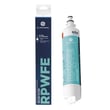
- Replace the filter if water flow is slow or ice output dropped; use the GE refrigerator water filter RPWFE.
- Dump the first batches after restoring water or replacing a filter; we recommend discarding the first few batches to clear the water line.
What you may notice (normal vs. not normal)
| Symptom | Usually means | What to do |
|---|---|---|
| Buzzing during fill | Water valve energizing | Normal during fill cycles |
| Cubes stuck together | Bin fills and cubes contact | Normal occasionally |
| Cloudy or stale ice | Ice not used often | Empty bin and make fresh ice |
Why it matters
Ice makers depend on two basics: cold enough freezer temperature and steady water flow. When either one is marginal, you will see slow production, small cubes, hollow cubes, or no ice at all. The PWE23KSKBSS owner's manual also notes that low household water pressure can cause the ice maker to cycle more than once to complete a batch.
Last updated: February 2026
What are the disadvantages of a bottom freezer refrigerator?
Bottom-freezer refrigerators like the GE PWE23KSKBSS keep fresh food at eye level, but the tradeoffs are real: the freezer is lower (more bending), the drawer layout can hide items, and some repairs (like defrost or drain issues) can be more involved than on simpler top-freezer designs. See the PWE23KSKBSS owner's manual for your model’s safety and use guidance.
Common disadvantages (what owners notice most)
- More bending and lifting: you reach down for frozen foods, and heavy baskets can be awkward.
- Deep drawer organization: items stack and get buried; you may need bins to keep it sorted.
- Freezer access is slower: drawers often require more clearance to open fully.
- Heavier door components: the freezer door and slides can be heavy; use two hands when removing or reinstalling the freezer door.
- Potential for drain and defrost hassles: bottom-freezer designs can be more sensitive to airflow restrictions and defrost drainage problems that lead to frost buildup or water puddles.
- Higher upfront cost (typical): many bottom-freezer models cost more than basic top-freezer units with similar capacity.
Why these drawbacks matter
A bottom-freezer layout is great when you use the refrigerator section most, but it can be frustrating if you access frozen foods frequently, store bulky items (pizza boxes, turkeys), or want quick visibility of everything in the freezer.
Bottom freezer vs. top freezer: quick comparison
| Feature | Bottom freezer | Top freezer |
|---|---|---|
| Fresh food access | Easier (eye level) | More bending |
| Freezer access | More bending | Easier |
| Organization | Deep drawers can hide items | Shelves are easier to see |
| Typical complexity | More moving parts (slides, drawers) | Simpler layout |
Tips to reduce the downsides
- Use clear bins or labeled baskets to prevent “lost” items.
- Keep heavy items (meat, large bags) in the lowest, most stable spot.
- Avoid blocking vents; good airflow helps prevent temperature swings and frost.
- If you see water under the unit, follow a drain-check routine from how to get rid of refrigerator puddles.
Last updated: February 2026