Installation guide
 Owner’s manual
 Error Codes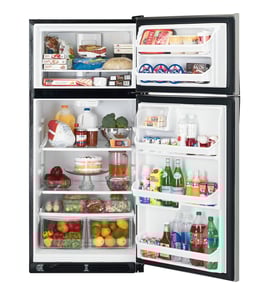

How much clearance does a refrigerator need on top?
For the Kenmore 25360609415 top-mount refrigerator, we recommend 3/8 inch of clearance at the top (and 3/8 inch on the sides) to support proper air circulation and easier installation; allow 1 inch at the rear. These clearances come from the model’s installation requirements in the installation guide.
Recommended clearances (model 25360609415)
Use these minimum guidelines when placing the refrigerator into cabinetry or an alcove:
- Top: 3/8 inch
- Each side: 3/8 inch
- Rear: 1 inch
- Keep the unit away from direct sunlight and heat sources (range, dishwasher, etc.)
- Place it on a level floor that can support a fully loaded refrigerator
| Location | Minimum clearance | Why it’s needed |
|---|---|---|
| Top | 3/8 in. | Air circulation and fit during install |
| Sides | 3/8 in. | Air circulation and easier positioning |
| Rear | 1 in. | Room for airflow and connections |
Why it matters
Adequate clearance helps the refrigerator shed heat efficiently. Tight spacing can reduce cooling performance and make it harder to route electrical and (if equipped) water connections.
Quick install checks that prevent clearance problems
After positioning the refrigerator, we use these checks to confirm it will operate and seal correctly:
- Verify doors close freely and seal on all sides
- Confirm the cabinet is level side-to-side
- Tilt the refrigerator slightly back (about 1/4 inch) so doors self-close
- Recheck for any contact with cabinets after loading shelves and bins
Last updated: February 2026
How to tell cubic feet of Kenmore refrigerator by model number?
For Kenmore model 25360609415, the most reliable way to get cubic feet is to look up the capacity in the specifications section of the owner's manual. If you need a quick estimate, you can calculate interior volume by measuring usable inside height, width, and depth and converting cubic inches to cubic feet.
Option 1: Find capacity in the manual (best method)
Use the model documentation for 25360609415 and look for “capacity”, “total volume”, or “cubic feet” in the specs.
- Check the specifications pages first
- Look for separate fresh food and freezer capacities plus a total
- Use the exact model number 25360609415 (not just “253”)
Option 2: Estimate cubic feet by measuring the interior
This gives a close estimate of usable space (not always the same as published capacity).
- Empty the compartment you are measuring.
- Measure inside dimensions in inches:
- Height
- Width
- Depth (front to back)
- Multiply:
H x W x D = cubic inches - Convert to cubic feet:
cubic inches ÷ 1728 = cubic feet
- Measure the refrigerator section and freezer section separately
- Subtract space taken by large fixed components (air ducts, light housings) for a more realistic “usable” number
Quick conversion table
| What you have | Convert to cubic feet |
|---|---|
| Cubic inches | Divide by 1728 |
| Example: 34,560 in³ | 34,560 ÷ 1728 = 20.0 ft³ |
Can you decode cubic feet from the model number?
Some Kenmore model families include patterns that loosely correlate with size, but it is not consistent enough to treat as a dependable “capacity code.” For 25360609415, the manual/spec listing is the correct source for the official cubic feet.
Why it matters
Cubic feet affects food storage planning, replacement fit, and performance expectations. It also helps when ordering shelves, bins, and storage parts sized for your exact interior layout, such as the frigidaire refrigerator door gallon bin 240338001 or crisper drawer - refrigerator storage component by frigidaire 240337103.
Last updated: February 2026
What is the top part of a fridge called?
In a Kenmore 25360609415 top-mount refrigerator, the top section is the freezer compartment. It’s the area designed to keep foods frozen and, on some setups, it also supports ice-making components.
What the freezer compartment does
The freezer compartment is built to maintain temperatures low enough to freeze food safely and keep it frozen.
Common freezer functions include:
- Freezing and long-term storage of foods
- Keeping ice cream and frozen items firm
- Supporting an ice maker (if your refrigerator is equipped with one)
- Helping overall cooling by circulating cold air through the cabinet
How to confirm what’s “top” on your exact setup
Most top-mount refrigerators place the freezer above the fresh food section. For model-specific details like control locations, door removal notes, and installation clearances, use the installation guide.
Quick checks you can do:
- Look for the coldest temperature setting area; it’s typically associated with the freezer section
- Check for a freezer door seal and shelving designed for frozen foods
- Verify control guidance; many models recommend waiting 24 hours between temperature adjustments
Freezer vs. refrigerator section (at a glance)
| Section | Typical location | Primary purpose |
|---|---|---|
| Freezer compartment | Top (top-mount designs) | Keeps food frozen; may support ice maker |
| Fresh food compartment | Bottom | Keeps food chilled (not frozen) |
Why it matters
Knowing the correct compartment name helps when you’re reading temperature instructions, following door removal steps during moving, or ordering the right replacement parts (like door bins, gaskets, or shelves) for the correct door.
Last updated: February 2026
What are the most common problems with Kenmore refrigerators?
For Kenmore model 25360609415 top-mount refrigerators, the most common problems are poor cooling, frost buildup in the freezer, water leaking onto the floor, ice maker or water supply issues, and unusual noises. Many of these start with airflow restrictions, dirty condenser areas, or doors that are not sealing correctly.
Most common symptoms and what usually causes them
- Not cooling or warm refrigerator section: blocked air vents, evaporator fan issues, or condenser airflow problems
- Too much frost or ice buildup: defrost system trouble (heater, controls) or frequent door openings
- Water leaking or puddles: defrost drain restriction, water line connection seepage, or door left ajar
- Noisy operation: fan blade interference, fan motor wear, or cabinet not level
- Doors not closing or sealing: cabinet not tilted correctly, gasket not sealing, or hinge alignment issues
Quick checks we recommend first (safe DIY)
- Confirm the refrigerator is level and tilted slightly back so doors self-close. The installation instructions call for about 1/4 inch (6 mm) tilt front-to-back to help doors close and seal.
- Make sure the toe grille is not blocked; airflow at the lower front is essential.
- Check door sealing by closing a sheet of paper in the door; it should resist being pulled out.
- If you have an ice maker, verify the water supply basics: 30 to 100 psi, 1/4-inch OD copper tubing, and no leaks at fittings.
Parts that commonly relate to these problems
| Symptom | Common part area | Example part for this model |
|---|---|---|
| Frost buildup, warm temps | Defrost system | Refrigerator defrost heater 242044008 |
| Door not sealing, moisture | Door seal | Frigidaire refrigerator door gasket (white) 242193206 or frigidaire refrigerator door gasket (black) 242193212 |
| Rattling or fan noise | Condenser fan area | Electrolux refrigerator condenser fan blade 241639502 |
Why it matters
Cooling and frost complaints often trace back to airflow and sealing. When doors do not seal or the toe grille is blocked, the refrigerator runs longer, temperatures drift, and frost and moisture problems show up faster.
For model-specific setup and leveling details (including door alignment guidance), use the installation guide.
Last updated: February 2026
What water filter fits my Kenmore fridge?
For Kenmore model 25360609415, the model-matched “filter” part listed for the sealed refrigeration system is the refrigerator filter dryer; use refrigerator filter dryer 5303305677 when you are servicing the refrigerant circuit. If you are looking for a drinking-water filter for an ice maker or dispenser, confirm first whether this model uses an internal cartridge or an inline filter; see the installation guide.
Identify which “filter” you mean
Refrigerators can have two very different filter types:
- Water filter: filters drinking water for an ice maker and or dispenser
- Filter dryer: removes moisture and contaminants from refrigerant; used during sealed-system repairs
- Air filter (some models): reduces odors in the fresh food compartment
Model-matched part on this model
The parts list for Kenmore 25360609415 includes this filter-related component:
| Filter type | What it does | Model-matched part |
|---|---|---|
| Refrigerant filter dryer | Protects the compressor and capillary system by drying and filtering refrigerant | Refrigerator filter dryer 5303305677 |
If you meant the drinking-water filter (ice maker and or dispenser)
Use these checks to find the correct style before ordering:
- Look inside the fresh food compartment for a twist-in or push-in cartridge housing
- Check the rear lower area for an inline filter on the 1/4-inch water line
- Confirm the refrigerator is connected to a cold water supply; typical supply pressure is 30 to 100 psi
- Match the filter by the exact part number specified for the water system on your model
Why it matters
Ordering the right filter type prevents wasted time and avoids problems like leaks, restricted water flow, poor ice production, or sealed-system damage.
Last updated: February 2026