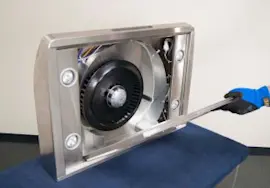
Installation guide
 Owner’s manual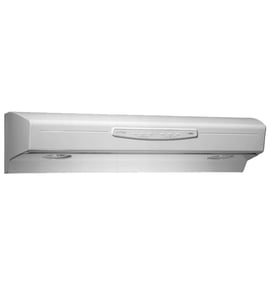

How wide should my range hood be for a 36 inch range?
For a 36-inch range, we recommend a range hood that is at least 36 inches wide. With the Thermador HMCB36FS chimney wall hood, proper performance also depends on centering the hood over the cooking surface and maintaining the required mounting height.
Recommended width (what to buy)
- Minimum: 36-inch hood for a 36-inch cooktop or range.
- Better capture: 42 inches (about 3 inches of overhang on each side) when space allows.
- Best results: Pair the right width with correct ducting and installation height.
| Cooktop/range width | Minimum hood width | Preferred hood width |
|---|---|---|
| 36 inches | 36 inches | 42 inches |
Installation details that matter for this model
The HMCB36FS is designed for exhaust-air mode and should be mounted over the center of the cooking surface. Keep the minimum clearance at 30 inches from the cooking surface to the bottom edge of the hood (electric and gas guidance in the installation instructions). See the installation guide for the exact mounting and duct connection steps.
- Mount over the centerline of the cooktop
- Maintain 30-inch minimum cooktop-to-hood clearance
- Use short, smooth duct runs with as few bends as possible
- Use a 6-inch round duct (recommended)
- Avoid tight bends and undersized ducting to reduce noise and improve airflow
Why it matters
A hood that is too narrow or mounted incorrectly lets smoke and grease escape around the sides, which can leave odors in the kitchen and increase grease buildup on cabinets and filters. Correct width plus correct height and ducting gives you the best capture and quieter operation.
Last updated: February 2026
What are the most common issues with HMCB36FS?
The most common issues we see with the Thermador HMCB36FS chimney wall hood involve weak or noisy ventilation, lights not working, and power or control problems. Many of these trace back to airflow restrictions (filters or damper), a failed lamp assembly, or a wiring connection issue; use the HMCB36FS owner's manual for model-specific checks.
Common symptoms and likely causes
- Low suction or poor smoke capture: clogged grease filter, blocked ducting, stuck backdraft damper
- Rattling or vibration: loose mounting hardware, duct not secured, damper flap chattering
- Lights not working: failed lamp assembly, loose lamp connection, power supply issue
- Hood won’t turn on: no power at outlet/breaker, damaged cord, loose terminal connection
- Intermittent operation: loose wiring, failing electrical component
Quick checks we recommend (before replacing parts)
- Turn power off at the breaker; confirm the hood is fully de-energized.
- Remove and clean the metal grease filter; reinstall it correctly.
- Inspect the duct path for obstructions and crushed flex duct; confirm the exterior cap opens.
- Check the damper for free movement; replace if it sticks or won’t seal.
- If lights are out, verify the correct bulb type and seating; then test the lamp circuit.
Parts that commonly solve these problems
If your troubleshooting points to a failed component, these model-matched parts are common fixes:
| Symptom | Part to check/replace | What it does |
|---|---|---|
| No power, cuts out | Line cord 00489303 | Supplies power to the hood |
| Poor airflow, backdraft | 1-way flap 00498498 | Acts as the backdraft damper |
| Lights out | Lamp cmplt 00606646 | Light assembly for the hood |
| Dead/erratic operation | Terminal 00603920 | Electrical connection point |
Why it matters
A range hood depends on clear airflow and solid electrical connections. A dirty filter or stuck damper reduces capture and can make the blower louder; electrical issues can stop the hood or lights entirely.
Last updated: March 2026
What are the parts of a range hood?
A Thermador chimney wall hood like model HMCB36FS is built from a few main systems: the venting path (air outlet and duct connection), the blower and controls that move air, the grease filtration, and the lighting and wiring that power and illuminate the cooktop area. See the HMCB36FS installation guide for the exact mounting and ducting requirements.
Main parts you will typically find
- Hood canopy (the main body that captures smoke and steam)
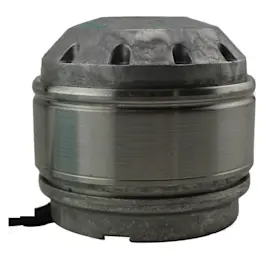
- Blower and motor assembly (moves air through the exhaust duct)
- Grease filter(s) (removable filters that trap grease)
- Duct connection and damper (often called a backdraft flap); on this model a common related part is the 1-way flap 00498498
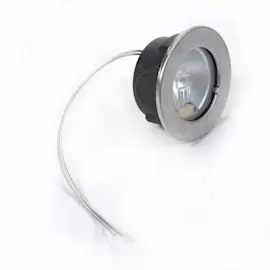
- Lights and light housing; a common related part is the lamp cmplt 00606646
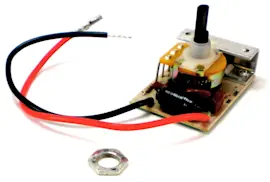
- Electrical components (wiring, terminals, capacitor, and power cord); a common related part is the line cord 00489303
- Chimney (flue) cover panels and mounting brackets (covers ductwork for a finished look)
Model-specific details that matter for HMCB36FS
This Thermador hood is designed for exhaust-air mode (ducted venting). For best performance, the installation guide recommends a short, smooth duct run, as few bends as possible, and a 6-inch round duct (or equivalent cross-section). Maintain a 30-inch minimum clearance from the cooktop to the bottom edge of the hood.
Quick reference (typical hood systems)
| System | What it does | Common symptoms when it fails |
|---|---|---|
| Venting and damper | Routes air outside, helps prevent backdraft | Poor airflow, outside air coming back in |
| Filtration | Captures grease before it reaches the blower/duct | Grease buildup, odors, reduced airflow |
| Lighting | Illuminates the cooking surface | Flickering, dim or dead lights |
| Electrical/power | Supplies and distributes power | Hood dead, intermittent operation |
Why it matters
Knowing the major parts helps you troubleshoot faster. For example, weak suction often points to ducting layout or a stuck damper, while a dead hood often points to the power supply path (cord, terminals, or internal electrical components).
Last updated: February 2026