Installation guide
 Owner’s manual


Is GE Profile considered high end?
Yes. GE Profile is generally considered GE’s higher-end line, positioned above standard GE models with more premium features, finishes, and performance options. For your GE dishwasher model PDW9980N20SS, the exact feature set depends on the configuration listed in the PDW9980N20SS owner's manual.
What “high end” usually means for GE Profile
GE Profile appliances typically focus on upgraded design and convenience features compared to base GE lines.
Common “premium” differences include:
- More advanced wash and dry options (cycle and sensor features)
- Quieter operation designs (varies by model)
- More refined controls and exterior styling
- Added convenience features (rack adjustability, dispensers, indicators)
- More specialized cleaning and drying performance settings
How to confirm what your PDW9980N20SS includes
The fastest way to verify whether your specific dishwasher is a Profile model and what features it has is to match the model number and review the feature list.
Use these checks:
- Confirm the full model number on the rating label matches PDW9980N20SS
- Review cycle options, indicators, and dispenser features in the manual
- Compare control panel options to the cycle descriptions
- Check recommended detergent and rinse aid guidance for best results
| What to check | Where it shows up | Why it helps |
|---|---|---|
| Model line (GE vs Profile) | Badge/branding and manual cover | Confirms product tier |
| Cycle and option list | Manual cycle chart | Shows feature depth |
| Drying behavior | Manual notes on drying fan/run time | Explains “premium” drying features |
Why it matters
Knowing whether you have a GE Profile dishwasher helps set expectations for cycle length, noise level, and available wash and dry options. It also helps you choose the right parts and maintenance steps for your exact configuration.
Last updated: January 2026
How do you force a GE dishwasher to drain?
On the GE PDW9980N20SS dishwasher, you can force a drain by canceling the cycle: press the START/RESET pad once and let the unit run its drain-out. The manual notes the dishwasher typically drains in about 90 seconds after a reset.
Quick steps to force a drain
- Press START/RESET once (this cancels the current cycle).
- Close and latch the door; the dishwasher will drain automatically.
- Wait about 90 seconds for the drain to finish.
- Open the door and confirm the water level dropped.
- If water remains, check the drain path (air gap, disposer plug, hose kinks).
If it still will not drain (most common causes)
A forced drain will not work if the drain path is blocked or restricted. Check these items in order:
- Disposer plug: If the dishwasher drain hose connects to a garbage disposer, make sure the knockout plug was removed.
- Air gap (if installed): Clean it if it is clogged (a blocked air gap can stop draining).
- Drain hose routing: Look for kinks under the dishwasher or under the sink; the installation guide specifically warns to keep the hose from kinking.
- Filter area: Clear debris that can restrict water flow.
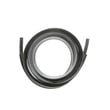
- Drain components: If you suspect a damaged hose or loose connection, inspect the drain tube WD24X10045.
What you should see (normal vs. problem)
| What happens | What it usually means | What to do next |
|---|---|---|
| Drains in about 90 seconds | Reset drain is working | Resume normal use |
| Hums but water stays | Blockage or kink | Check air gap, disposer plug, hose routing |
| Stops and leaves water | Drain restriction or pump issue | Inspect drain hose and filter area |
Why it matters
Standing water can cause odors, poor cleaning, and can trigger leak checks under the dishwasher. Clearing the drain path (air gap, disposer plug, and hose routing) is the fastest way to restore normal draining.
For model-specific control and indicator details, use the PDW9980N20SS owner’s manual.
Last updated: January 2026
Which GE dishwasher is the quietest?
GE has promoted a GE Profile dishwasher with SmartDispense technology as the quietest dishwasher in GE’s history. For your GE PDW9980N20SS, the best way to confirm your exact sound rating (dBA) is to check the model’s published specifications in the PDW9980N20SS owner’s manual.
How to compare “quietest” the right way
Dishwasher noise is typically measured in decibels (dBA); lower numbers are quieter.
- Compare dBA ratings, not just marketing terms like “quiet”
- Expect “quietest” models to be in the low-to-mid 40 dBA range
- Mid-range models are often around the upper 40s to low 50s dBA
- Older or value models can be louder (mid 50s dBA and up)
- Installation and cabinet mounting can change what you hear in the kitchen
Quick reference: what dBA usually sounds like
| dBA range | What most people notice | Best fit |
|---|---|---|
| 39 to 45 dBA | Very hard to hear | Open-concept kitchens |
| 46 to 50 dBA | Low, steady wash sound | Most homes |
| 51 to 55 dBA | Clearly audible | Closed kitchens |
| 56+ dBA | Noticeably loud | Budget or older units |
Why your dishwasher may sound louder than its rating
Even a quiet GE dishwasher can seem noisy if something is off.
- Dishes or utensils are touching the spray arm
- The dishwasher is not secured tightly to the cabinet
- A clogged filter causes pump strain and louder operation
- A damaged spray arm creates a “ticking” or “thumping” sound
- A worn door seal lets sound escape
If you’re troubleshooting noise on PDW9980N20SS, checking the dishwasher filter WD12X10109 and the dishwasher spray arm WD22X10047 is a practical starting point.
Why it matters
Choosing the quietest GE dishwasher usually comes down to the published dBA rating and features like improved insulation and wash system design; verifying the spec for PDW9980N20SS helps you make an apples-to-apples comparison.
Last updated: January 2026
Can a clogged drain cause an FTD error?
Yes. On the GE PDW9980N20SS dishwasher, an FTD (fail to drain) error commonly happens when water cannot pump out due to a clog in the drain path, such as the air gap, disposer connection, drain hose routing, or internal filter area. See the PDW9980N20SS owner's manual for drain checks.
What to check first (fast, no parts)
- Cancel the cycle and let the dishwasher attempt to drain; many GE models drain for about 90 seconds after a reset.
- If you have an air gap, remove the cover and cap and clean debris from the air gap.
- If the drain connects to a garbage disposer, confirm the disposer inlet plug was removed; leaving it in place prevents draining.
- Verify the sink drains normally; a slow kitchen drain can back up the dishwasher.
- Check that the drain hose is not kinked or crushed behind the unit.
Drain hose setup that can trigger FTD
The PDW9980N20SS needs correct drain hose routing for proper drain operation.
| Installation item | What “good” looks like | What can cause FTD |
|---|---|---|
| High drain loop | Drain hose routed up to at least 32 inches above the floor | Hose routed low so water flows back |
| Total hose length | 10 feet max total length | Hose extended too long, weak drain performance |
| Disposer connection | Disposer plug removed, hose clamped | Plug left in, loose clamp, restriction |
For the exact routing method and clamp locations, use the PDW9980N20SS installation guide.
When a part is likely involved
If the hose and air gap are clear but the dishwasher still will not drain, a restriction inside the tub or pump area is common.
- Food soil buildup around the filter area (cleaning may restore draining)
- Debris interfering with the pump impeller
- A damaged or restricted drain tube
If you find the drain tube is split, brittle, or blocked, replace the drain tube WD24X10045.
Why it matters
An FTD condition leaves standing water in the tub, can cause odors, and can stop the cycle from completing. Clearing the drain path and confirming correct hose routing fixes most drain errors without major repair.
Last updated: January 2026