Installation guide
 Owner’s manual
 Error Codes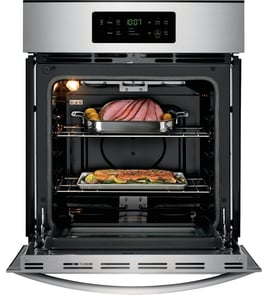


Are all 30 inch wall ovens the same size?
No. “30-inch” wall ovens are grouped by nominal width, but the actual oven frame size and, more importantly, the cabinet cutout dimensions vary by model. For Kenmore model 91147719200, the installation guide lists a 30-inch cabinet width with a 28 1/2-inch to 28 5/8-inch cutout width (single or double oven). See the installation guide for the exact cutout chart.
When replacing a built-in wall oven, we match the cutout, not the label.
- Cabinet width is often called 30 inches, but the cutout opening is smaller.
- Cutout width, height, and depth must all meet the new oven’s requirements.
- Overlap/trim can hide small gaps, but it cannot fix an undersized cutout.
- Door swing clearance matters; this guide calls for 21 inches minimum clearance to adjacent corners/walls when the door is open.
- Electrical connection matters too; this model is hard-wired to a junction box (no plug).
These are the cabinet opening targets used for installation.
| Installation type | Cutout width | Cutout height | Cutout depth | Notes |
|---|---|---|---|---|
| Single oven | 28 1/2" min to 28 5/8" max | 27 1/4" min to 27 5/16" max | 23 1/2" min | 30" cabinet width |
| Double oven | 28 1/2" min to 28 5/8" max | 51 13/16" min to 51 15/16" max | 23 1/2" min | 30" cabinet width |
- Measure width between the inside cabinet walls at the front.
- Measure height from the cutout floor to the underside of the top rail.
- Measure depth from the cabinet front to the back wall (account for wiring space).
- Confirm the cabinet sides are sturdy; if sides are under 3/4-inch thick (frameless cabinets), shimming may be needed to establish the correct width.
- Verify your oven type; this model is not approved for stackable or side-by-side installation.
A “30-inch” label can still leave you with an oven that will not slide in, will not sit flush, or will not mount safely. Matching the cutout dimensions for 91147719200 prevents fit issues and helps ensure safe, secure installation.
Last updated: February 2026
How to find wall oven model number?
For Kenmore wall oven model 91147719200, the model and serial number label is located on the front frame behind the oven door. Open the door fully and look along the frame (often near the top or side edge) for a rating plate or sticker.
- Open the oven door and inspect the front frame around the opening.
- Check the frame behind the door (this is the most common location for this model).
- Look for a label that lists MODEL NUMBER and SERIAL NUMBER.
- Wipe the area with a damp cloth; grease can hide the print.
- Use a flashlight and look from different angles; labels can be reflective.
If the label is missing or unreadable, these are the next most common places to check on built-in wall ovens:
- Along the door rim or inner edge of the door
- On an interior side panel just inside the oven cavity
- On the outer cabinet (usually only visible after the oven is pulled from the cutout)
| Item on label | What it’s used for | Example for this page |
|---|---|---|
| Model number | Matching parts and diagrams | 91147719200 |
| Serial number | Dating the unit and service history | Varies by unit |
We use the exact model number to match the correct Kenmore wall oven parts and documentation. Even small model-number differences can change which items fit, such as the wall oven temperature sensor WB23T10015 or the oven lamp 40A15.
For additional identification details and model-specific documentation, check the owner's manual.
Last updated: February 2026
What are the parts of an electric oven?
An electric wall oven like Kenmore model 91147719200 is built around heating components (bake and broil), temperature sensing and safety controls, airflow and venting parts, and door and light assemblies. Your exact configuration and service access points are shown in the installation guide.
- Bake element: primary heat source for baking and roasting
- Broil element: high, top heat for broiling and browning
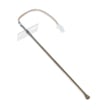
- Oven temperature sensor: tells the control how hot the oven is (common replacement: wall oven temperature sensor WB23T10015)
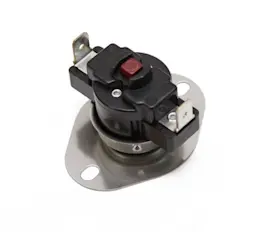
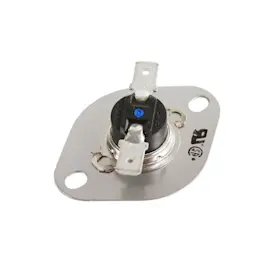
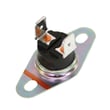
- Safety thermostat or thermal limiter: helps prevent overheating (example: wall oven safety thermostat WB24T10060)
- Cooling fan and fan housing: moves air to protect controls and cabinetry (examples: range control panel cooling fan WB26T10018, fan housing WB26T10014)
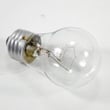
- Oven light system: bulb, lens, and holder so you can see inside (examples: oven lamp 40A15, lens cover WB25T10002, oven lamp holder WB08T10002)
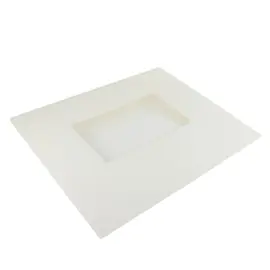
- Door system: hinges, glass, gasket, and handle to seal heat and operate smoothly (examples: oven door hinge, left WB10T10035, range oven door inner glass WB57T10233, range oven door gasket WB41T10003)
| System | What it does | Common symptom when it fails |
|---|---|---|
| Heating (bake/broil) | Produces cooking heat | Oven will not heat, uneven baking |
| Sensing and safety | Regulates temperature, prevents overheating | Temperature swings, error codes, shutdown |
| Airflow and venting | Protects electronics and surrounding cabinet | Control area gets too hot, fan noise |
| Door and lighting | Seals heat, provides visibility | Heat leaks, foggy/dirty glass, no light |
Knowing the major oven parts helps you troubleshoot faster and replace the right component the first time. For example, a “won’t reach temperature” complaint often points to the sensor or safety thermostat, not the light bulb or door glass.
Last updated: February 2026
Why are wall ovens not gas?
Most wall ovens are electric because built-in installations are simpler and more consistent with electric heat control; running a gas line, meeting clearance requirements, and handling ventilation in a wall cabinet adds complexity compared with a dedicated 240V circuit and hardwired junction box.
In many kitchens, electric wall ovens fit standard cabinet cutouts and electrical planning more easily than gas.
- Utility routing: Electrical wiring is easier to route through walls and cabinets than adding a new gas line.
- Built-in safety and code considerations: Gas appliances often require additional planning for combustion air and venting.
- Temperature control: Electric elements typically deliver steadier baking performance in a closed cavity.
- Installation consistency: Many wall ovens are designed around a fixed electrical connection and cabinet support.
- Product availability: Manufacturers offer far more electric wall oven models than gas, so selection is wider.
Your Kenmore 91147719200 is designed as an electric built-in wall oven and is intended to be hard wired (direct wired) into an approved junction box (a plug and receptacle connection is not permitted for this style of installation).
| Feature | Electric wall oven | Gas wall oven |
|---|---|---|
| Typical hookup | 240V circuit, hardwired | Gas line plus electrical |
| Cabinet install complexity | Lower | Higher |
| Heat characteristics | Even, steady bake | Strong burner heat, more variability |
| Model availability | High | Limited |
A wall oven is surrounded by cabinetry, so the installation method matters as much as cooking performance. Choosing the fuel type affects your remodel scope, required trades (electrician vs plumber), and how the oven is safely connected and supported.
Use the installation guide for model-specific electrical connection notes, cabinet support expectations, and installer safety requirements.
Last updated: February 2026