
Is it cheaper to repair or replace a garage door opener?
It’s usually cheaper to repair a Craftsman garage door opener when the problem is small (remote/transmitter issues, safety sensor alignment, loose wiring) and the opener is under about 10 to 12 years old. Replacement makes more sense when repair costs stack up, parts are hard to match, or you want newer safety and convenience features.
- Repair when the door is mechanically fine and the opener issue is isolated (remote, sensors, wall control, wiring).
- Replace when the opener is older, has repeated failures, or the repair estimate is a large share of a new unit.
- Replace if you want modern upgrades like Wi-Fi control, battery backup, quieter operation, and improved security features.
- Repair if troubleshooting points to a simple fix you can confirm quickly (battery, alignment, connection).
- Replace if the motor/control board is failing and the opener has a long history of intermittent problems.
| Option | Typical cost range | Best for |
|---|---|---|
| Minor repair (adjustments, sensors, remote issues) | $0 to $150 | Newer openers with simple faults |
| Standard service repair (parts + labor) | $100 to $500 | Mid-life openers with one clear failure |
| Full replacement (opener + installation) | $200 to $1,000+ | Older openers or frequent breakdowns |
- Replace the transmitter battery and re-test range.
- Confirm the opener has power and the outlet works.
- Clean and align the safety sensors; verify both indicator lights are steady.
- Inspect visible wiring for damage and secure any loose connections.
- If you’re testing electrical components, follow safe practices from are diy appliance repairs safe.
A garage door opener is a safety device as much as a convenience feature. When repairs approach the cost of a replacement, a newer opener often delivers better reliability, smoother operation, and updated security features, which reduces repeat service calls.
Last updated: February 2026
How do I know what model my garage door opener is?
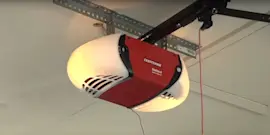
You can identify your Craftsman garage door opener model by finding the model label on the opener’s powerhead. On many Craftsman units, the label is under a front light lens or under the left light lens (when facing the opener), often on the side opposite the antenna.
Check these common label locations on the ceiling-mounted motor unit (powerhead):
- Under the front light lens cover
- Under the left light lens cover (when you’re standing in the garage facing the opener)
- On the side opposite the antenna wire
- On the back or side panel near the wiring terminals
- On the top surface of the powerhead (use a flashlight)
For this Craftsman model page, the model number format is numeric, like 13953718. When you find the label, write down:
- Model number (example: 13953718)
- Any additional ID numbers (logic board number, receiver number, or date code)
- The opener type (chain drive, belt drive, or screw drive)
| What to capture | Why it matters |
|---|---|
| Model number | Matches the correct parts list and diagrams |
| Date code/serial | Helps confirm version changes within a model family |
| Drive type | Affects which rail, trolley, and gear parts fit |
Garage door opener parts are model-specific, especially remotes/transmitters, receiver logic boards, travel modules, and safety sensor wiring. Using the exact model number helps us match the right Craftsman garage door opener parts the first time.
If the label is hard to read, take a clear photo and compare the digits to the model format shown on this page, then use how to find your appliance model number (and what it means for parts) to confirm you are capturing the correct identifier.
Last updated: February 2026
What are the common problems with Craftsman garage door openers?
Common problems with Craftsman garage door openers (including systems that use the Craftsman 13953718 transmitter) are usually caused by sensor alignment issues, worn drive components (chain/belt, sprocket, gear), power or wiring faults, or remote/keypad programming and battery problems. These show up as a door that will not close, reverses unexpectedly, or an opener that hums, clicks, or runs but does not move the door.
- Door will not close and lights flash: photo eye safety sensors are blocked, dirty, or misaligned.
- Door reverses right after touching the floor: travel limits or force settings are off, or the door is binding.
- Opener runs but door does not move: stripped internal gear, broken belt/chain connection, or a failed sprocket.
- Grinding, rattling, or squealing: dry rail/rollers, loose hardware, or worn drive parts.
- Remote works only up close: weak transmitter battery, interference, or an aging receiver/logic board.
- Wall control works but remotes do not: remote programming issue, lock/vacation feature enabled, or receiver problem.
- Clean and realign the photo eye sensors; confirm both indicator LEDs are steady.
- Replace the remote battery in the Craftsman 13953718 transmitter; then re-test range.
- Verify the door is balanced (disconnect opener and lift by hand); a heavy door overloads the opener.
- Tighten visible rail and header bracket fasteners; vibration loosens hardware over time.
- Inspect the rail for bends and the trolley for damage.
- Check for obstructions at the door tracks and along the floor line.
| Symptom | Most likely cause | What to do first |
|---|---|---|
| Won’t close | Sensors blocked/misaligned | Clean lenses, align sensors |
| Reverses | Travel/force setting, binding door | Check door movement by hand |
| No response | Power issue, bad wall control, logic board | Confirm outlet power, inspect wiring |
| Remote intermittent | Battery, interference, receiver | Replace battery, reprogram remote |
Most “opener problems” are actually safety sensor alignment, door balance, or worn drive components. Fixing those early prevents stripped gears, overheated motors, and repeated nuisance reversals.
For model-specific parts and diagrams tied to Craftsman 13953718, use the model lookup on Sears PartsDirect.
Last updated: February 2026
Can you get a universal remote for an old garage door opener?
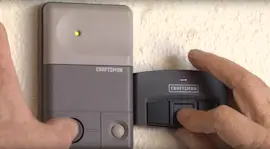
Yes. For an older Craftsman garage door opener system like model 13953718, you can usually use a universal garage door remote, but compatibility depends on the opener’s radio frequency and “learn” method (or DIP switches). If it will not pair, adding an external receiver is the reliable universal fix.
- Identify whether your opener uses a learn button (newer style) or DIP switches (older style).
- Check the universal remote packaging for supported brands (Craftsman, LiftMaster, Chamberlain) and frequencies.
- If your opener uses DIP switches, match the switch pattern in the new remote.
- If your opener uses a learn button, follow the remote’s pairing steps and test from a few feet away.
- Replace the remote battery and retry pairing if programming fails.
| Option | Works with very old openers | Typical setup effort | Notes |
|---|---|---|---|
| Universal remote only | Sometimes | Low | Depends on frequency and coding style |
| Universal remote + external receiver kit | Yes | Medium | Receiver “translates” to a new remote standard |
| Keypad (universal) | Sometimes | Medium | Same compatibility limits as remotes |
An external receiver wires into the opener’s control terminals and provides a modern, compatible radio system. This is the most dependable path when the opener’s original frequency or coding is too old for today’s universal remotes.
A mismatched remote can look like a bad opener, but it is usually a compatibility issue (frequency, learn method, or coding). Choosing the right approach saves time and avoids unnecessary opener troubleshooting.
For help confirming your exact model identification before you buy, use how to find your appliance model number (and what it means for parts).
Last updated: February 2026
How to find a compatible garage door opener?
For a Craftsman 13953718 transmitter, compatibility comes down to matching the opener’s radio system (learn button type, frequency, and whether it uses rolling code or DIP switches). We recommend identifying the opener head’s learn button color and/or logic board details before buying a replacement remote, keypad, or smart controller.
You are not matching “any Craftsman remote” to “any Craftsman opener.” You are matching the accessory (remote/keypad/smart hub) to the opener’s receiver technology.
Check these items on the opener motor head (the unit on the ceiling):
- Brand family: Craftsman openers are commonly built on Chamberlain/LiftMaster platforms.
- Learn button color (often near the antenna wire): yellow, purple, red/orange, or green.
- Radio type: rolling code (newer) vs DIP switches (older).
- Frequency (sometimes listed on the label or receiver): common ranges include 315 MHz, 390 MHz, or 310/315/390 tri-band on some universal remotes.
Use this as a fast filter, then confirm with the opener label.
| What you see on the opener | What it usually means | What to buy/search for |
|---|---|---|
| DIP switches in remote/receiver | Fixed code system | A DIP-switch compatible remote/keypad |
| Learn button (any color) | Rolling code system | A remote/keypad compatible with that learn-button system |
| Yellow learn button | Newer rolling code generation | A compatible “yellow learn button” remote/keypad |
- Match the learn button color first; it is the quickest identifier.
- If you are using a universal remote, confirm it explicitly lists your opener’s brand family and frequency.
- If the opener is very old (DIP switches), avoid “Security+ style” remotes; they will not pair.
- If you are adding smart control, confirm the smart controller supports your opener’s receiver type.
A remote can look correct and still be incompatible if the frequency or rolling-code generation does not match. Getting the receiver technology right saves time and avoids pairing failures.
For help confirming the exact model number on the opener head (not just the handheld remote), use how to find your appliance model number (and what it means for parts).
Last updated: February 2026