Owner’s manual
 Error Codes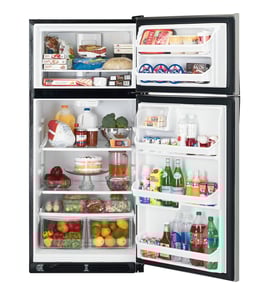


What are the disadvantages of a top mount fridge?
A top-mount refrigerator like Kenmore 25331422100 puts the freezer on top and the fresh-food section below, so the biggest disadvantages are less convenient access to everyday refrigerated items, fewer premium storage features, and fewer dispenser options compared with many bottom-freezer designs. For model-specific features and setup details, use the 25331422100 owner's manual.
Common disadvantages (what most owners notice)
- More bending for fresh food: the refrigerator compartment is lower, so you reach down more often.
- Less “at-a-glance” organization: many top-mount designs have simpler bins and shelf layouts than higher-end bottom-freezer models.
- Fewer built-in dispenser options: top-mount units are less likely to include through-the-door water or ice.
- Freezer access can be tight: stacked items can be harder to see and reach.
- Door storage varies by model: bins and racks can be basic, even though they are designed for quick access to frequently used items.
What to check on your Kenmore 25331422100
Use these quick checks to decide whether the “disadvantages” are deal-breakers for your kitchen and habits:
- Measure how often you access fresh food vs. frozen food.
- Confirm you have enough clearance for airflow and door swing.
- Review door bin and rack options for your storage needs.
- Decide whether you need an automatic ice maker or dispenser features.
| Feature | Top-mount refrigerator (like 25331422100) | Bottom-freezer refrigerator (typical) |
|---|---|---|
| Fresh-food access | Lower, more bending | Higher, easier daily access |
| Freezer access | Eye level | Lower drawer/basket style |
| Storage features | Often simpler | Often more “premium” layouts |
| Dispensers | Less common | More common |
Why it matters
Choosing a refrigerator layout affects daily comfort, food visibility, and how well you can keep items organized. With a top-mount, we typically recommend planning your most-used items in the most accessible shelves and door bins to reduce bending and searching.
Last updated: January 2026
What are the common problems with Kenmore Elite refrigerators?
Kenmore Elite refrigerators most often have cooling, frost, noise, and water-leak complaints; the same core checks apply to your Kenmore 25331422100 top-mount refrigerator. We start with airflow (condenser coils and fans), then the defrost system, then door sealing and drain issues; these cover the majority of real-world failures.
Common problems and what usually causes them
- Not cooling or warm temperatures: dirty condenser coils, failed condenser fan motor, failed evaporator fan, or restricted airflow.
- Excessive frost or ice buildup: defrost heater, defrost thermostat, or defrost control problems; sometimes a door left ajar or a poor door seal.
- Water puddles inside or under the refrigerator: clogged/iced defrost drain, drain tube issues, or door left open causing heavy frost melt.
- Unusual noises (buzzing, clicking, rattling): fan blade hitting ice, loose panels, or a struggling compressor/start components.
- Lights not working: burned-out bulb or door switch issue.
Quick checks we recommend first (safe, high-impact)
- Confirm power and controls: Make sure the unit is plugged in and the temperature control is not set to “0”; the manual also notes the refrigerator may be in a defrost cycle, so waiting about 20 minutes can help confirm operation. See the 25331422100 owner’s manual.
- Clean condenser coils: Dust buildup is a top cause of poor cooling and long run times.
- Listen for fans: You should typically hear a steady fan sound when running; scraping often points to ice contact.
- Check door closing and sealing: Look for gaps, torn gasket areas, or doors not closing fully.
- Look for drain symptoms: Ice on the freezer floor or water under crispers often points to a drain restriction.
Parts that commonly relate to these symptoms (for model 25331422100)
| Symptom | Likely system | Example part for this model |
|---|---|---|
| Frost/ice buildup, warm fridge | Defrost system | Refrigerator defrost heater 5303918203, refrigerator defrost bi-metal thermostat 5303918202 |
| Rattling/scraping in freezer | Evaporator fan area | Refrigerator evaporator fan blade 5308000010 |
| No interior light | Lighting | Appliance light bulb, 40-watt 316538904 |
Why it matters
Cooling and frost problems usually start as airflow or defrost issues; fixing them early helps protect food temperatures, reduces energy use, and prevents ice buildup that can damage fan components.
Last updated: January 2026
What size is Kenmore refrigerator model 25331422100?
Kenmore top-mount refrigerator model 25331422100 has a 17.0 cu. ft. total capacity. For fit planning, use the model’s published exterior dimensions and clearances in the 25331422100 owner's manual so you measure doorways, cabinet openings, and door swing correctly.
Size and dimensions for model 25331422100
Use these specs when you are checking kitchen fit or delivery clearance:
- Total capacity: 17.0 cu. ft.
- Width: 28 in.
- Height: 65-1/2 in. (cabinet) or 66-5/8 in. (including hinge)
- Depth: 31-1/2 in. (including handle)
| Measurement | What to include | Why it matters |
|---|---|---|
| Width | Cabinet side to side | Fit in the opening and through doorways |
| Height | Cabinet vs. hinge height | Overhead cabinet clearance and leveling |
| Depth | Include handle projection | Walkway clearance and door swing |
How we recommend confirming fit in your kitchen
Even with published specs, we always verify the real-world space and clearances:
- Measure the opening width at the front and back (walls are not always square).
- Measure height to the lowest cabinet/soffit above the refrigerator.
- Measure depth to the front edge of counters and note handle clearance.
- Allow room for door swing and for pulling out crisper drawers.
- Confirm the model number on the serial plate inside the fresh food compartment.
Why it matters
Capacity (17.0 cu. ft.) tells you how much storage you get, but the exterior dimensions determine whether the refrigerator fits your cutout, clears cabinets, and can be moved through doorways without damage.
Last updated: January 2026