 Error Codes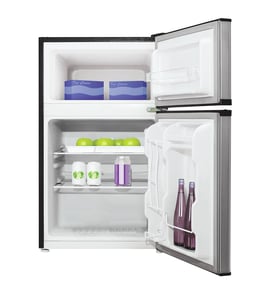


How can I tell how many cubic feet my Kenmore refrigerator is?
For your Kenmore compact refrigerator model 56497362690, the quickest way to confirm cubic feet is to check the rating plate for a capacity listing (often shown as “cu. ft.” or “total volume”). If it is not listed, you can estimate capacity by measuring the interior and converting cubic inches to cubic feet.
Where to look for the capacity label
On most compact refrigerators, the rating plate is typically found in one of these spots:
- Inside the fresh food compartment on a side wall
- Along the ceiling area inside the cabinet
- Behind the lower front kick plate or grille area
- On the back exterior panel near the power cord
If you find a label, look for terms like “Capacity,” “Total volume,” or “Cu. Ft.”.
How to calculate cubic feet (quick method)
If the label does not show capacity, measure the usable interior space (not the outside cabinet).
- Measure height, width, and depth in inches
- Multiply:
H × W × D = cubic inches - Divide by 1728 to convert to cubic feet
Example calculation
| Measurement | Inches (example) |
|---|---|
| Interior height | 24 |
| Interior width | 18 |
| Interior depth | 16 |
| Total cubic inches | 6,912 |
| Estimated cubic feet (÷ 1728) | 4.0 |
Tips to get a more realistic estimate
Interior layouts reduce usable volume, so your calculation is an approximation. For best results:
- Measure to the inside liner, not to door bins or shelves
- Subtract space taken by a freezer box/evaporator cover if it blocks storage
- Use the largest open rectangle you can measure consistently
- Round to the nearest 0.1 cu. ft. for a practical estimate
Why it matters
Cubic feet helps you compare refrigerator sizes, plan food storage, and choose compatible accessories (like bins and shelves). It also helps when you are matching a replacement unit to the same footprint and capacity class.
For help confirming you are using the correct model number when searching specs or parts, use how to find your appliance model number (and what it means for parts).
Last updated: February 2026
How do I reset my Kenmore refrigerator?
For the Kenmore compact refrigerator model 56497362690, the most reliable “reset” is a power reset: unplug the refrigerator (or switch off the circuit breaker) for 5 to 10 minutes, then restore power. This clears minor control glitches and restarts the compressor cycle.
Quick reset steps (power cycle)
- Set the temperature control to a normal setting (mid-range) before resetting.
- Unplug the power cord from the outlet (or turn the breaker off).
- Wait 5 to 10 minutes.
- Plug it back in (or turn the breaker on).
- Allow 24 hours for temperatures to fully stabilize after any reset or adjustment.
If it still is not cooling after the reset
A reset will not fix airflow restrictions or sealed-system problems. Check these common items first:
- Make sure the door closes tightly and the gasket is sealing.
- Confirm the condenser area is not packed with dust (clean if needed).
- Leave space around the cabinet for ventilation (especially at the back and sides).
- Avoid overloading; blocked vents reduce cold-air circulation.
- Listen for the compressor and fan cycling on and off.
What a reset can and cannot fix
| Situation | Reset helps? | What to do next |
|---|---|---|
| Control glitch after a brief power flicker | Yes | Power cycle, then wait for normal cycling |
| Unit runs but warms up when door is opened often | Sometimes | Reduce door openings; verify door seal |
| Frost buildup or poor airflow | Sometimes | Improve airflow; defrost if needed |
| No cooling at all and no sound | Sometimes | Check outlet power; inspect cord and breaker |
| Loud clicking, repeated start attempts | No | Troubleshoot start components and wiring |
Why it matters
A power reset forces the refrigerator’s controls and compressor protection circuit to restart cleanly. That can clear minor electronic hiccups, but cooling performance still depends on proper airflow, clean heat exchange surfaces, and a healthy compressor system.
Helpful DIY reference
If you need to check power at the outlet or test electrical components safely, use our guide: how to use a multimeter to test electrical parts video.
Last updated: February 2026
Why is my Kenmore mini fridge not cold?
If your Kenmore compact refrigerator model 56497362690 is not cold, the most common causes are poor airflow (dirty condenser coils or blocked vents), a door seal leak, or a cooling-system problem such as a failed start device or compressor. Start with cleaning and airflow checks first.
Quick checks that fix many “not cooling” complaints
- Make sure the temperature control is not set to OFF or 0.
- Clean dust off the condenser coils and the area around the compressor.
- Confirm the door closes fully and the gasket seals all the way around.
- Leave at least 2 to 3 inches of clearance behind and on the sides for ventilation.
- Avoid overpacking; blocked interior vents stop cold air circulation.
What to listen and feel for (fast diagnosis)
| What you notice | What it usually means | What to do next |
|---|---|---|
| Compressor is warm and runs, but cabinet is still warm | Heat cannot leave the unit well | Clean coils; improve clearance; recheck in 12 to 24 hours |
| Clicking every few minutes, compressor not staying on | Start device/overload issue or compressor problem | Unplug; inspect wiring; test electrical parts |
| No sound at all (no fan, no compressor) | Power/control issue | Check outlet, cord, control setting; test for voltage |
| Heavy frost inside (if it has a freezer section) | Airflow restriction from frost | Defrost fully (24 hours unplugged, doors open), then restart |
Step-by-step troubleshooting (in order)
1) Confirm power and settings
- Verify the outlet works (try a lamp).
- Check the cord and plug for damage.
- Set the control to a mid-range setting and wait 8 to 12 hours for temperature change.
2) Clean and ventilate
Dusty coils and tight clearances are a top reason mini fridges run but do not get cold.
3) Check the door seal
Close the door on a sheet of paper; if it slides out easily, the gasket is leaking and warm air is entering.
4) Electrical checks (unplug first)
Use a meter to check suspect components and connections, especially if you hear repeated clicking: how to use a multimeter to test electrical parts video.
Why it matters
A mini fridge depends on steady airflow across the condenser and a tight door seal. When either fails, the compressor can run longer, temperatures rise, and food safety becomes a concern.
Last updated: February 2026





