Owner’s manual
 Error Codes


What is the average lifespan of a GE refrigerator?
A GE refrigerator typically lasts 12 to 15 years. For your GE PZS23KSEEFSS side-by-side refrigerator, regular maintenance (especially airflow and clean seals) helps you reach the high end of that range and reduces common cooling and ice maker issues.
Typical lifespan and what affects it
Most refrigerators fail early due to heat stress, poor airflow, or neglected wear items. These factors have the biggest impact:
- Condenser cleanliness and ventilation (dust buildup makes the compressor work harder)
- Door gasket condition (air leaks cause longer run times and frost)
- Ice maker and dispenser use (jams and leaks add strain and can create icing)
- Water filter changes (restricted flow can affect dispenser performance)
- Temperature settings and loading habits (overpacking blocks vents and reduces circulation)
Maintenance that extends life (high impact)
We recommend these practical steps for GE side-by-side models like PZS23KSEEFSS:
- Vacuum and brush the condenser area every 6 to 12 months
- Keep doors closing tightly; clean the gasket with mild soap and water
- Leave space around the cabinet for airflow (especially behind and above)
- Replace the water filter on schedule; use the steps in the owner's manual
- If cooling becomes inconsistent, check for frost buildup and listen for the evaporator fan
Helpful part examples for common age-related symptoms
If you are troubleshooting temperature swings, warm freezer, or heavy frost, these parts are commonly involved:
| Symptom | Common system | Example part for this model |
|---|---|---|
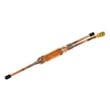
| Warm fridge/freezer, erratic temps | Temperature sensing | Refrigerator temperature sensor WR55X10025 |
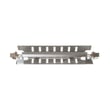
| Heavy frost, poor airflow | Defrost system | Refrigerator defrost heater WR51X10055 |
| Noisy or weak airflow | Evaporator fan | Refrigerator evaporator fan motor WR60X10307 |
Why it matters
Once a refrigerator gets past about 10 years, small efficiency losses (dirty coils, weak airflow, minor air leaks) can snowball into longer run times, temperature instability, and higher wear on sealed-system components like the compressor.
Last updated: February 2026
How to reset an ice maker on a GE side by side?
To reset the ice maker on your GE PZS23KSEEFSS side-by-side refrigerator, turn the ice maker power switch to OFF for about 15 to 30 seconds, then switch it back to ON. After reset, allow time for the freezer to reach about 15°F so the ice maker can cycle and refill.
Quick reset steps (PZS23KSEEFSS)
- Open the freezer door and locate the ice maker.
- Find the ice maker power switch (some models also have a green power light).
- Move the switch to OFF.
- Wait 15 to 30 seconds.
- Move the switch back to ON.
- If the bin is full or cubes are piled up, level the cubes by hand so the feeler arm can move freely.
For diagrams and model-specific details, use the owner's manual.
What to expect after a reset
A reset does not make ice instantly. Use this as a timing guide:
| Situation | What’s normal | What to do |
|---|---|---|
| New install or long downtime | Ice may take 12 to 24 hours to start | Keep freezer cold and doors closed as much as possible |
| First batches after reset | Ice and water line may need to clear | Discard the first few batches of ice |
| Buzzing sound | Ice maker filling with water | Normal during fill cycles |
If it still won’t make ice
These checks solve most “no ice” complaints on GE side-by-side models:
- Confirm the ice maker switch is ON.
- Make sure the water supply is connected and turned on.
- Verify the freezer is cold enough; after temperature changes, allow 24 hours to stabilize.
- Remove stuck cubes in the mold: switch OFF, clear cubes, then switch ON.
- Replace a clogged filter if cubes are small or hollow; use the correct filter such as the refrigerator water filter MWFP (or the filter specified for your setup).
Why it matters
Resetting the ice maker restores normal cycling, but ice production still depends on freezer temperature, water supply, and the feeler arm sensing the bin level. Fixing those basics prevents repeat shutoffs and slow ice production.
Last updated: February 2026
How big is the GE AutoFill pitcher?
The GE PZS23KSEEFSS side-by-side refrigerator does not use an AutoFill pitcher system; that feature is found on some newer GE Profile refrigerator designs. For your model, filtered water is dispensed through the door, and capacity is based on the filter and your household water supply.
What your model uses instead
On the PZS23KSEEFSS, the key “capacity” spec tied to filtered water is the water filter’s rated life, not a removable pitcher size.
- Water is dispensed at the door (no pitcher reservoir to measure).
- The refrigerator must have a filter installed or a filter bypass plug to run the dispenser and ice maker.
- Filter type is typically identified on the filter label.
- If water flow is slow, the filter and water inlet valve are common checks.
For model-specific feature details and dispenser operation, use the PZS23KSEEFSS owner's manual.
Filter capacity vs. pitcher capacity (quick comparison)
| Item | What it measures | What you can expect on PZS23KSEEFSS |
|---|---|---|
| AutoFill pitcher | Ounces of a removable pitcher | Not applicable on this model |
| Refrigerator water filter | Gallons filtered before replacement | Commonly rated around 300 gallons for GE MWF-style systems |
| Water reservoir | Chilled water storage inside cabinet | Varies by design; not a removable “pitcher” |
Parts that relate to filtered water on this model
If you are trying to solve a water taste, flow, or dispensing issue (often the reason people ask about “pitcher size”), these parts are the most relevant for the PZS23KSEEFSS:
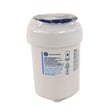
- GE refrigerator water filter MWFP for routine filter replacement
- Refrigerator filter head and tub WR02X45206 if the filter housing/manifold is leaking or not sealing
- Refrigerator water valve WR57X33326 if the dispenser or ice maker is not getting water
- Refrigerator water reservoir assembly WR17X11440 if you suspect an internal leak or warm dispensing water
Why it matters
Using the correct filtration setup keeps the dispenser and ice maker operating normally and helps prevent low flow, odd taste, and leaks. On this model, “capacity” is best tracked by filter life (gallons used and time in service), not by a pitcher volume.
Last updated: February 2026
What is the most common problem with a GE refrigerator?
The most common GE refrigerator complaint is not cooling properly, and on the GE PZS23KSEEFSS it is often tied to airflow, control settings, or a defrost-related issue. Our first step is always to use the troubleshooting chart in the owner's manual to narrow the cause before replacing parts.
Quick checks we do first (no parts needed)
- Confirm the temperature controls are not set to OFF.
- Make sure the refrigerator is fully plugged in and the breaker is not tripped.
- If it was just plugged in, allow 24 hours to reach normal temperatures.
- Check for a door left ajar or packages holding the door open.
- Listen for normal cycling; longer run times are common in hot weather or with frequent door openings.
- If the unit is in a defrost cycle, wait about 30 minutes and recheck cooling.
Common “most frequent” symptoms and what they usually point to
| Symptom | Most common cause category | What we check next |
|---|---|---|
| Fresh food section warm | Airflow or evaporator-side issue | Vents blocked, fan running, frost buildup |
| Freezer warm too | Cooling system or defrost issue | Frost pattern, condenser cleanliness |
| Buzzing near back | Water line not connected but ice maker on | Turn ice maker off until water is connected |
| Water on floor | Ice jam in chute or drain issue | Clear chute, check for recurring leaks |
Parts that commonly relate to cooling and defrost problems
If your checks point to a cooling or defrost problem, these model-compatible parts are common suspects:
- Refrigerator evaporator fan motor WR60X10307 (moves cold air through the compartments)
- Refrigerator defrost heater WR51X10055 (melts frost off the evaporator)
- Refrigerator defrost bi-metal thermostat WR50X10065 (helps control defrost heating)
- GE profile refrigerator temperature sensor WR55X10025 (feeds temperature info to the control system)
Why it matters
A refrigerator that is not cooling can spoil food quickly, and restricted airflow or a failed defrost component can also cause heavy frost buildup that makes the problem worse over time. Using the manual’s symptom charts helps prevent replacing the wrong part.
Last updated: February 2026