Owner’s manual
 Error Codes


What can cause a chest freezer to stop working?
A Kenmore 25312822510 chest freezer can stop working because it is not getting power, the temperature control is set incorrectly or has failed, the lid is not sealing, or the compressor start components are bad. We use the troubleshooting steps in the owner's manual to narrow it down safely.
Quick checks first (most common)
- Make sure the outlet has power; reset the breaker if it tripped.
- Confirm the control is set colder; wait 24 hours after any adjustment.
- Check the lid closes fully; rearrange items that prevent a tight close.
- Look for heavy frost or ice buildup that can reduce cooling.
- Listen for the compressor: a steady hum is normal; repeated clicking often points to a start issue.
Likely causes and what you will notice
| Symptom | Most likely cause | What to do next |
|---|---|---|
| No lights, no sound | No power, tripped breaker | Verify outlet power and reset breaker |
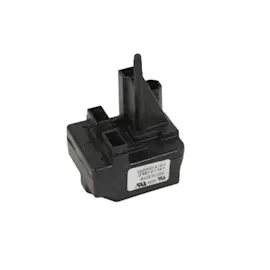
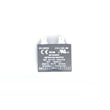
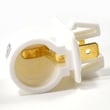
| Clicking every few minutes, not cooling | Start device problem | Inspect/replace the white-westinghouse freezer compressor start relay 297259515 |
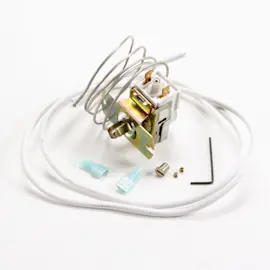
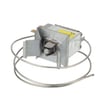
| Runs but warms up | Temperature control issue | Check/replace the temperature control 297216043 |
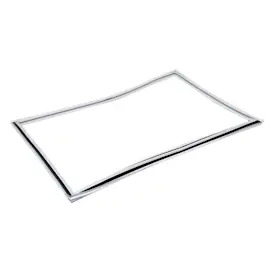
| Frost, moisture, or warm edges at lid | Lid not sealing well | Inspect gasket area; consider the frigidaire freezer gasket and liner fastener kit 5304406520 |
Why it matters
A freezer that is short-cycling (clicking on and off) can overheat the compressor and spoil food quickly. Catching a power, control, or lid-seal problem early often prevents a bigger sealed-system repair.
When to stop and get service
- You smell burning insulation or see damaged wiring.
- The compressor is extremely hot and keeps clicking off.
- The freezer has power but will not cool after 24 hours of proper settings.
Last updated: February 2026
Where are the condenser coils on a Kenmore chest freezer?
On the Kenmore 25312822510 chest freezer, the condenser coils are typically built into the outer cabinet walls (often the side walls) rather than being an exposed coil you can easily see. Some designs also route condenser tubing around the back or near the bottom edge of the cabinet; confirm the exact layout in the owner's manual.
How to find the condenser coil area (quick checks)
- Look and feel along the outside side walls; mild warmth during running often indicates the condenser loop is inside.
- Check the back exterior panel area (if your unit has a service cover) for any visible tubing or airflow path.
- Inspect the bottom perimeter (front or back) for a condenser channel, grille, or service access.
- If the freezer has a fan-cooled condenser, listen for a fan near the lower rear area while the compressor runs.
- If you are troubleshooting poor cooling, also check the compressor start components such as the white-westinghouse freezer compressor start relay 297259515.
Cleaning and airflow tips (what we recommend)
Even when coils are hidden in the walls, keeping airflow and heat rejection strong helps the freezer cool properly.
- Leave clearance around the cabinet (especially the sides and back).
- Vacuum dust from any rear or bottom vents if present.
- Keep the room temperature reasonable; extreme heat makes the condenser work harder.
- Avoid blocking the exterior walls with boxes, shelving, or tight enclosures.
What you will see on common chest-freezer designs
| Design style | Where the condenser is | What you can access |
|---|---|---|
| “Skin condenser” (most common) | Tubing embedded in side walls | No exposed coil; focus on clearance |
| Rear/bottom condenser channel | Back or bottom perimeter | Possible vent/grille cleaning |
| Fan-cooled condenser | Lower rear area | Vent cleaning; fan noise/airflow check |
Why it matters
The condenser is where heat leaves the sealed system. If airflow is restricted or the cabinet cannot shed heat, run times increase, temperatures rise, and food quality can suffer.
Last updated: February 2026
Is there a reset button on chest freezers?
Most chest freezers (including Kenmore model 25312822510) do not have a dedicated reset button. The practical “reset” is a power reset: unplug the freezer (or switch off the breaker) for about 30 seconds, then restore power and allow the control to restart.
How to reset a Kenmore chest freezer safely
- Unplug the freezer from the wall outlet (preferred), or turn the circuit breaker off.
- Wait 30 seconds.
- Plug it back in (or turn the breaker on).
- Set the temperature control back to your normal setting.
- Give the freezer time to stabilize; cooling performance is best judged after several hours.
If the freezer still will not run or the light is acting up
A power reset helps when the control is “stuck,” but it will not fix a failed component. Check these common causes:
- No power at the outlet (tripped breaker, loose plug, bad outlet)
- Temperature control issue (knob damaged or control not switching on)
- Start components problem (relay or overload not starting the compressor)
- Door or lid switch issue (light behavior can be affected on some designs)
Quick symptom guide
| What you notice | Most likely area to check | Common next step |
|---|---|---|
| No sound at all | Power supply, temperature control | Verify outlet power; confirm control setting |
| Clicks but won’t start | Start relay/overload | Inspect/replace start components |
| Runs but not cold | Seals, airflow, sealed system | Check lid seal; confirm settings |
| Light not working | Bulb or switch | Test switch; replace bulb if needed |
Parts that commonly relate to “reset” type problems
If you find a damaged control knob or a start issue, these model-matched parts are commonly involved:
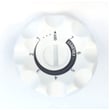
- Freezer temperature control knob 216707200
- Temperature control 297216043
- White-westinghouse freezer compressor start relay 297259515
- Freezer compressor overload and relay clamp 216954300
Why it matters
A chest freezer that will not restart after a brief power reset usually has a power, control, or compressor-start problem. Identifying the symptom (silent, clicking, running warm, light-only issue) helps you choose the right repair path and avoid replacing unnecessary parts.
For model-specific operating details and control settings, use the owner's manual.
Last updated: February 2026
How big is a Kenmore chest freezer model 25312822510?
Kenmore chest freezer model 25312822510 is a compact chest freezer. For the exact exterior dimensions (width, height, depth) and required clearances for your specific unit, use the specifications section in the 25312822510 owner's manual and confirm with a quick tape-measure check.
How to get the exact dimensions (fast and accurate)
Use the manual for the official spec, then measure the cabinet so you know it will fit through doorways and allow the lid to open.
- Check the Specifications or Installation section in the 25312822510 owner's manual
- Note width, height, depth (depth may be listed with and without the handle)
- Measure your space and add clearance for lid swing and airflow
- Measure the freezer itself at the widest points (hinge side, handle side)
- If moving downstairs, measure stair turns and door trim, not just the opening
Typical size range for compact chest freezers
Most compact chest freezers are built to fit tight spaces; these ranges help you plan before you measure.
| Size class | Typical capacity | Typical exterior size (W x H x D) |
|---|---|---|
| Compact chest freezer | 3 to 7 cu. ft. | 20 to 36 in. x 32 to 36 in. x 20 to 28 in. |
Parts that can change the “depth” you need
Handles and hinges can add a little extra projection, which matters in narrow alcoves.
Why it matters
Correct dimensions prevent delivery and placement problems, ensure the lid opens fully, and maintain airflow so the compressor and condenser can cool efficiently.
Last updated: February 2026